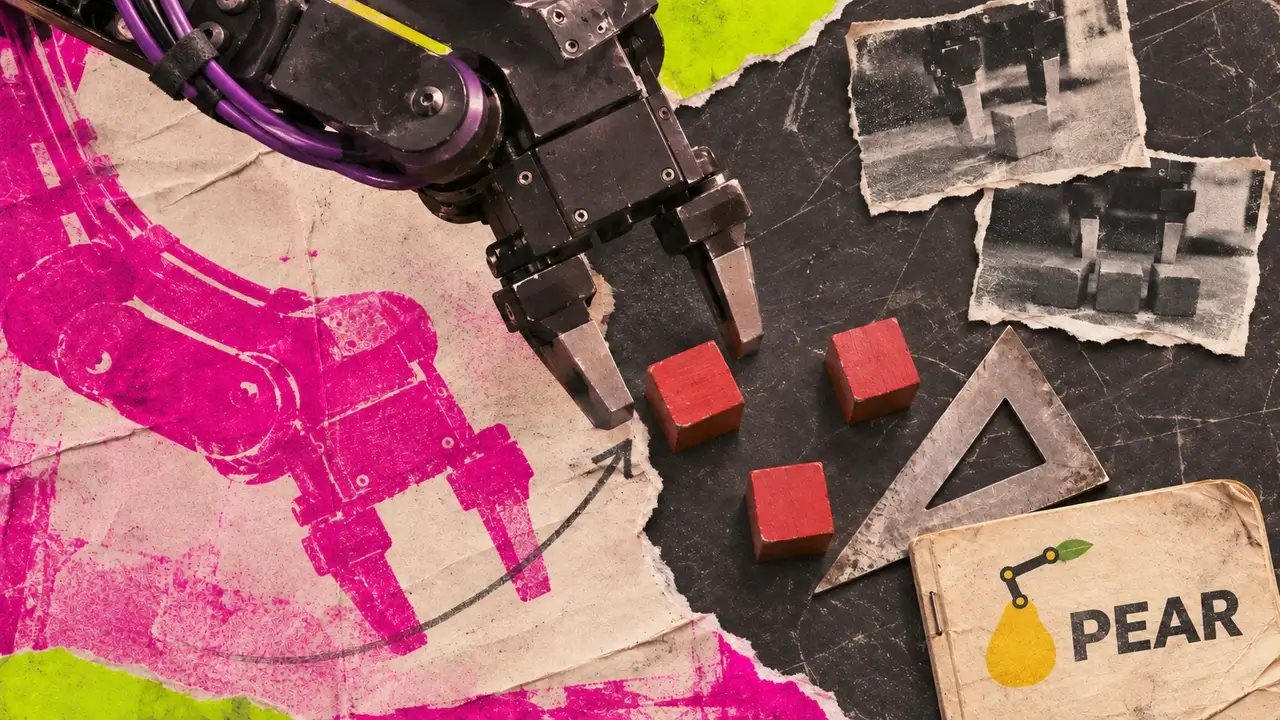
Researchers trained a 27-billion-parameter AI model in simulation to control an unfamiliar robot, succeeding in 60% of real-world trials.
Researchers behind PEAR, a system for training AI models to control robots, reported that a model completed 18 of 30 physical trials after learning its robot skills entirely in simulation.
The preprint submitted Nov. 13 describes robot post-training of Qwen3.8-27B, an open-weight reasoning model with 27 billion parameters. Researchers used reinforcement learning without demonstrations during that stage.
The result offers evidence that simulated practice can teach skills that carry over to different physical hardware. The final model had already practiced the two evaluated task types, pickup and block alignment, in simulation.
The physical test used a dual-arm YAM robot, which none of the compared models received training on in this study. It included 20 pickup attempts across ten objects and ten alignment attempts across five block layouts, with each object or layout tried twice.
The final model succeeded in 12 pickup attempts and six alignment attempts. A checkpoint trained only on the LIBERO simulation benchmark completed seven of the 30 trials.
The final model had continued training on the corresponding two tasks in RoboDojo using a different robot, according to the paper's physical-trial account.
Thanks for signing up to The Catalyst. Look out for your first daily email. If you already receive it, you’re all set.
PEAR researchers report 18 successes in 30 physical trials after robot post-training in simulation. Explore how the tested checkpoints compare.
Source link