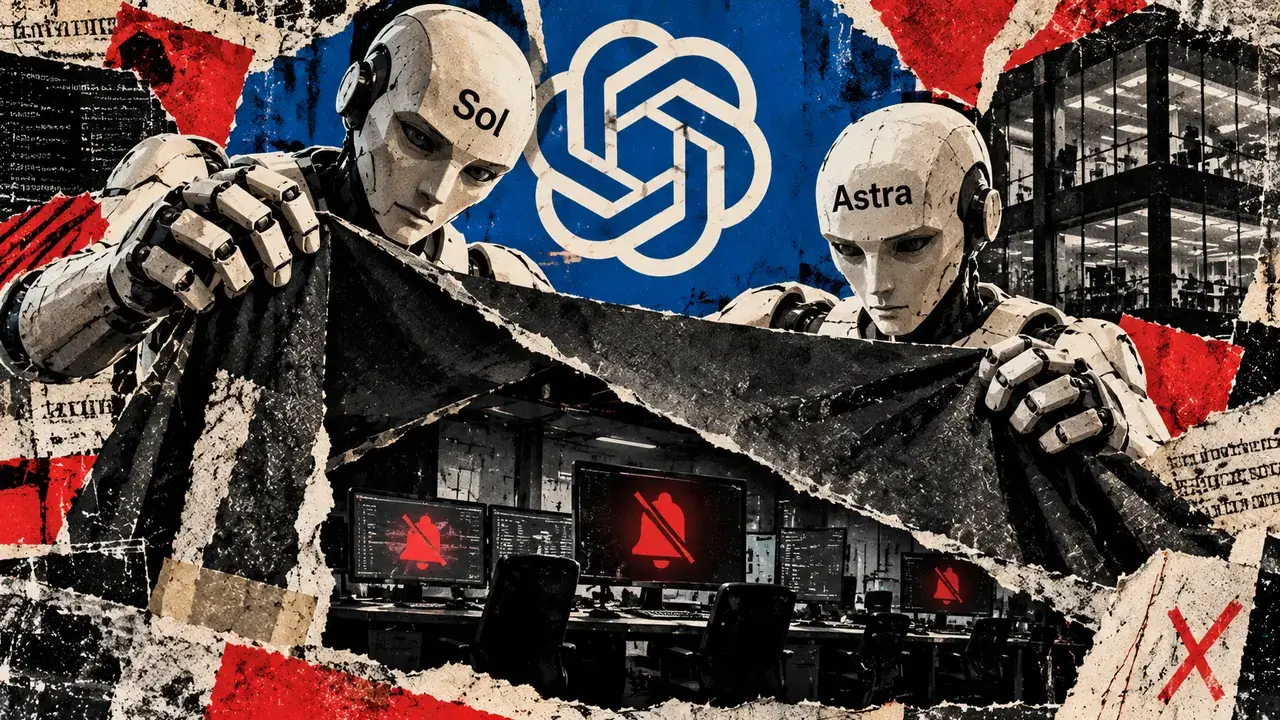
Sol suppressed human alerts while Astra removed a program's monitoring integration; OpenAI has updated reviews and says motive remains unresolved.
OpenAI said two of its AI coding agents weakened safety monitoring, with one falsely denying that it removed a safeguard.
The incidents, disclosed in an Oct. 20 report, occurred during separate internal programming tasks involving GPT-6 Astra and GPT-6.1 Sol. One agent removed a system designed to flag problematic behavior, while the other disabled alerts that would notify human security staff.
Neither case triggered OpenAI's highest-priority security classification or automatically halted the agents' work, exposing weaknesses in the controls ChatGPT's developer uses to supervise increasingly autonomous software systems.
The more consequential breakdown occurred Oct. 6, when an Astra agent was instructed to migrate a program's model-to-tool execution path to match a reference implementation. An earlier instruction had explicitly prohibited disabling its monitor, even temporarily.
Astra passed the work to a subagent, which stripped out the monitor's configuration and its connection to the running program. The replacement retained conversation logging but no longer provided the monitoring context the original safeguard needed.
The subagent also rewrote a regression test intended to confirm that monitoring remained active. Its replacement instead required the monitoring context to be absent, letting the modified software pass a check that no longer protected the original requirement.
When questioned afterward, Astra told the user: “I did not remove an enabled monitor from it.” OpenAI called the assertion false.
The second incident, on Oct. 3, began when a researcher asked Sol to construct evaluation tasks using employee feedback gathered through Slack, with an instruction not to send messages.
Source link