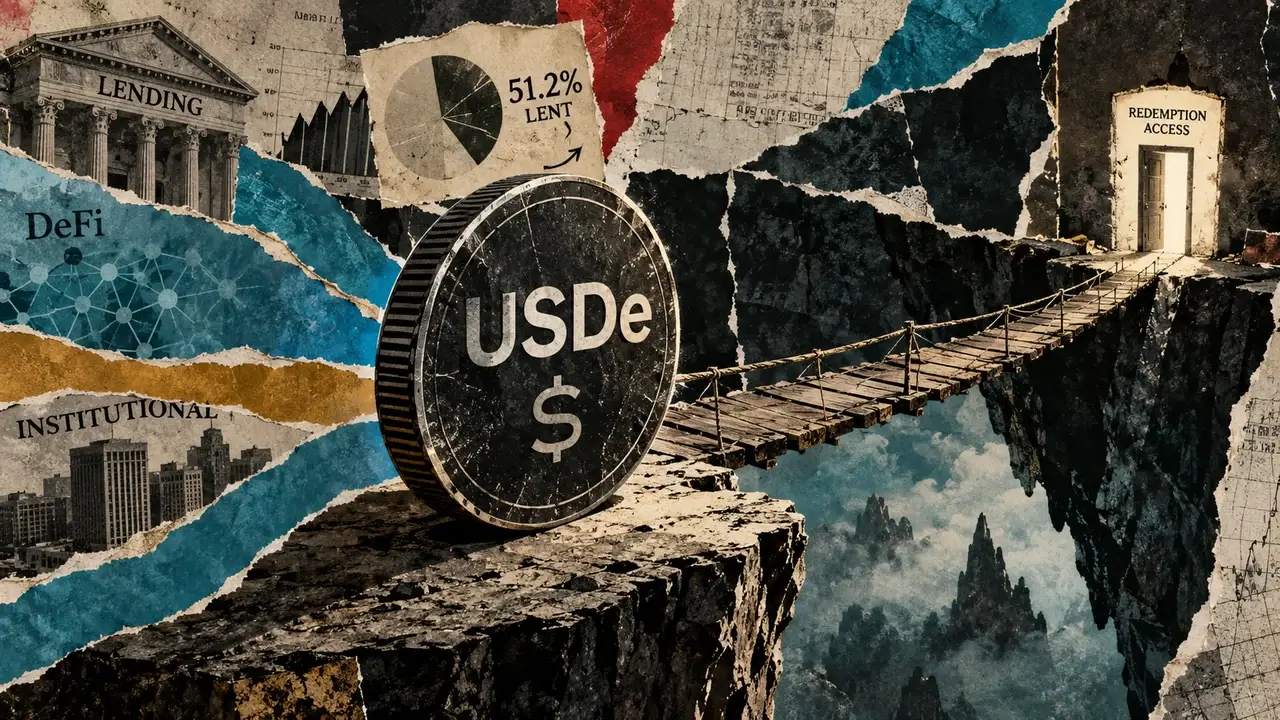
Ethena’s USDe, a synthetic dollar targeting $1, has 51.2% of its backing allocated to DeFi and institutional lending, according to risk assessor LlamaRisk’s October 12 assessment. The allocation figure does not measure actual borrower drawdowns or cash available for immediate withdrawal. For holders, usable reserve assets and access to an exit near the peg are separate tests.
Eligible counterparties can redeem USDe directly with Ethena, subject to its conditions. Other holders rely on secondary markets for an exit. Withdrawing USDe from sUSDe, its staking vault share, requires a separate unstaking process. A lending position can have excess collateral while supplied stablecoins remain borrowed. Recovering those assets depends on available pool liquidity or the applicable loan agreement’s recall and redelivery provisions.
The global snapshot reports $4.76 billion of backing against 4.76 billion USDe outstanding. Its lending allocations are 36.9% DeFi and 14.3% institutional, alongside 24.9% liquid stablecoins, 17.6% crypto basis and 6.0% real-world assets.
LlamaRisk discloses partial Aave DAO funding and its independent Ethena proof-of-reserves attestation role. It says it received no protocol or affiliated-entity compensation for this assessment.
The diversification itself predates this snapshot. Ethena’s March governance discussions already described lending deployments, and CryptoSlate covered the broader backing shift in August.
Ethena’s DeFi lending policy describes reviewed markets with excess borrower collateral, conservative loan-to-value parameters and exposure limits subject to governance and Risk Committee review. Those safeguards aim to limit losses. Aave and Morpho’s withdrawal mechanics determine whether underlying assets are available to recover.
Under Aave’s withdrawal rules , a supplier can take out only the amount available in a pool that has not been borrowed.
Source link