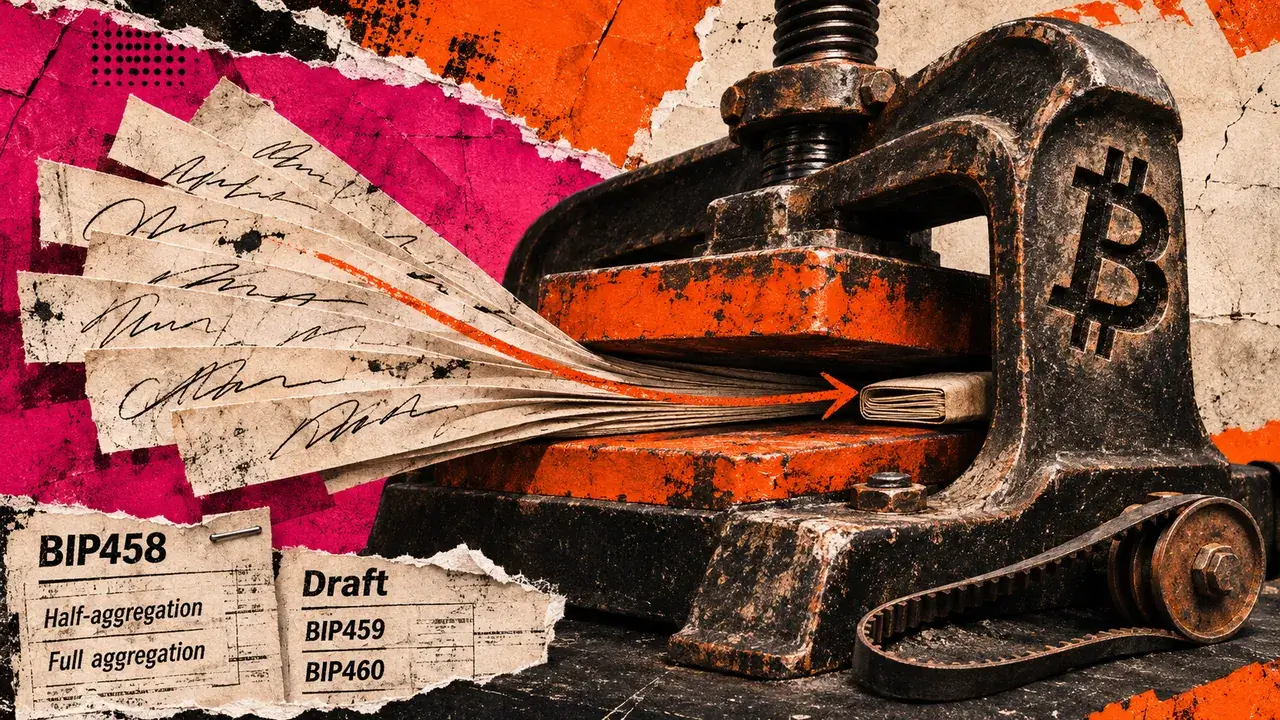
The Bitcoin proposals could cut fees by up to 27% through signature aggregation, with wallet upgrades and network activation still required.
Bitcoin's proposal repository added three draft specifications on Nov. 2-4 that could lower fees for payments assembled jointly by multiple users and for consolidating many inputs into one output.
BIP458 merged on Nov. 2, BIP459 on Nov. 3, and BIP460 on Nov. 4. Their mechanism combines the signatures attached to transaction inputs, the coins being spent.
Half-aggregation combines independently produced signatures without an interactive signing session: n signatures of 64 bytes become 32(n+1) bytes. Full aggregation requires coordinated signing but produces a single 64-byte signature for all aggregated signatures in a group.
For ten signatures, that means shrinking 640 bytes to 352 or 64 bytes, respectively. That's a 45% and 90% reduction in signature payload, before encoding overhead. The reduction in the whole transaction's fee would be much smaller.
Bitcoin fees are commonly expressed per virtual byte (vB). Under Bitcoin's weight rules, virtual size is transaction weight divided by four, rounded up.
Hypothetical examples put all inputs in one eligible aggregation group and use default signing settings, 34-byte output scripts and no optional extra witness data, or annex. Transaction overhead, witness encoding, and the group's marker byte are included.
2%. At an illustrative 10 satoshis per vB, the savings would be 720 or 1,440 satoshis.
Source link