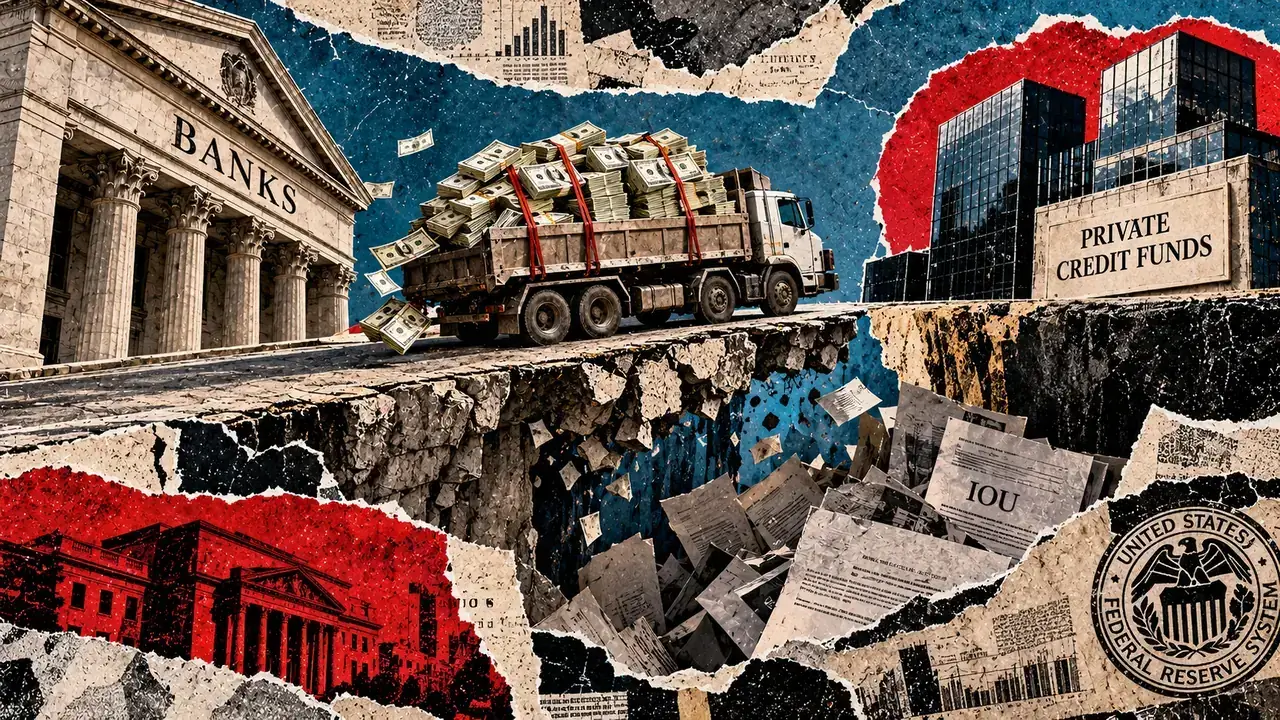
The Federal Reserve has revealed how deeply banks finance private credit, exposing a dangerous mismatch between interest funds record and cash they actually collect.
Private credit funds can count interest as income even when the borrower hasn't sent them any cash, because some loan contracts let businesses add interest to what they owe.
That gives a company more time to pay, but it doesn't extend the same courtesy to the fund, which could have borrowed money from a bank to finance the loan.
If you read the Federal Reserve's new private credit accounts alongside its research on bank financing, you'd see that the separation between banks and nonbank lenders essentially disappears.
US-domiciled private credit vehicles owed banks $349 billion at the end of 2025, while other research showed borrowers were paying interest with additional debt. The fund can accept that payment method while its lender still expects cash.
Banks have protections that fund investors don't, including collateral and (most importantly) priority in distributing money. Those protections can keep a bad business loan from becoming a bank loss, but exercising them can require a fund to produce cash before its borrowers are ready to pay.
According to the Fed's Oct. 16 account of the market, private credit vehicles with a US footprint currently hold more than $2.6 trillion in assets, including foreign-based vehicles. Roughly $1.5 trillion of that consisted of private loans to US businesses, while the larger total includes equities and other investments.
Within the US-domiciled group, business development companies (BDCs) owed banks $181 billion at the end of 2025.
Source link