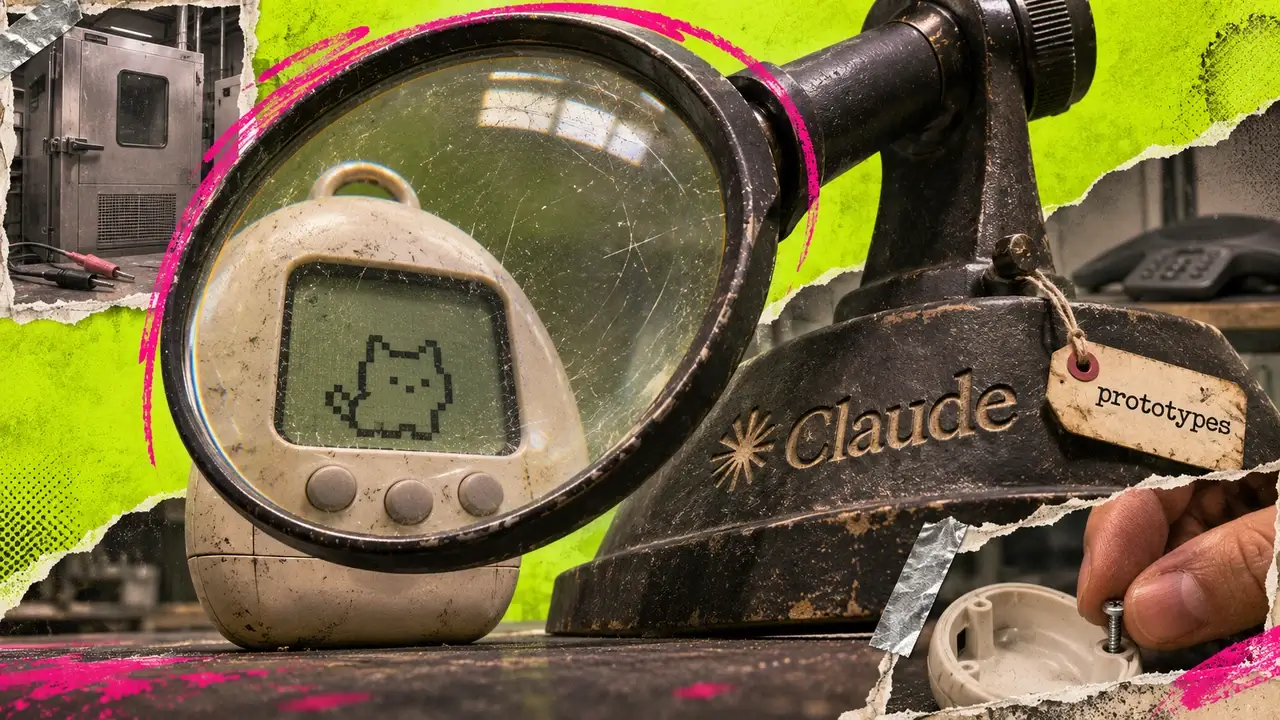
Anthropic's Claude designed circuit boards, enclosures and firmware for three working gadgets assembled and tested by engineers.
Anthropic says Claude turned short gadget briefs into designs for three working prototypes, coordinating circuit boards, enclosures, and firmware that human engineers then assembled and tested.
In a Nov. 9 research post, Anthropic described a speakerphone, a voice-assistant hub, and a handheld virtual pet designed by Claude Fable 5.2, while Diode Computers built and tested the
For the speakerphone, Anthropic said Claude produced specifications and schematics, placed components on a printed circuit board, routed the copper connections, designed a 3D-printable case, wrote the device's software, and prepared a parts list. The other two devices followed a similar process.
Anthropic reports three working gadgets from linked electronics, enclosure and firmware designs. Diode engineers performed the physical work.
The demonstration joins several design disciplines, while people build and test hardware and commercial readiness remains unresolved.
Company and commercial-partner account. Three working examples do not establish a repeated-attempt success rate. Electrical validation, antenna tuning, thermal testing and certification remain undone; devices were not designed for mass production.
Qualitative handoff diagram from Anthropic's account. Three branches identify design disciplines, then converge into human construction and testing. Device silhouettes are schematic illustrations, not engineering drawings; connector lengths encode no time or performance.
Company and commercial-partner account. Three working examples do not establish a repeated-attempt success rate. Electrical validation, antenna tuning, thermal testing and certification remain undone; devices were not designed for mass production.
Diode supplied occasional follow-up directives, and an engineer asked whether the virtual pet would operate without a battery.
Source link