
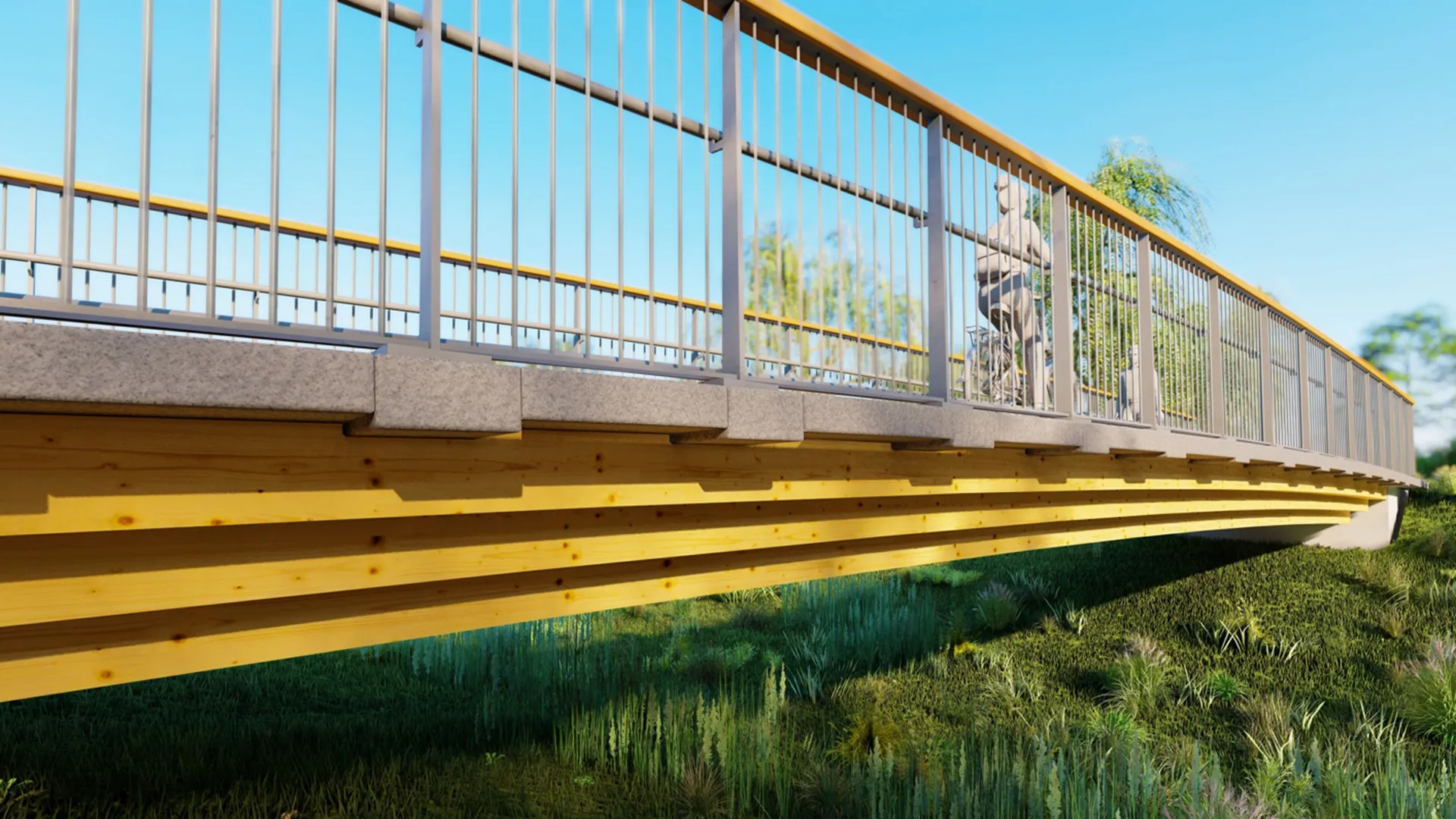
German engineers have developed a concrete-free bridge made from wood and granite that could last up to five times longer than conventional wooden bridges and significantly reduce carbon dioxide (CO2) emissions.
The bridge created by researchers at the Technical University of Berlin (TU Berlin) in collaboration with engineering firm Miebach is reportedly the first in the world to combine these two building materials. The team carried out numerous stress tests to ensure its stability and safety.
The structure uses large granite slabs instead of concrete to protect the wooden structure from harsh weather conditions. Miebach now intends to construct two such bridges for pedestrians and cyclists in Berlin’s Spandau district.
Each will measure about 49 feet (15 meters) long and replace an old, deteriorating wooden bridge. The team believes the material combination could also support heavier loads and make bridges easier to dismantle and recycle.
The approach, backed by around USD 153,000 (EUR 140,000) in funding from the German Federal Environmental Foundation (DBU), addresses a major weakness of wooden bridges. Exposure to rain and harsh weather conditions can significantly shorten their lifespan.
“Composite bridges made of wood and concrete already exist,” Volker Schmid, PhD, a researcher at TU Berlin and head of the research group, said. “However, we use large granite slabs instead of concrete, thus reducing the resulting emissions.”
Schmid added that the biggest weakness of unprotected wooden bridges is their relatively short lifespan. “At the same time, the lifespan and load-bearing capacity increase compared with a wooden bridge ,” he continued.
Source link





