
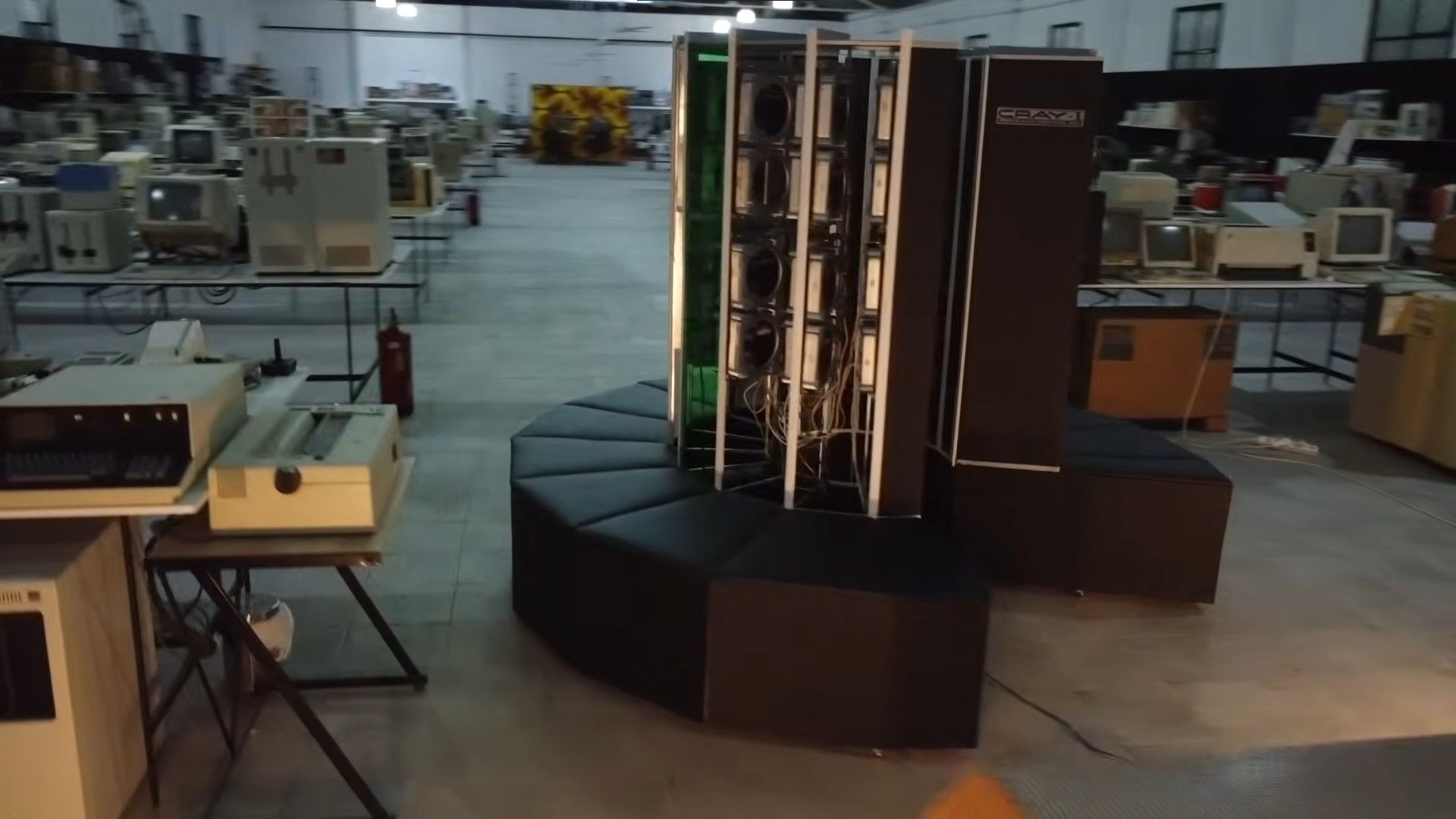
Spain’s Museo de Historia de la Computación unveiled its 18-month-long project to commemorate the 50th anniversary of both the Cray-1’s first operational use in Los Alamos and Apple’s founding. The replica uses 30 Mac Minis, 25 dual-core i5 units, and five quad-core i7 units from 2012-2014, totaling 70 cores that produce a peak of 1.5 TeraFLOPS; a theoretical 9,375x jump from the original Cray-1's 160 MegaFLOPS. After one quad-core machine went offline, the current reported peak sits at 1.3 TeraFLOPS.
The original Cray-1 is considered to be the first commercially successful supercomputer, with 80 systems sold in its heyday. Science and engineering institutions sought it out to churn through gigantic datasets for uses ranging from intense weather prediction and aerodynamics to nuclear physics and structural analysis, among many others.
It was very efficient at these computations thanks to vector processing, a computing technique we take for granted nowadays. Vector computing made this supercomputer so powerful; while most computers still handled tasks one instruction at a time, the Cray-1 could process chunks of numbers in parallel, saving a huge amount of time.
The replica has 70 cores from the 30 Mac Minis, and of course, vector processing has since become the norm and a standard feature of modern CPUs; jumping from a single core to 70 “modern” cores and 50 years' worth of innovation is what Museo de Historia de la Computación wants to showcase in this project. It is not only a replica, but a representation of how far technology has come.
Source link





