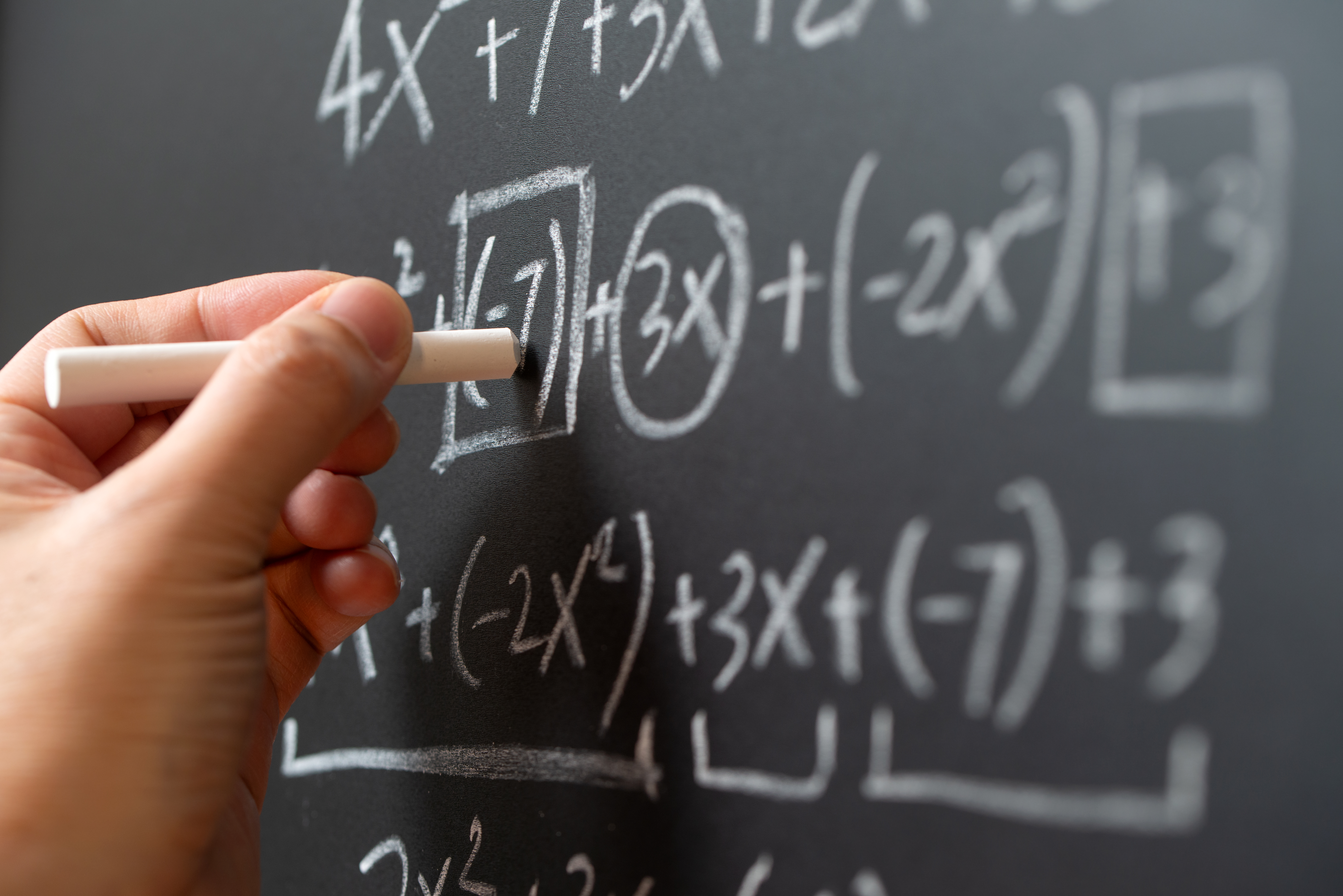
Our modern world runs on math, from social media algorithms, package delivery, and weather prediction to medical imaging and machine learning. The rise of computers helped fuel its dominance, enabling us to work with increasingly large numbers that would otherwise be beyond the capacity of our finite human brains. But with the rise of large language models, AI chatbots, and, soon, quantum computing, so-called "big math" is beginning to outstrip its creators entirely. What that means, and how we might adapt, is the focus of a new book, Big Math: The Hidden Codes That Run Our World, by applied mathematicians Steven Strogatz and Alex Townsend.
Strogatz is perhaps best known in his field for his co-authorship of a seminal 1998 paper with Duncan Watts on the collective dynamics of small-world networks. He has also studied chaos theory as applied to physics, the geometry of supercoiled DNA, and the biological collective oscillators, such as swarms of synchronously flashing fireflies and crickets that chirp in unison. In 2005, Strogatz extended his study of synchronicity to the crowds that caused the wobbling of London's Millennium Bridge.
An award-winning communicator, Strogatz wrote three series of columns on mathematics for The New York Times in 2010, 2012, and 2025 and hosted a podcast for Quanta magazine from 2020–2021. He has written four popular books: Sync (2003), The Calculus of Friendship (2009), The Joy of X (2012), and the New York Times bestseller Infinite Powers (2019).
Source link