
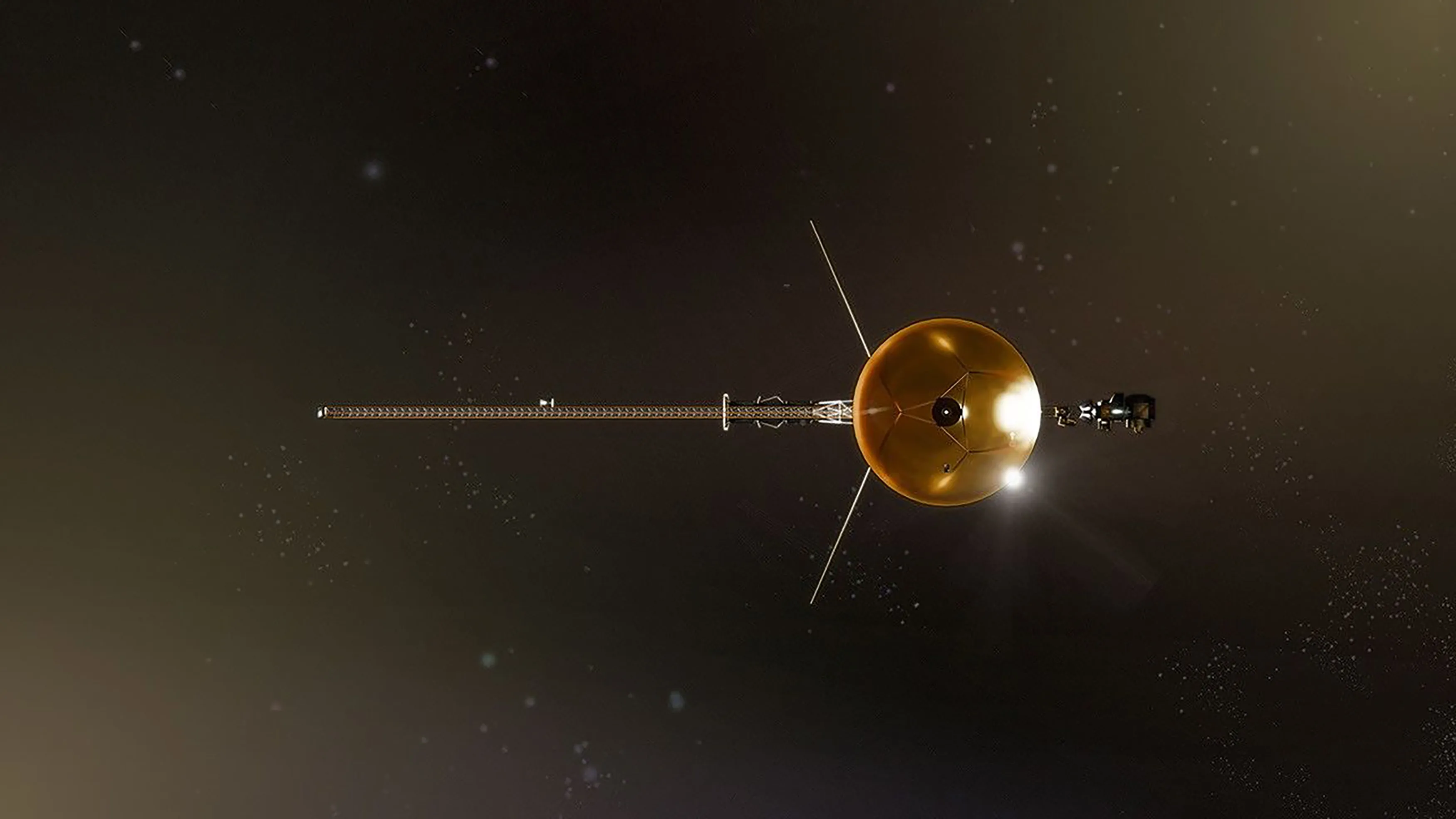
It’s not just old; it’s also really far away. In fact, it’s so far that it takes light one whole day to travel from the spacecraft to Earth and vice versa. That puts its distance at one light-day.
The expanse separating it from Earth raises so many interesting physics questions about Voyager 1’s epic, well, voyage. Let’s get to the questions—and the answers.
In science, we like to measure things, including distance. Surely, you’re familiar with meters. If you put a mass on a string and let it swing back and forth (like the pendulum of a clock), it will take about 1 second to go from side to side if the string is 1 meter long.
But if you want to measure larger distances like the proximity of stuff in space, this unit quickly becomes silly because objects are so far apart. While kilometers can be helpful for measuring the distance between things like Earth and the International Space Station or the moon, even they become hard to comprehend at larger scales.
5 x 10 11 meters. Humans found this distance by observing the transit of Venus. This transit is like a solar eclipse, except instead of the moon passing in front of the sun, it’s the planet Venus. Looking at Venus’ movement from different locations on Earth, the planet creates a shadow at different times. If you know the radius of the Earth, you can find this distance from the Earth to sun.
Source link





