
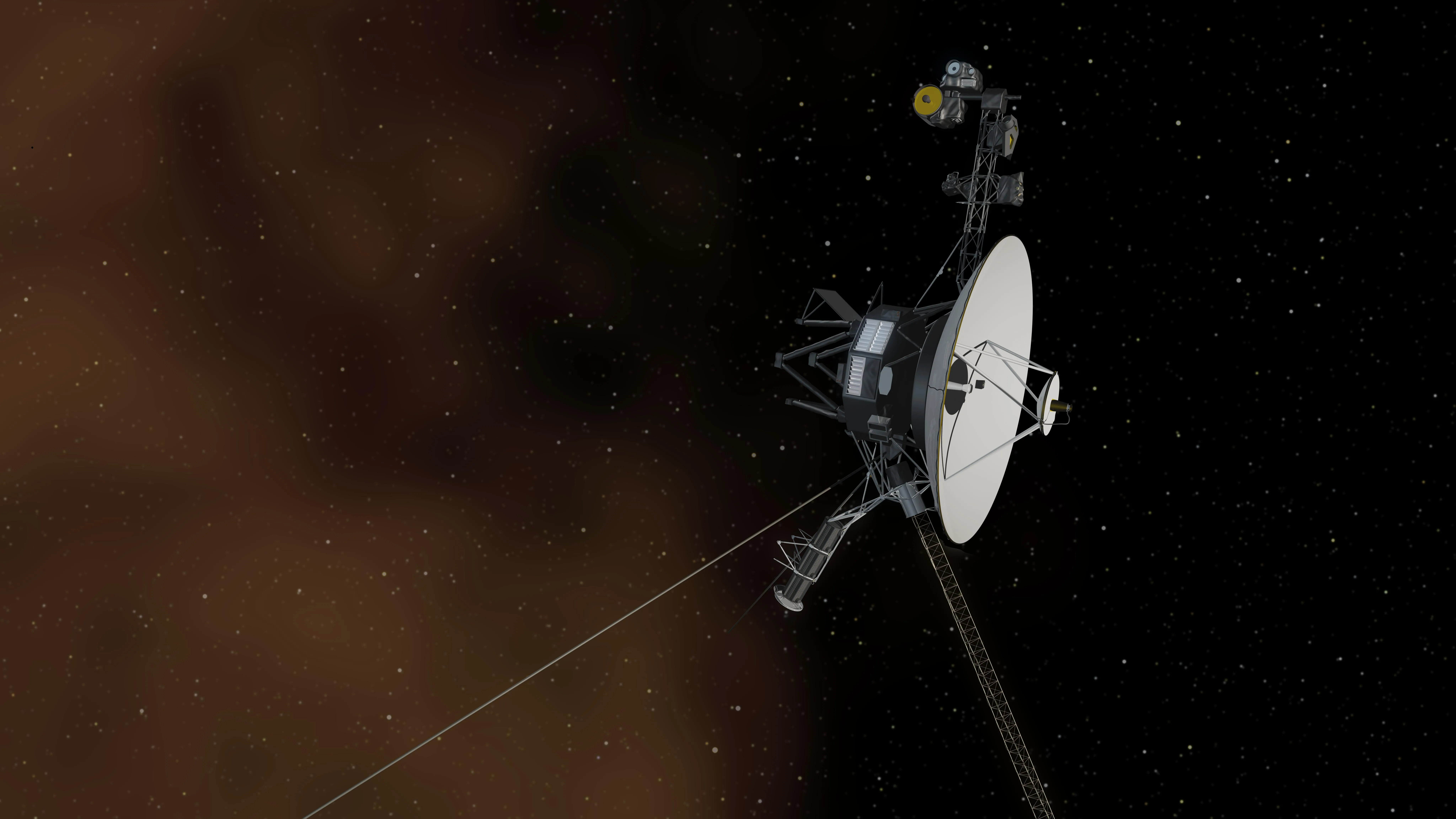
One of NASA’s longest-tenured spacecraft is quite literally stuck in the past.
Voyager 1, launched in September 1977 toward the outer planets of our solar system, is poised to achieve a historic milestone on Wednesday: It will be the first human-made object to reach one light-day from Earth. The spacecraft will be so far away, that by the time its light reaches Earth, it will come from the spacecraft as it existed one day in the past. The achievement is one researchers hadn’t planned on, and yet, as Voyager 1 wades deeper into uncharted stretches of the galaxy, it continues sending back valuable scientific information.
“It's just a wonderful happenstance,” Kareem Badaruddin, Voyager mission manager at NASA’s Jet Propulsion Laboratory, says of the milestone. “Just as the stars were aligned for the tour of the planets, they're also aligned for this really magical, special thing that's happening for humankind.”
For Fran Bagenal, a planetary scientist at the University of Colorado, Boulder, who began working with Voyager 1 as a graduate student during its earliest years, the occasion is a momentous technological feat. “What's exciting is the fact that we have a spacecraft that was built in the mid ’70s that is still working,” she says. “Storing data on an eight-track tape that’s working on a spacecraft after 50 years—I mean, it’s amazing.”
Even as Voyager 1 approaches its 50-year anniversary next September, and its end of mission perhaps not long after that, the spacecraft is still checking items off its laundry list of scientific achievements.
Source link





