
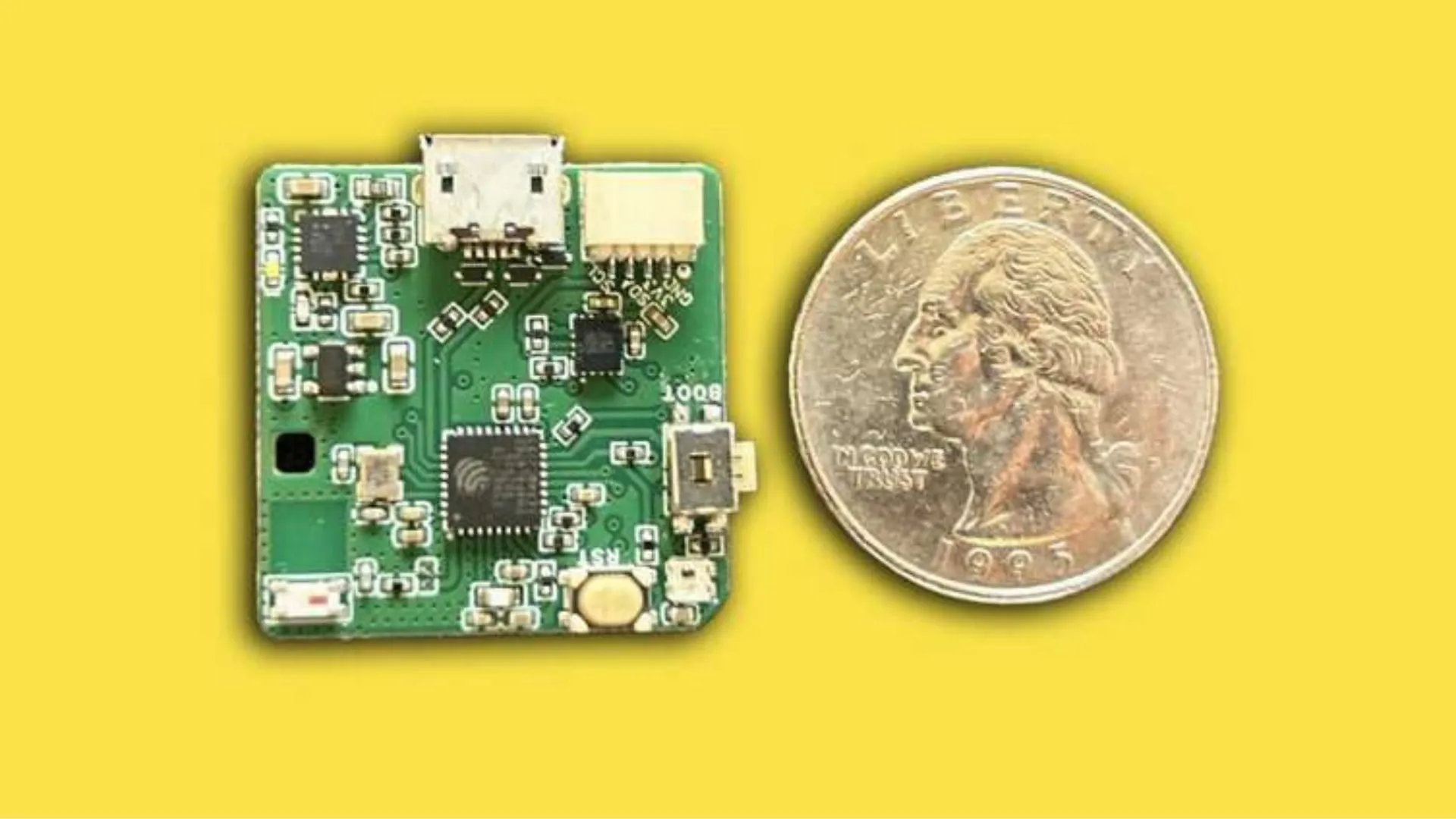
Researchers at the New Jersey Institute of Technology (NJIT) and collaborating institutions have developed an open-source microcontroller that combines sensing, wireless connectivity, onboard storage, and battery management into a device about the size of a quarter, opening the door to compact wearables, robotic systems, and other connected electronics.
They named it TinZr (pronounced “TIN-zer”), which is the square-shaped microcontroller that measures just 0.98 inches (2.5 centimeters) on each side. Despite its compact footprint, it integrates an inertial measurement unit (IMU) for tracking motion and orientation, a microSD card reader for local data storage, a battery management circuit, and built-in Wi-Fi and Bluetooth connectivity.
Researchers positioned TinZr as a flexible, open-source system that can be adapted for a range of applications covering physiological monitoring to robotics and industrial sensing.
Microcontrollers act as the central processing units of many embedded devices that can collect information from sensors, store data, and communicate with other electronics. However, combining all of these functions into a compact board often requires engineers to compromise on size or capability.
According to the researchers, the chip was designed to overcome those limitations by integrating multiple functions into a single miniature platform without significantly increasing its footprint. Besides keeping it tiny, the the microcontroller has wireless connectivity; the board supports analog, digital, and serial communication interfaces through general-purpose input/output (GPIO) pins. Together, these features could let developers connect a wide variety of external sensors.
Lead author Ludvik Alkhoury, who completed his doctoral research at NJIT and is now a postdoctoral associate at Weill Cornell Medicine, said the team could not find an existing microcontroller that combined the required size, form factor, and functionality.
Source link





