
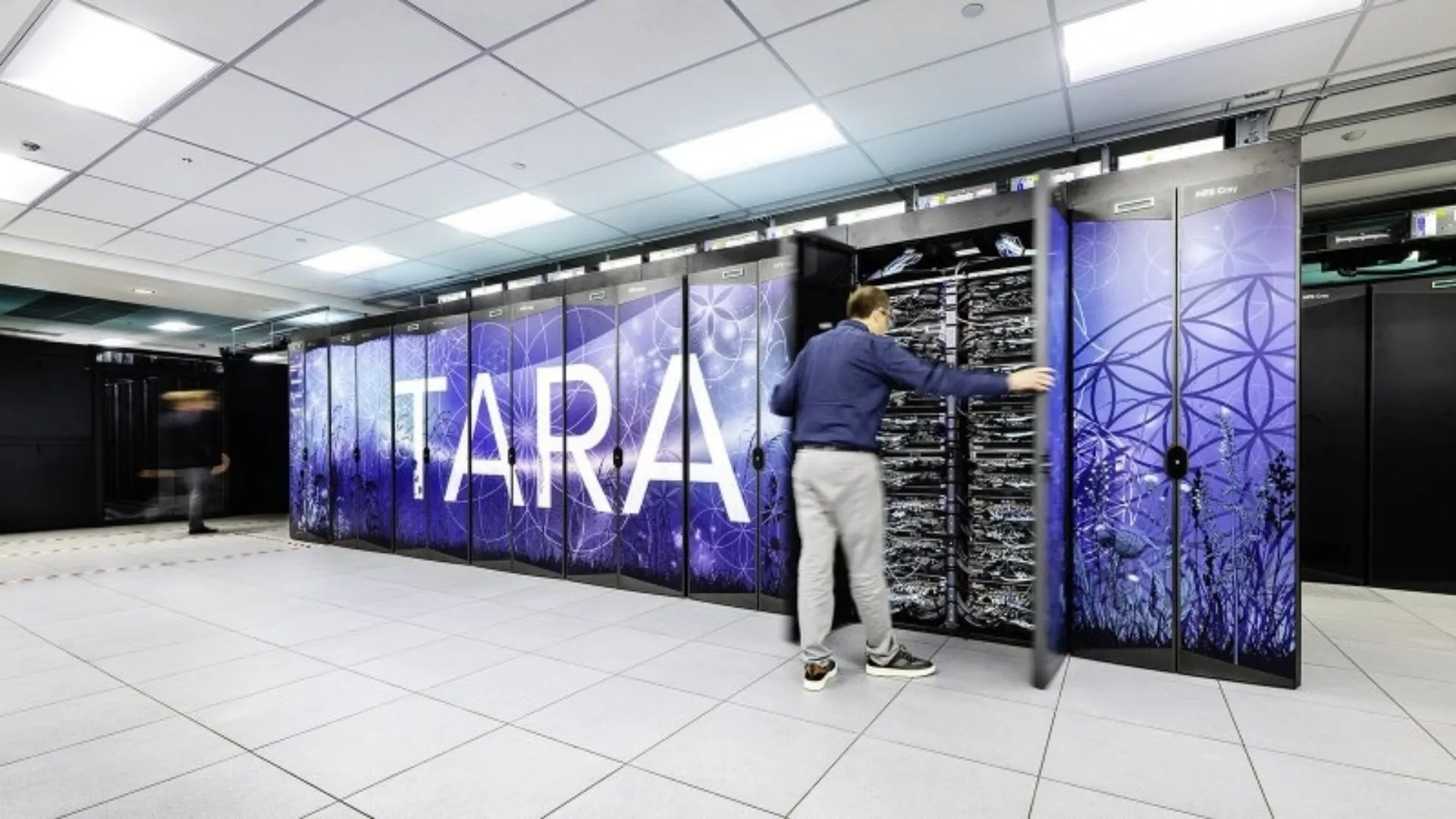
Argonne National Laboratory’s Argonne Leadership Computing Facility (ALCF) is expanding its inference service, led by the deployment of a new large-scale system called Tara, built on supercomputing architecture.
The expansion brings a wider array of AI/super intelligence (SI) models and agentic workflows directly into scientific research.
The upgrade arrives at a pivotal moment for American science. Going beyond simple prompts, researchers can now use autonomous AI agents to plan experiments, write code, and run lab instruments at scale.
“The ALCF has long provided the computing resources researchers need to pursue science at scale,” said Venkat Vishwanath, SI team lead at the ALCF. “As inference and agentic workflows take on a growing role in science, we are evolving to provide new services and tools that complement our computing systems and help scientists be more productive in their research.”
Tara is a powerhouse built alongside Hewlett Packard Enterprise (HPE) on its exascale-class HPE Cray Supercomputing EX4000 architecture. The supercomputer packs 672 computing nodes and 2,688 NVIDIA GH200 Grace Hopper Superchips. Tara delivers roughly 100 times the GPU memory previously available on the platform.
Tara does not stand alone. Argonne also unveiled Minerva, an eight-node system built with World Wide Technology and powered by 64 NVIDIA B200 GPUs. At the same time, the lab tripled its Metis platform to six SambaRacks equipped with 96 SambaNova SN40L chips.
Paired with the existing Sophia platform, this hardware expansion supports more than 50 advanced models, including open-weight large language models, scientific foundation models, and computer vision tools.
Source link





