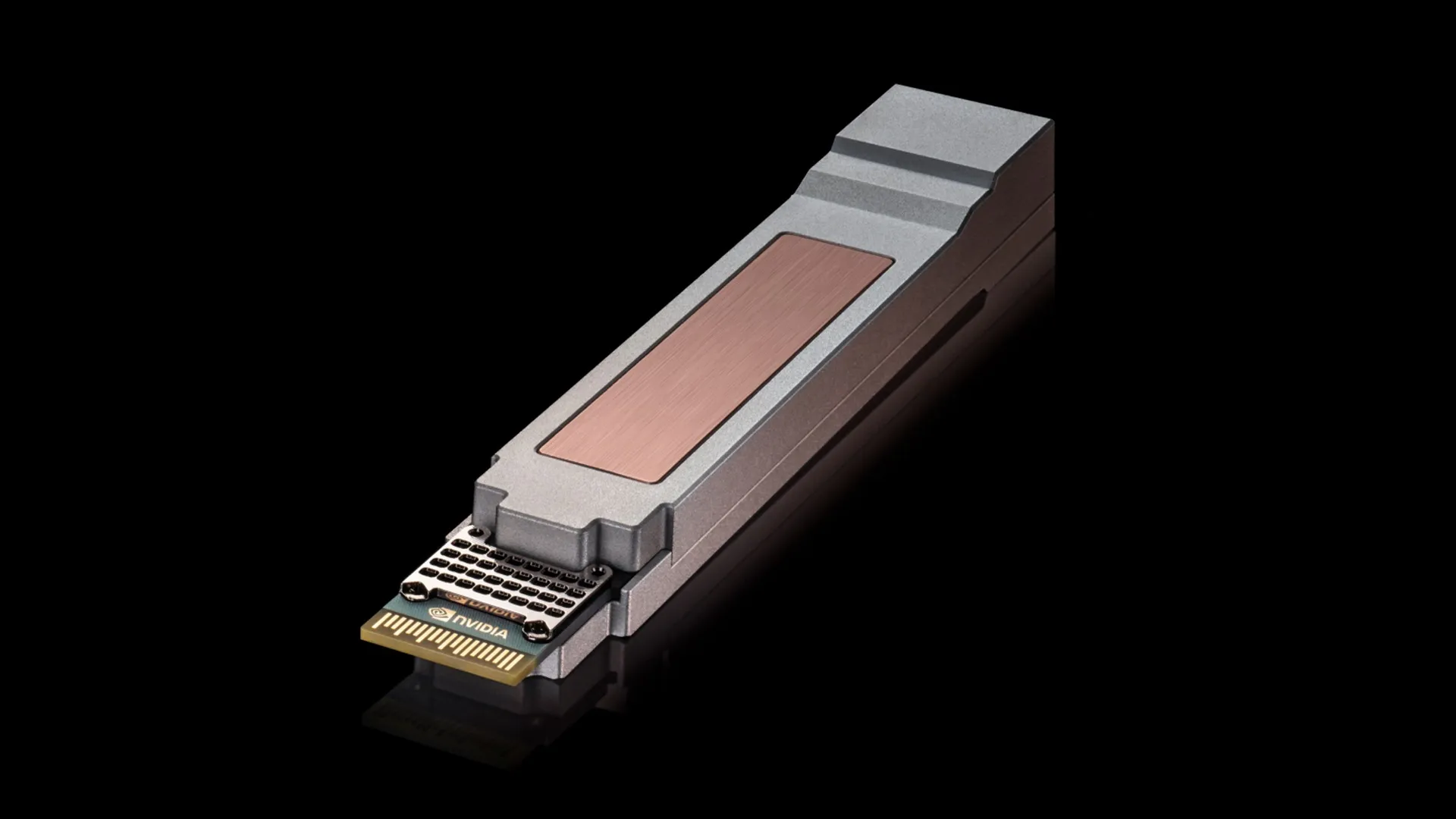
NVIDIA and Cisco have announced plans for a new optical module that could deliver up to 12.8 terabits per second (Tbps) of capacity, offering four times the bandwidth density of existing 200-gigabit-per-second-per-lane technology for data center networks.
Called Ultra-Dense Small Form Factor Pluggable (USFP), the module is designed to support electrical signals operating at 400 gigabits per second (Gbps) per lane. The companies say it could also deliver approximately 30 percent greater power efficiency than current 200Gbps-per-lane pluggable modules.
The technology is intended for large computing facilities that train and run artificial intelligence models. These systems require thousands of processors to exchange enormous amounts of data, placing growing demands on the networks connecting them.
NVIDIA and Cisco are developing USFP with connector manufacturers TE Connectivity and Amphenol. The companies plan to establish a common hardware standard that would allow multiple suppliers to produce compatible modules. They have not announced a commercial launch date.
The first planned USFP transceivers will combine 16 full-duplex lanes in a module roughly the size of an existing octal small form factor pluggable (OSFP) transceiver. Full-duplex means each lane can send and receive data simultaneously.
By doubling both the number of lanes and the bandwidth per lane, the design aims to provide four times the bandwidth density of current 200Gbps-per-lane modules.
This could allow operators to connect more computing systems through existing switch infrastructure without adding extra network layers. Additional switches and optical connections can increase latency, electricity consumption, and operating costs.
Source link