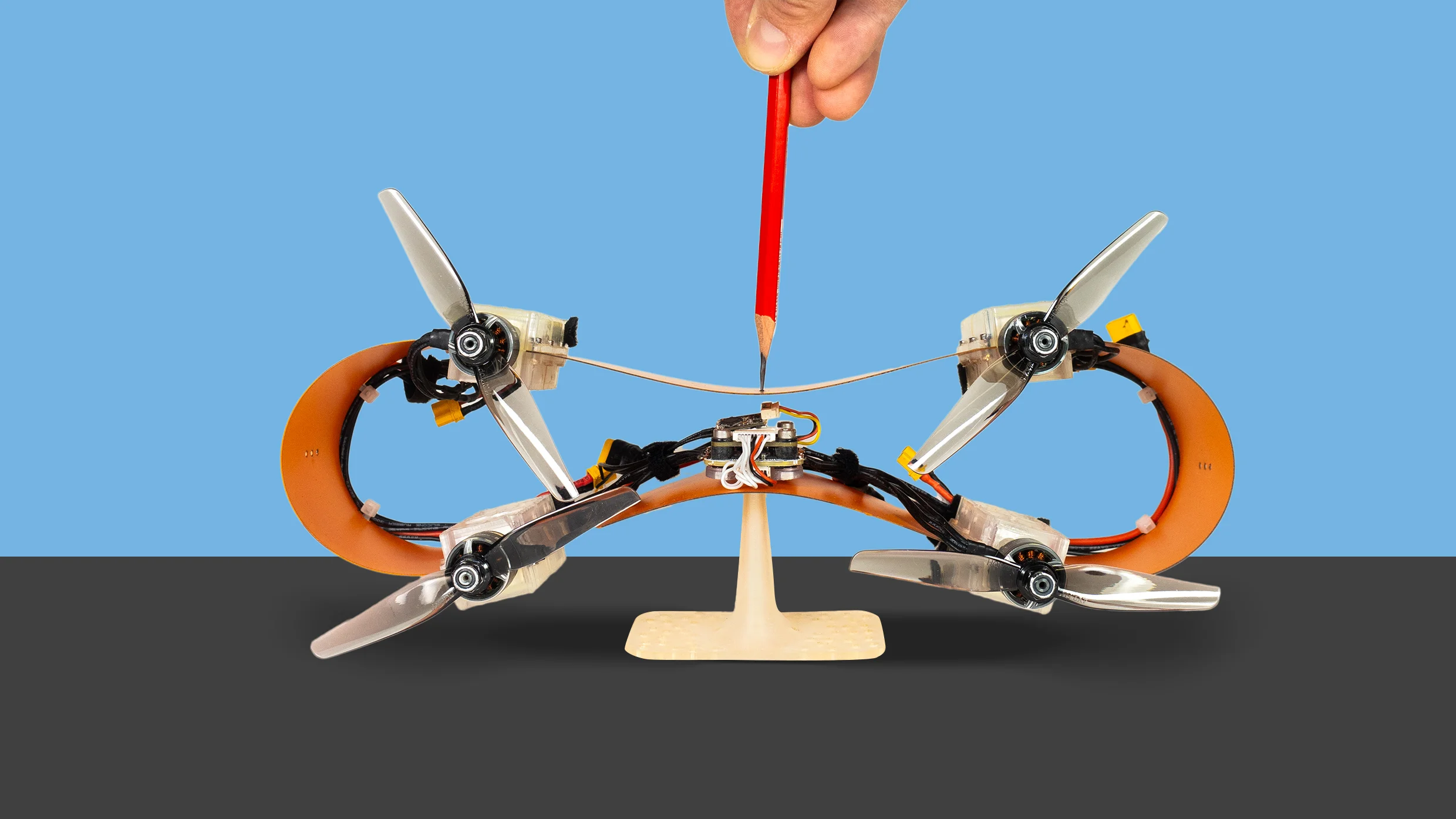
At first glance, FlexiQuad looks like a small drone. Just one more buzzing thingy doing its flying thing. Then you see it crashing against a tree. A regular drone would crash and fall to the ground, but this one bounces back from the tree trunk and happily keeps flying along.
The key to this trick is a hollow ring design crafted from flexible materials.
Today, almost every quadcopter uses four stiff arms bolted to a central body that holds its battery, brains, sensors, and sometimes other payloads. ETH Zürich researchers trashed that core and the arms, placing the rotors on a ring, with the batteries and the rest of the electronics spread evenly around the rim. The FlexiQuad’s middle is empty, like a vertically flat donut.
The ring is flexible. That’s its superpower. Hit a wall and it buckles, absorbing the force of the impact and bouncing back. As the structure stabilizes, it keeps itself in the air.
Developed by engineer Luca Girardi and Stefano Mintchev, a former professor at ETH Zürich’s Environmental Robotics Lab, the drone takes its design inspiration from how the wings of birds and insects bend in some directions but not others. “We were interested in how stiff their wings are and how they bend them—or don’t bend them—in different directions,” Girardi said in a statement.
Wings yield in some directions but can also hold rigid in others. Engineers call this “anisotropic stiffness,” the resistance of a material or a structure to deformation, which changes depending on the pushing force’s direction.
Source link