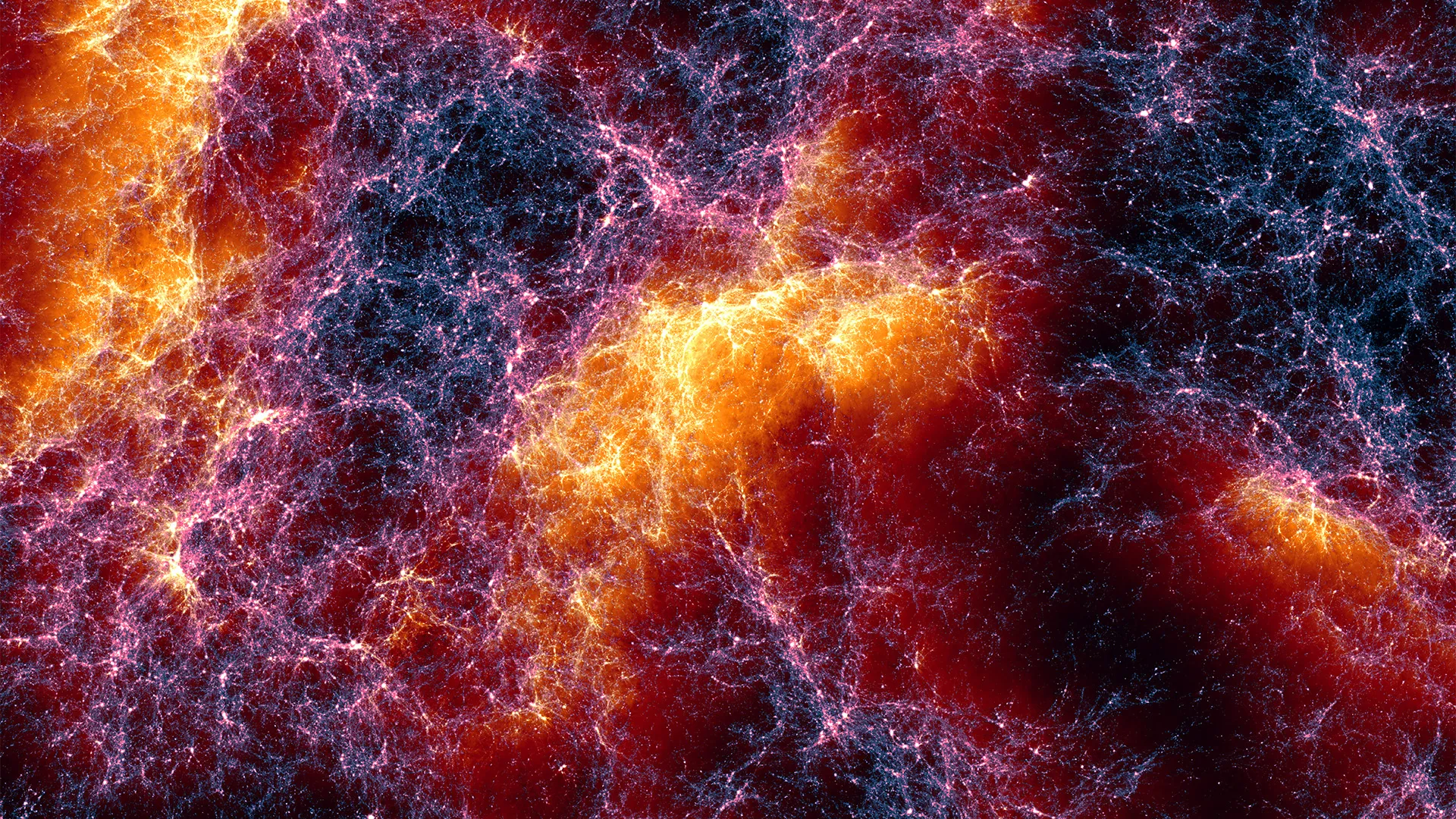
The Lumina Project spans 2 billion years and will allow scientists to test theories and predictions about the origins of the cosmos.
The origin of the universe is one of the greatest scientific mysteries of all time. Scientists have developed numerous theories and testable predictions about how the universe began, including the Big Bang model, cosmic inflation and quantum-cosmology proposals.
To test those theories, researchers from the Center for Astrophysics, a collaboration between Harvard and the Smithsonian, assembled the Lumina Project, a simulation of the early universe far larger than any prior one.
The details of the simulation, published in the Monthly Notices of the Royal Astronomical Society (PDF), describe how regular matter, dark matter and radiation likely interacted during the first 2 billion years of the universe, covering a region equivalent to a cube roughly 1.5 billion light-years on each side.
For reference, the prior champion for the largest early-universe simulation was the Thesan simulation in 2022, which simulated about a billion years of the early universe across a region roughly equivalent to a 300-million-light-year cube.
It does all of this in incredible detail, largely due to observations made by NASA’s James Webb Space Telescope and other telescopes that spend considerable time observing the oldest celestial objects. By looking at those ancient space objects, scientists have been able to piece together at least some ideas of what the early universe may have looked like.
“With JWST, the early universe has become an exciting new frontier in astrophysics,” said Oliver Zier, lead author of the study, in a statement .
Source link