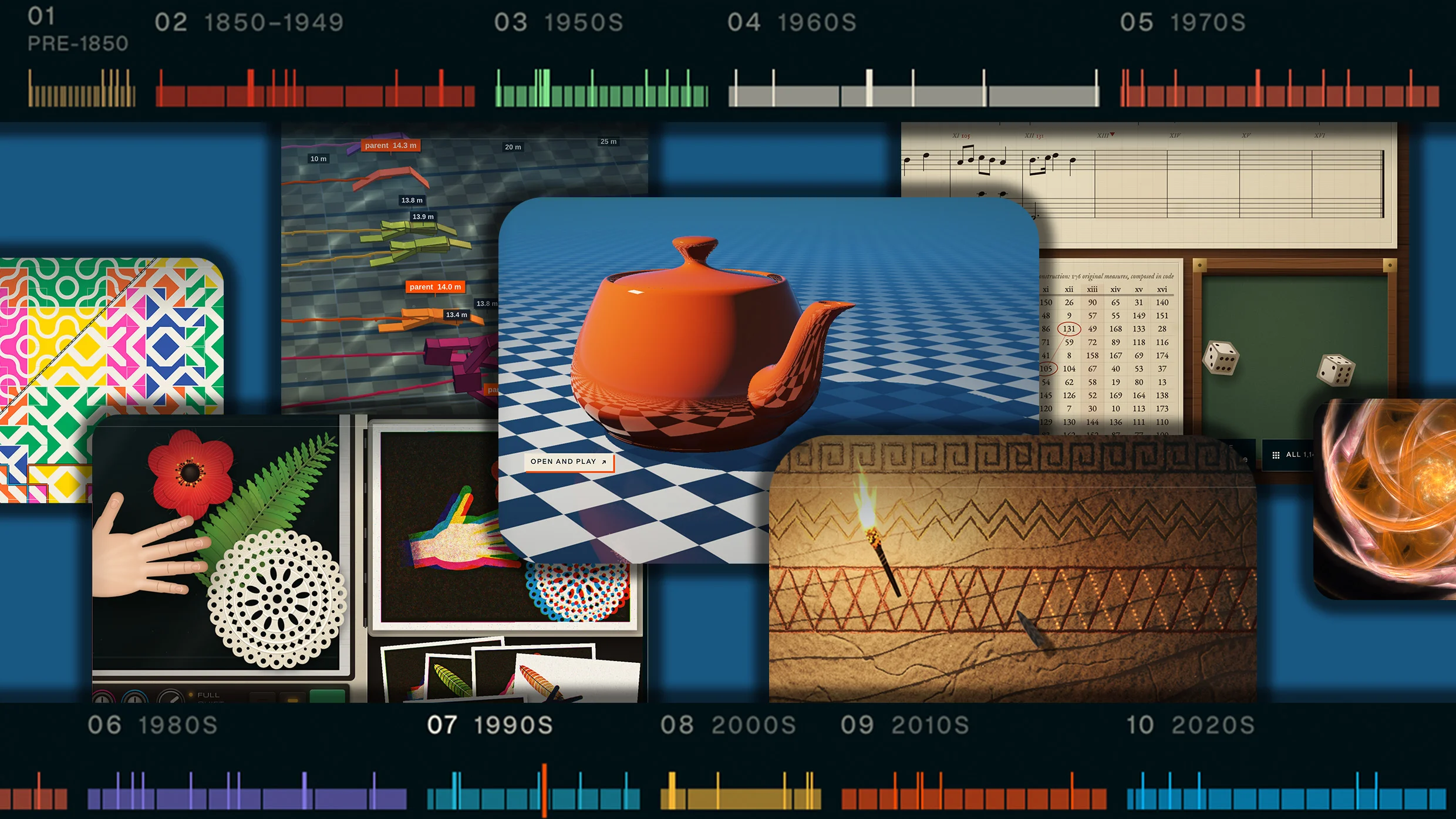
Around 71,000 BCE, someone in a place now called Blombos Cave, on the southern coast of what is now South Africa, scratched crosshatched lines into a piece of ocher. No computer. No code. No prompt. But according to The Living Timeline, launched by digital art institution Le Random, the drawing is a work of generative art, just like your latest AI-styled photo on Instagram.
The Living Timeline is an interactive history of generative art, with 1,147 moments running from 71,000 BCE to 2026 that cover artworks, ideas, and exhibitions connected to the human-made algorithms and machines that made them possible. It includes examples as disparate as those primitive etchings, the 1804 invention of the jacquard loom, and a video processor from 1974.
According to Peter Bauman, editor-in-chief at Le Random, the timeline “helps explain to people outside of the space why certain works are important.” He believes you can’t judge 1960s plotter art by its appearance alone, for example, because “you also have to consider the context, and how difficult every single thing they were doing at the time was.”
Bauman wrote The Living Timeline with contributions from Sasha Stiles—a Kalmyk American poet and AI researcher—and Vuk Ćosić, a Slovenian pioneer of the 1990s net.art movement known for his ASCII-based work.
Take those 73,000-year-old crosshatched lines in the Blombos Cave, the first known drawing by humans and the first entry in the timeline.
Source link