
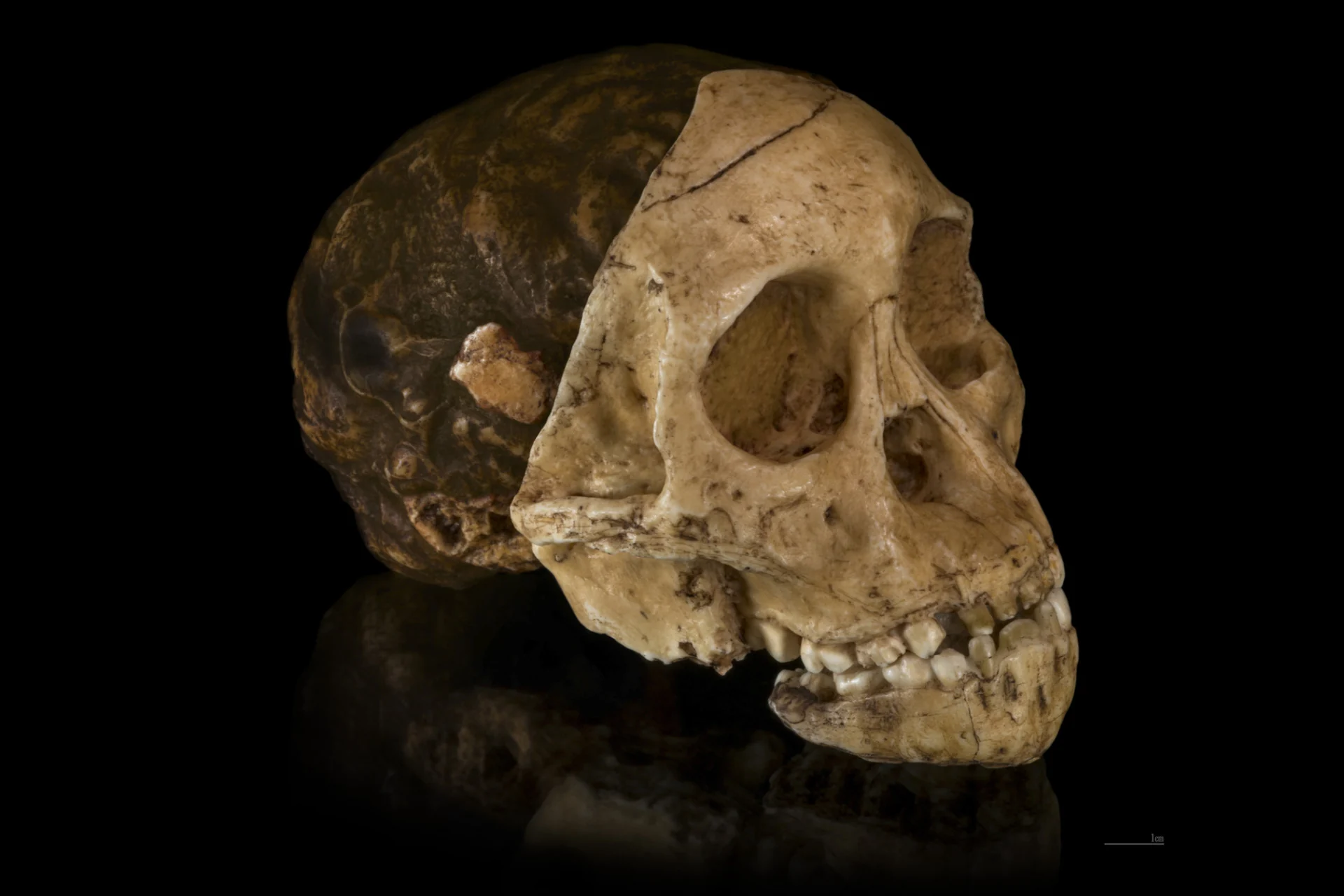
In 1924, the skull of a 3-year-old early human emerged in Taung, South Africa. It was the first solid proof that humans originated in Africa, confirming a fundamental aspect of human evolution. Now, the so-called “Taung Child” is at it again, shaking up what we know about the early human lineage.
In a study published earlier this month in the journal npj Palaeoecosystems, researchers compared features of other early human fossils to the Taung Child. The differences they found suggest that natural climate change turned early human evolution into a chaotic web of lineages, and their research emphasizes that the human family tree in southern Africa was significantly more complicated than researchers thought.
The Taung Child was an Australopithecus africanus, a long-bygone primate species that lived in modern-day South Africa from around 3.3 to 2.1 million years ago. They had a mix of human and ape features and may have been a direct ancestor of the Homo genus, which of course includes us modern humans, Homo sapiens. There’s just one problem. In the entire known fossil record, the Taung Child is the only unequivocal A. africanus specimen.
That’s because after its discovery, experts didn’t establish determinative criteria to categorize later findings. And so paleontologists basically proceeded based on vibes, tentatively classifying similar fossils to the Taung Child as A. africanus.
“For over 100 years, we assumed the Taung Child was just one of many similar fossils from the era,” Gabriele Macho , lead author of the study and a bioarchaeologist at the Free University of Brussels, said in a statement .
Source link





