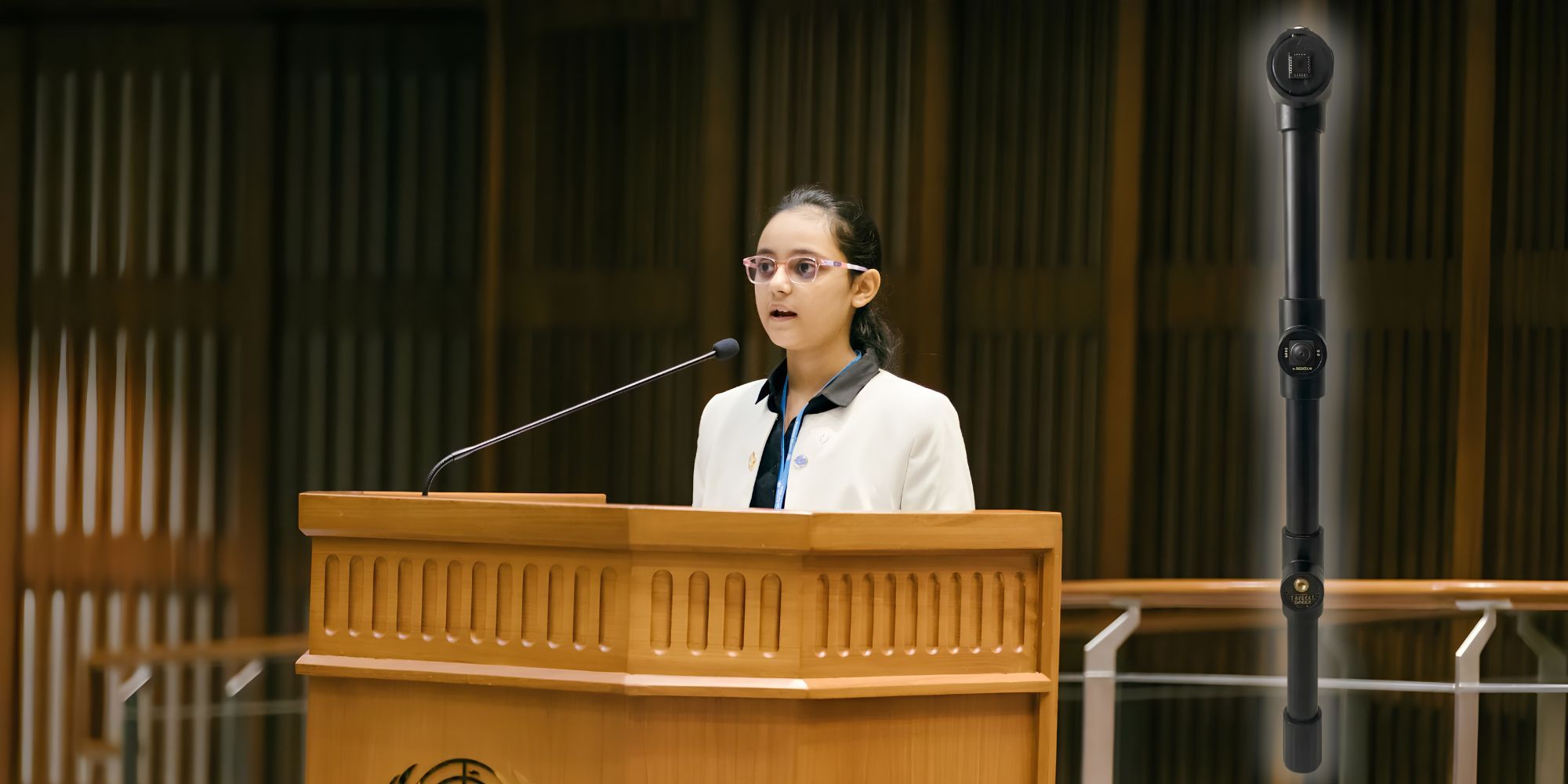
On 25 September, inside the UN Conference Centre in Bangkok, the youngest speaker in the room walked up holding a cane.
Aaradhya Jain was there as a youth speaker at the Second World Summit on Sustainable Health and Well-Being. The cane in her hand was STAMBHA (स्तम्भ, “the pillar”), which she designed, wired and programmed herself. After her talk, she found herself explaining it to a WHO regional adviser and to Hungary’s Ambassador to Thailand.
It was a long way from where the idea began: her own living room in Noida.
“When I was small, someone was always checking on me,” Aaradhya says. “Then they got old, and no one was checking on them.”
She means her grandparents. They used to fuss over whether she was warm, whether she was safe. As they aged, she noticed the roles never reversed. Her conclusion is disarmingly simple: a life should be held all the way through, not just at the beginning.
A second spark came from the screen. Watching Srikanth, the biopic of visually impaired industrialist Srikanth Bolla, made her wonder what moving through the world without sight actually feels like.
So she tried it. She shut her eyes and walked around the house. “Naturally, I was banging everywhere,” she told Digit. That bruising experiment became her first piece of user research.
Most smart canes look only outward, at the ground ahead. STAMBHA also looks inward, at the person gripping it. In the world of assistive tech, that usually means three separate products.
Source link