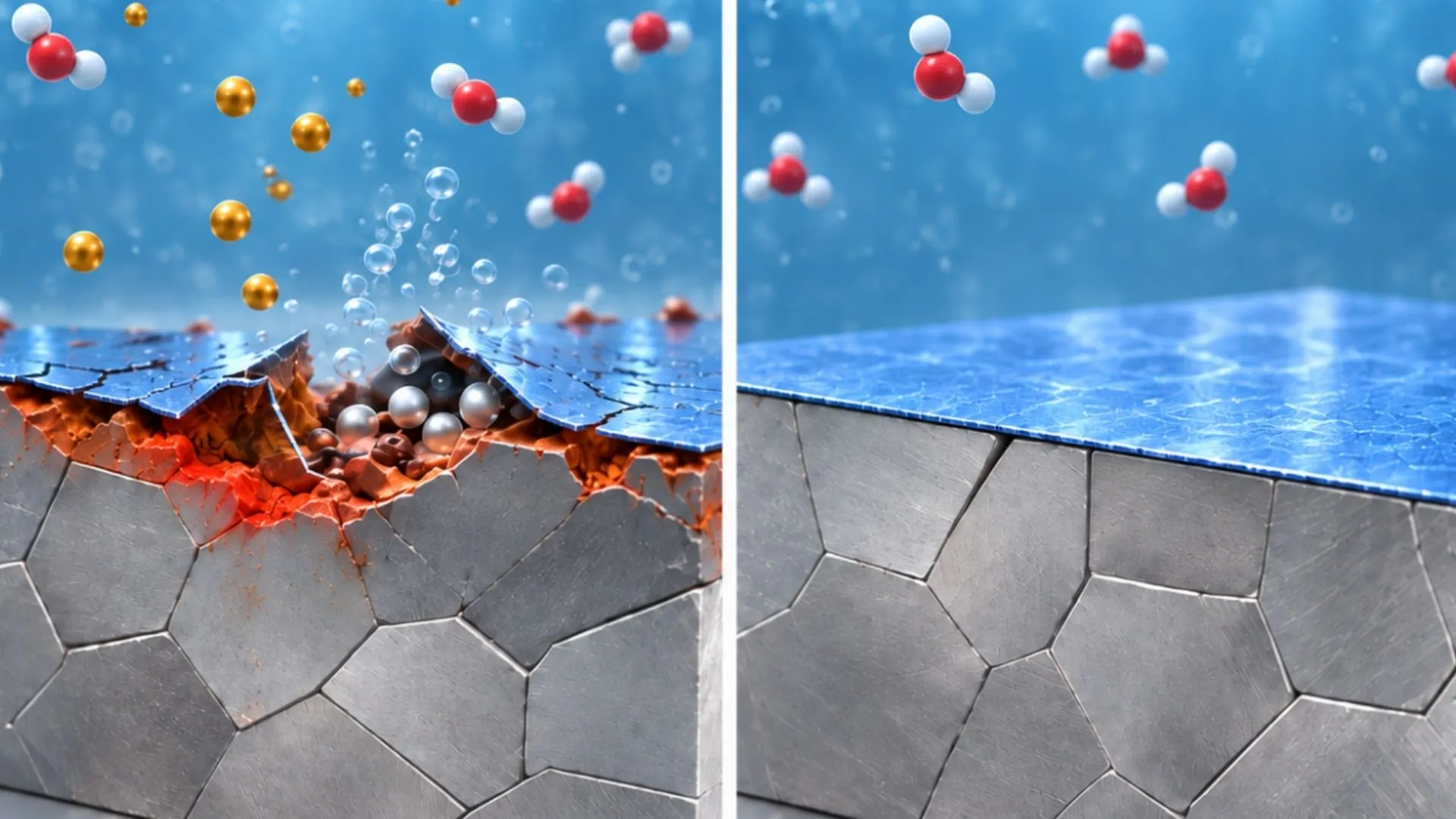
Researchers at Austria’s TU Wien have found that a much thinner platinum coating could protect components used in hydrogen production. It can potentially reduce the amount of the precious metal needed for these protective layers by around 88%.
The experiments examined platinum-coated titanium bipolar plates used in proton exchange membrane (PEM) water electrolysis.
Under the conditions studied, a coating just 24 nanometers thick remained largely intact and retained good electrical conductivity after electrochemical stress.
The findings point to a possible way to reduce equipment costs. However, the researchers cautioned that the optimal thickness depends on factors including how the coating is manufactured and how uniformly it covers the surface.
Water electrolysis uses electricity to split water into hydrogen and oxygen. At one electrode, the process produces oxygen, positively charged hydrogen ions (protons), and electrons.
The protons pass through a membrane to the second electrode, where they combine with electrons to form hydrogen. Keeping the equipment operational in this environment is more complicated than the basic reaction suggests.
“Electrolysis creates a chemical environment that is damaging to many metallic components. Metal can dissolve, while oxide layers can form at the same time and impede the flow of electric current,” explained Helmut Riedl-Tragenreif from the Institute of Materials Science and Technology at TU Wien.
“If the system is to remain operational for a long time, the different components have to be carefully matched to one another. Bipolar plates play a particularly important role here, accounting for up to 30% of total system costs,” he added.
Source link