
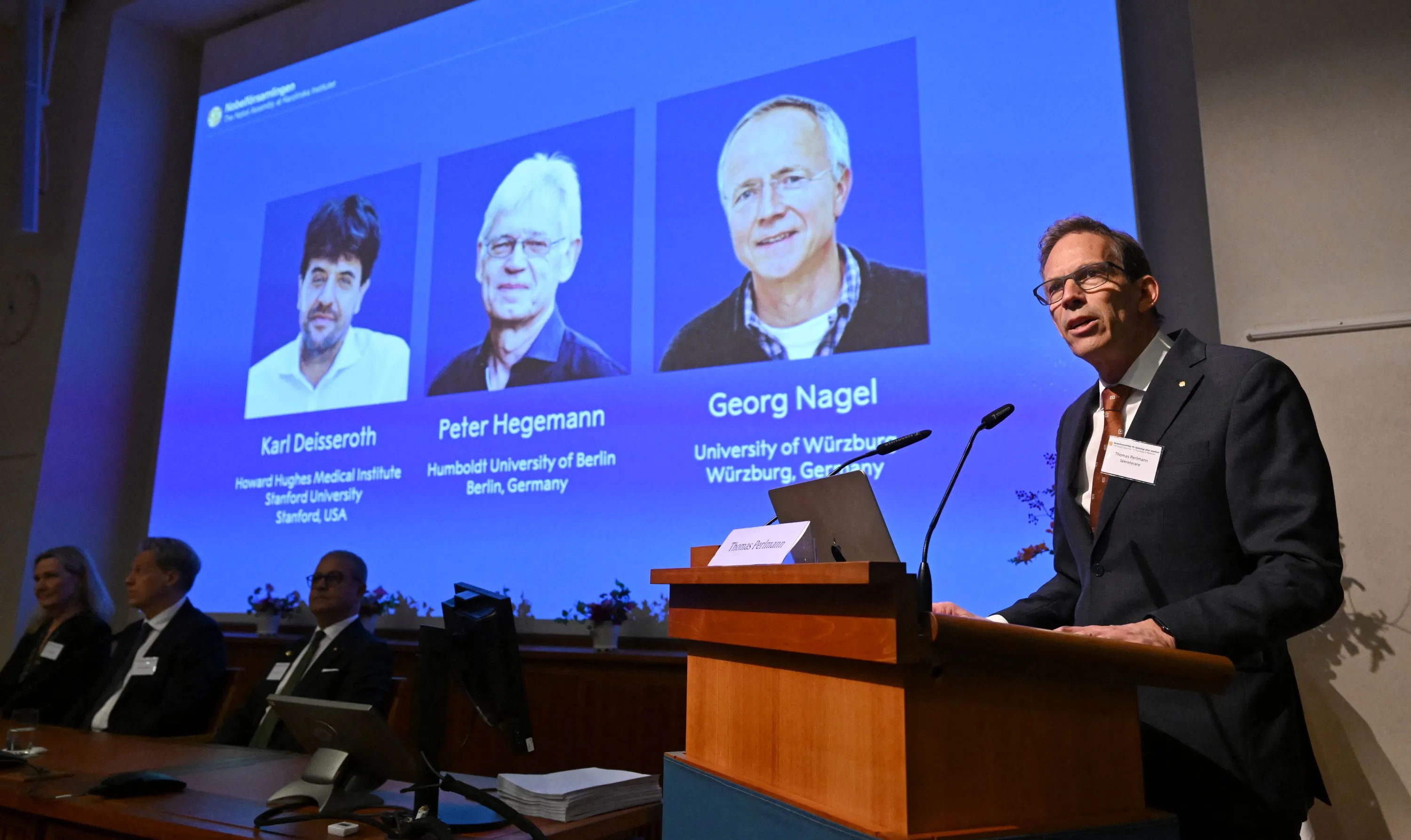
The Karolinska Institute awarded the 2026 Nobel Prize in Medicine to researchers Karl Deisseroth of Stanford University, Peter Hegemann of Humboldt University in Berlin, and Georg Nagel of the University of Würzburg. Their discoveries led to the development of optogenetics, a technique where scientists can turn individual nerve cells on or off using beams of light.
According to Per Svenningsson, chair of the Nobel Committee for Medicine, “Optogenetics provides opportunities for mapping the brain in a way that we could once only dream of.” No other technique allows for such precise study of a living brain, helping researchers better understand the functions of our nervous systems as well as various neurological diseases and disorders.
But this prize is not just a celebration of neuroscience. It also serves as a triumphant example of what can happen when different disciplines of biology converge, as the findings that served as the basis for the development of optogenetics emerged from research in microbiology.
At the end of the last century, Peter Hegemann began a series of studies to understand how the single-celled alga Chlamydomonas is able to detect and react to light. Previous research documented that Chlamydomonas has an “eye spot,” a small orange dot on its surface that contains a light-sensing molecule called retinal.
Hegemann used tiny electrodes to measure the electrical signals generated by the alga and to expand our understanding of this structure’s rapid response. 5 milliseconds after receiving light. This response time is 20 times faster than that of the human eye, whose light detection process takes at least 10 milliseconds.
Source link





