Global warming has become one of Earth’s biggest environmental challenges. To address this growing problem, nearly every nation in the world adopted the Paris Agreement in 2015, and pledged to keep global warming well below 3.6 degrees Fahrenheit (two degrees Celsius) above pre-industrial levels. The agreement also pushed for a lower limit of 2.7 degrees Fahrenheit (1.5 degrees Celsius).
But things didn’t go as planned. Greenhouse emissions remained high, fossil fuels continued to dominate the energy market, and countries eventually fell behind on their climate goals. By September 2026, even the best-case scenario pointed to a temperature rise of 3.1 to 3.2 degrees Fahrenheit (1.7 to 1.8 degrees Celsius).
Cities are at the center of this problem. Urban areas generate up to 76 percent of the global carbon dioxide (CO2) emissions from final energy use, despite covering around three percent of the planet’s land surface. Concrete buildings and asphalt roads also trap heat, creating what is known as the urban heat island effect. This can leave cities up to seven degrees Fahrenheit hotter than the surrounding rural areas during the day.
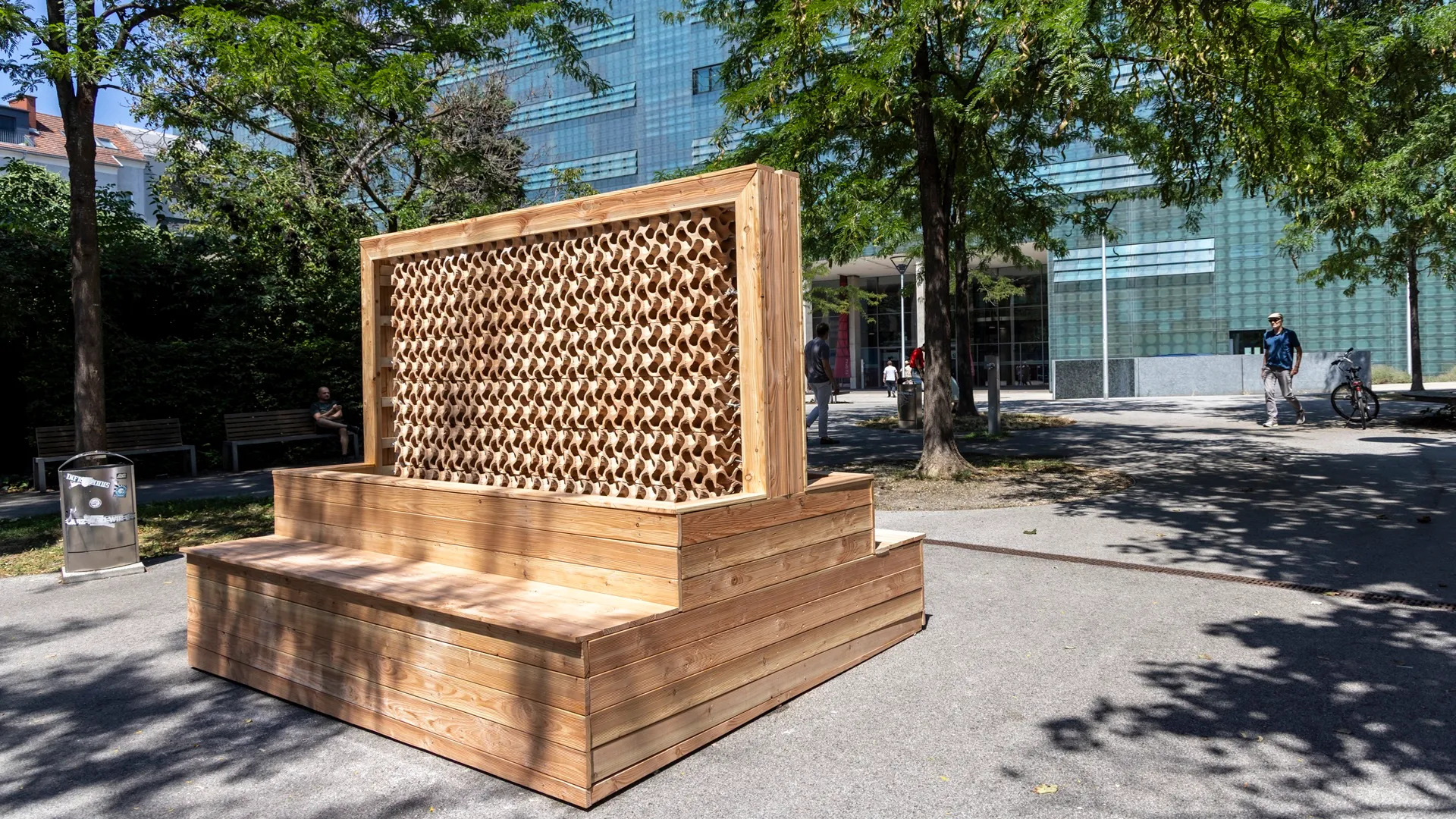
However, researchers at Austria’s Graz University of Technology (TU Graz) recently unveiled an inventive solution to tackle urban heat: a 3D-printed ceramic wall that uses water evaporation to cool its surroundings.
The structure consists of 3D-printed cubes made from a ceramic clay mix. Their porous surfaces absorb and hold water, which gradually evaporates and draws heat from the nearby environment.
Known as evaporative cooling , this centuries-old principle has long been used in hot and dry regions.
Source link