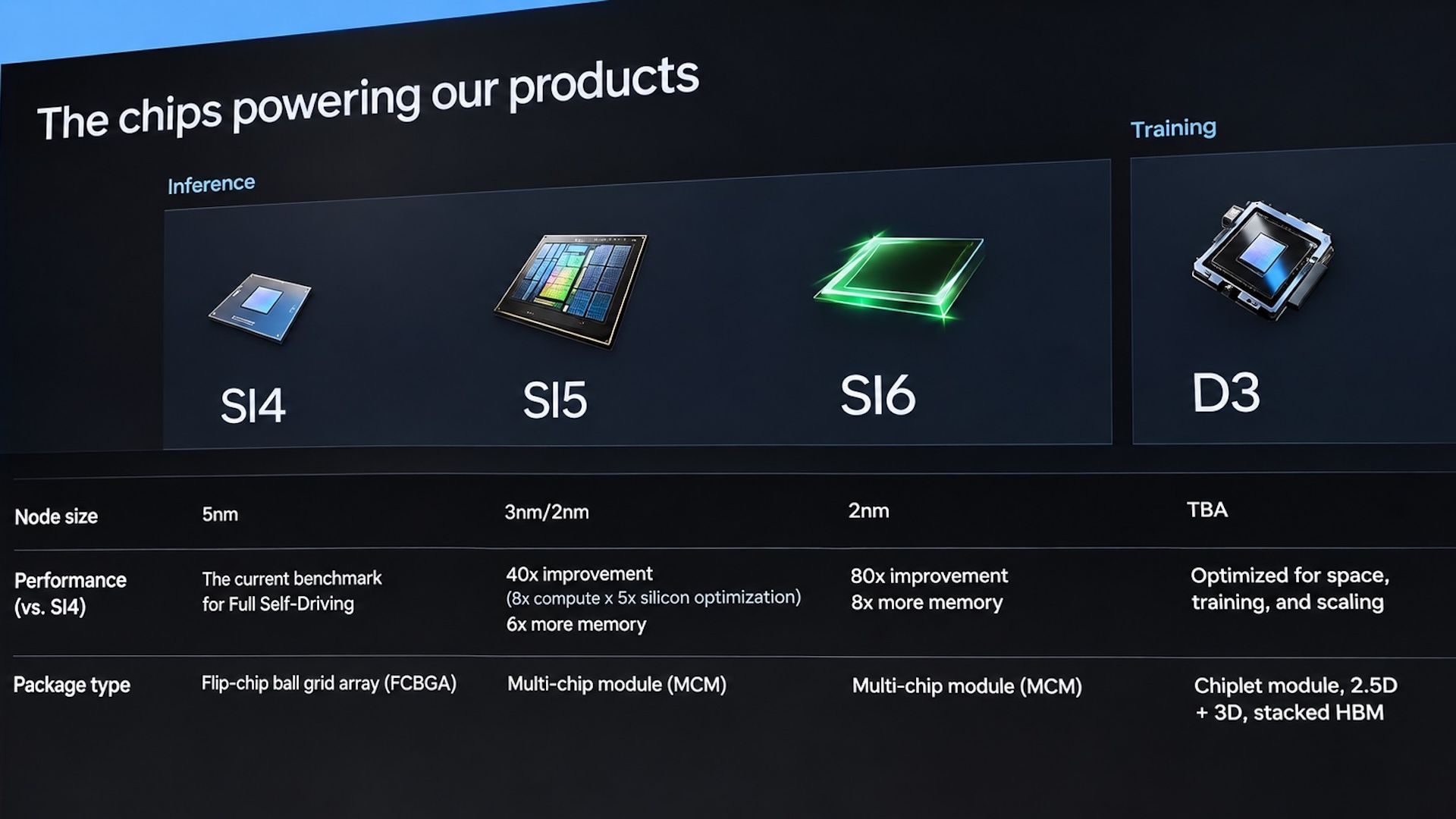
Tesla has disclosed its revamped AI accelerator roadmap that sheds some light on the future of the company's chip development efforts. The Elon Musk company expects that its 6th Generation inference accelerator will bring 80X more compute performance than the existing 4th Generation chip, whereas its D3 training accelerator will cease to use SRAM-centric architecture in favor of a multi-chiplet design with stacked HBM. Also, Tesla has adopted the term "super intelligence" instead of artificial intelligence for its AI accelerators, renaming them with SI monikers. Musk recently confirmed SpaceXAI would be redubbed SpaceXSI for the same reason.
Wait a minute… I thought @elonmusk ’s Tesla chips were called AI4, AI5, and AI6.But in this latest presentation, they’re now labeled SI4, SI5, and SI6.Then I remembered: President Trump wants to replace “Artificial Intelligence” (AI) with “Super Intelligence” (SI).Looks like Elon Musk may already be embracing the new terminology. 🤔November 4, 2026
Perhaps the most interesting development in Tesla's AI hardware roadmap is the re-emergence of the in-house developed Dojo training accelerator after Elon Musk cancelled the whole wafer-level Dojo project in August, 2025, and then said SpaceX and xAI would exclusively use Nvidia hardware in August, 2026, both in its terrestrial and extraterrestrial data centers. Yet, the 3rd Generation Dojo will be considerably different from the first two generations, Dojo D1 and Dojo D2.
5D and 3D packaging technologies with stacked HBM. This represents a substantial departure from the original Dojo D1 system-on-wafer architecture , which relied on distributed on-chip SRAM and interconnected 25 D1 processors with 11 GB of SRAM using wafer-scale packaging technology.
Source link