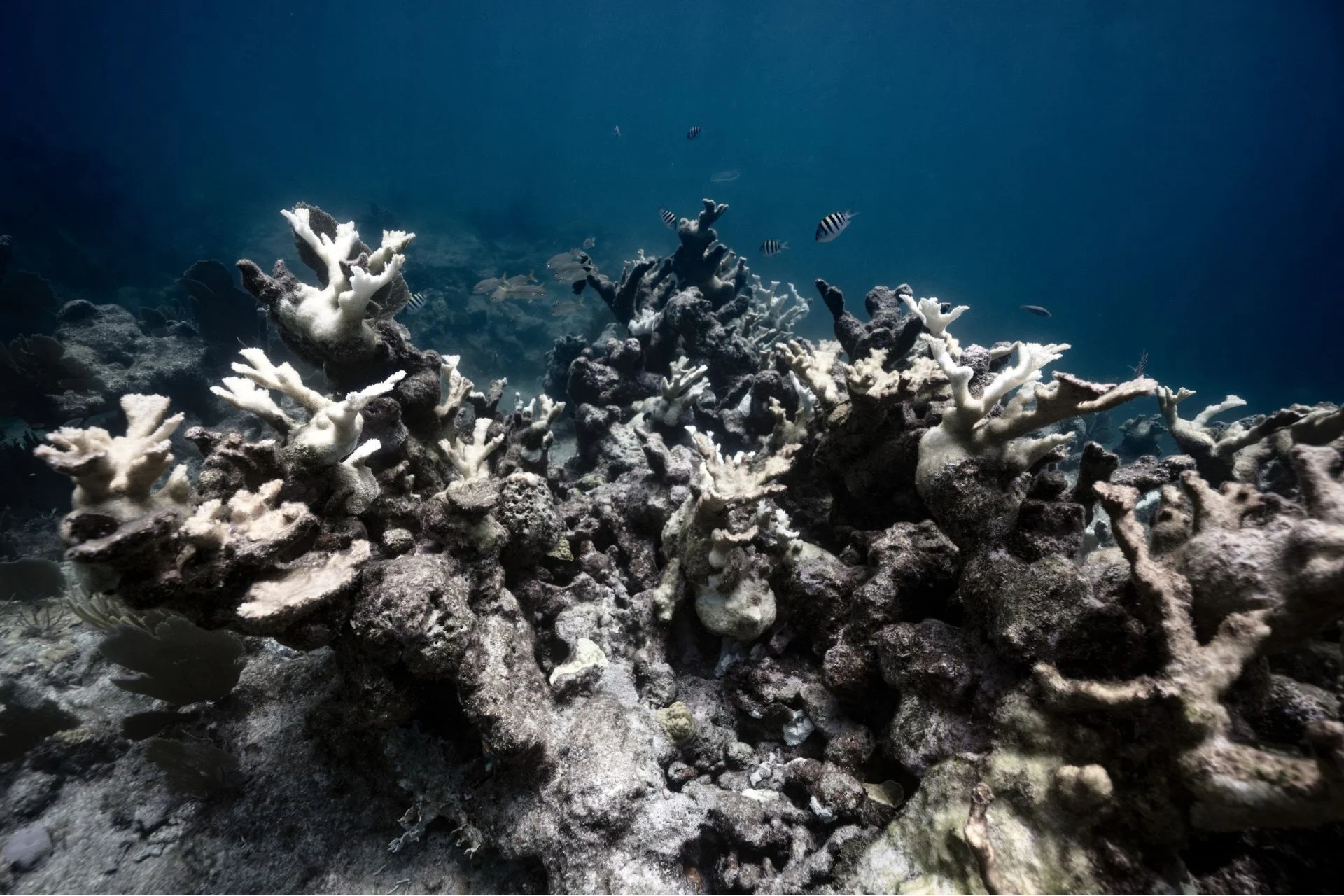
Let’s set aside the fact that coral reefs are essential wellsprings of marine biodiversity, colorful aquatic oases that nourish innumerable animals across the entire ocean food chain. These reefs are critical for humans too. By one assessment, the worldwide societal benefits from coral ecosystems—including protected coastal infrastructure, habitats fostering commercial fishing, tourism, and even drug discovery—provide an estimated $9.8 trillion per year in value.
So, it matters that roughly 84.4% of the world’s coral reefs suffered bleaching-levels of heat stress during the last major marine heat wave from January 2023 to September 2025, with over half already lost compared to coral coverage in the 1950s. Fundamentally, corals bleach when rising temperatures kill off its algal symbionts, a form of single-celled phytoplankton known as dinoflagellates.
Left to themselves, these coral reefs can (if they’re lucky) slowly repopulate their essential partners from dinoflagellates drifting in the marine environment—but all too often that incremental organic rejuvenation happens too slowly to save a reef from certain death.
“Bleached corals are often considered a lost cause because recovery after a heatwave is very slow, if it happens at all,” explains Fiorenza Micheli, a marine ecologist with Stanford University’s Center for Ocean Solutions.
But there’s some good news, thanks to a new study published this Wednesday in the journal Science Advances: Marine ecologists at Stanford have discovered that bleached corals can be revived via contact with a healthy coral neighbor, who (like a good neighbor) shares their photosynthetic, symbiotic algae ( Symbiodiniaceae ) with their peers.
Source link