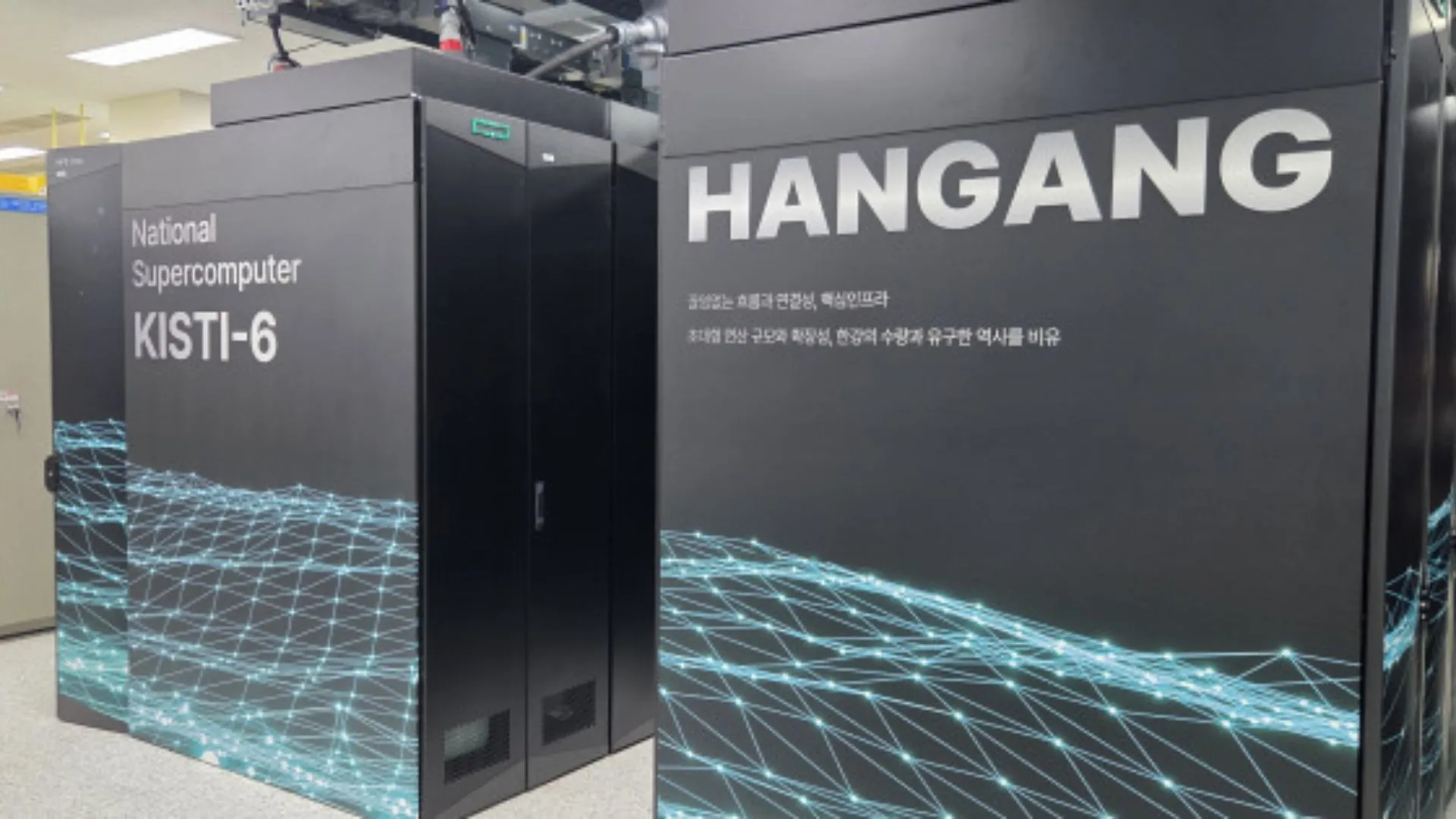
The Korea Institute of Science and Technology Information (KISTI) launched ‘Hangang’, the nation’s sixth supercomputer at a ceremony attended by over 200 members from academia, research institutes and industry at its headquarters in Daejeon.
With a computing performance of 614.7 petaflops, the supercomputer is expected to break into the top 10 of the 500 supercomputers in the world when the list is updated this month.
The Hangang supercomputer succeeds Nurion, which was launched in 2018 and has a stellar track record. In the past eight years of operation, South Korea’s fifth supercomputer was involved in 1,730 research projects which culminated in over 1,520 publications across a wide spectrum of subject areas ranging from next-generation battery materials to building AI systems for chemical analysis using large language models (LLMs).
Hangang’s arrival has been delayed by surges in GPU prices during the recent artificial intelligence (AI) boom. The project passed a feasibility study in 2022, but tenders failed as demand for GPUs skyrocketed.
The team had to redraw plans to meet changing research needs and possibilities, and after four years, Korea’s supercomputer no. 6 will soon be available for users.
Hangang is powered by 8,496 NVIDIA GH200 chips that integrate GPUs and CPUs, and it boasts 9,936 CPUs. The storage capacity of the supercomputer is 205 petabytes (PB) with transmission speeds of 400 gigabits per second (Gbps). Together, the supercomputer can perform 61.47 quadrillion calculations per second.
6 petaflops (PF), when it ranked 12th on the TOP500 list. In September, KISTI began recruiting researchers for pilot services on the Hangang and slowly scaling up its utilization.
Source link