
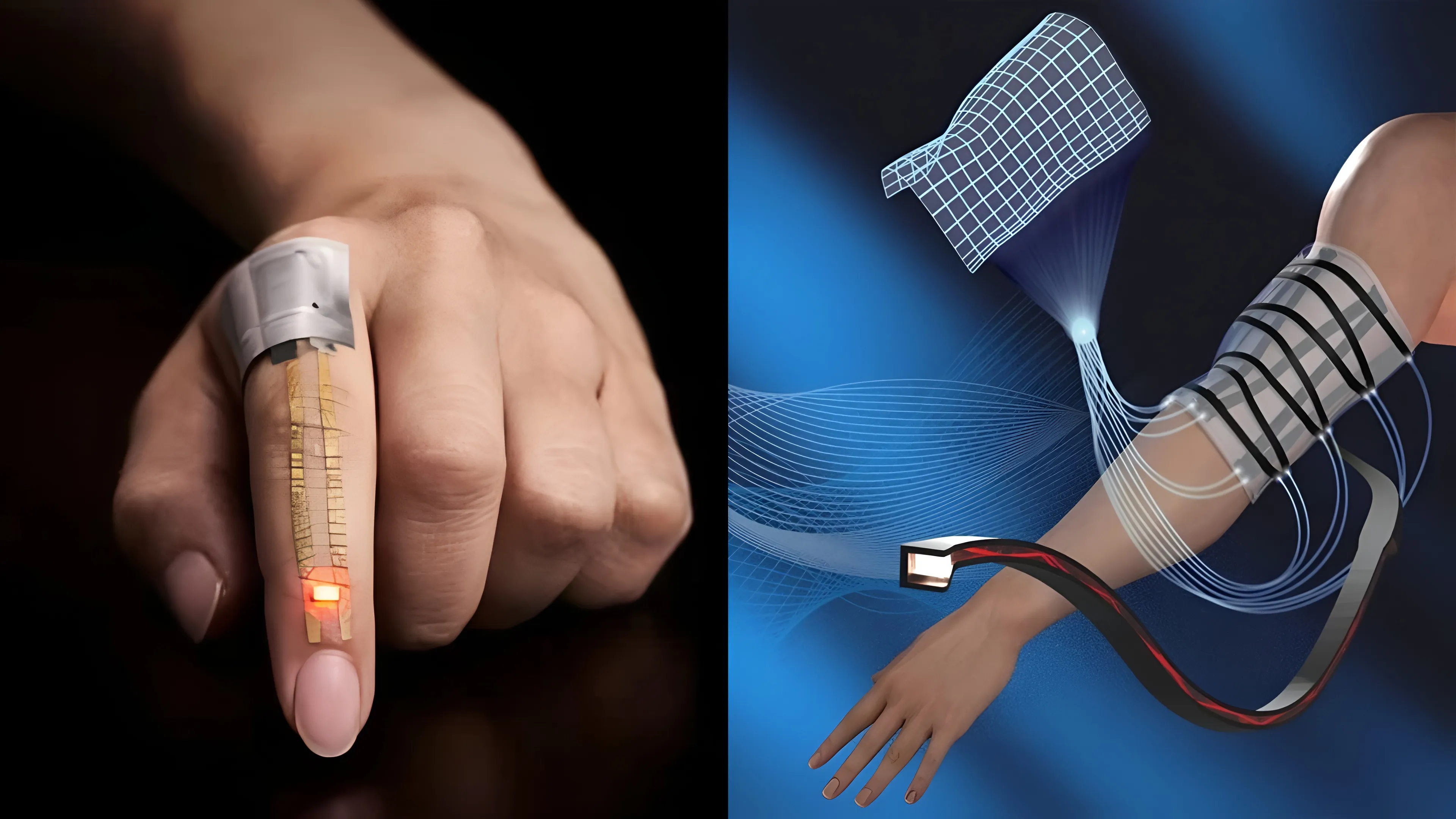
MIT researchers have developed a soft sensor that recreates its own three-dimensional shape as it bends, folds, and twists. The technology could help control robots remotely, create motion-tracking garments, and measure patients’ progress during physical rehabilitation.
The system embeds flexible optical fibers in silicone and uses changes in transmitted light to track surface deformations. Software then converts those measurements into a digital reconstruction that follows the material’s movements almost in real time.
Unlike motion-capture systems that rely on rigid sensors attached to clothing, the design uses soft components throughout its sensing surface. It can also tolerate damaged fibers without losing its ability to reconstruct its overall shape.
The researchers fabricated optical fibers using a flexible rubber core surrounded by black rubber cladding. They deliberately roughened one side of each core to make its response to bending more distinctive.
When a fiber bends, some light scatters away from its path. The roughened surface makes this effect sensitive to bending direction, allowing researchers to estimate how each fiber curves by measuring the light emerging from its opposite end.
Individual fibers can detect curvature along a line, but reconstructing an entire surface presents a greater challenge. MIT’s team addressed this problem by embedding multiple fibers into a stretchable silicone sheet.
Computer simulations helped the researchers compare different fiber arrangements, including checkerboard and zigzag patterns. A particular zigzag configuration proved most effective at capturing complex changes in the sheet’s shape.
The researchers fabricated a physical sheet using that arrangement. LEDs send light through the fibers, while sensors at their opposite ends measure the output.
Source link





