
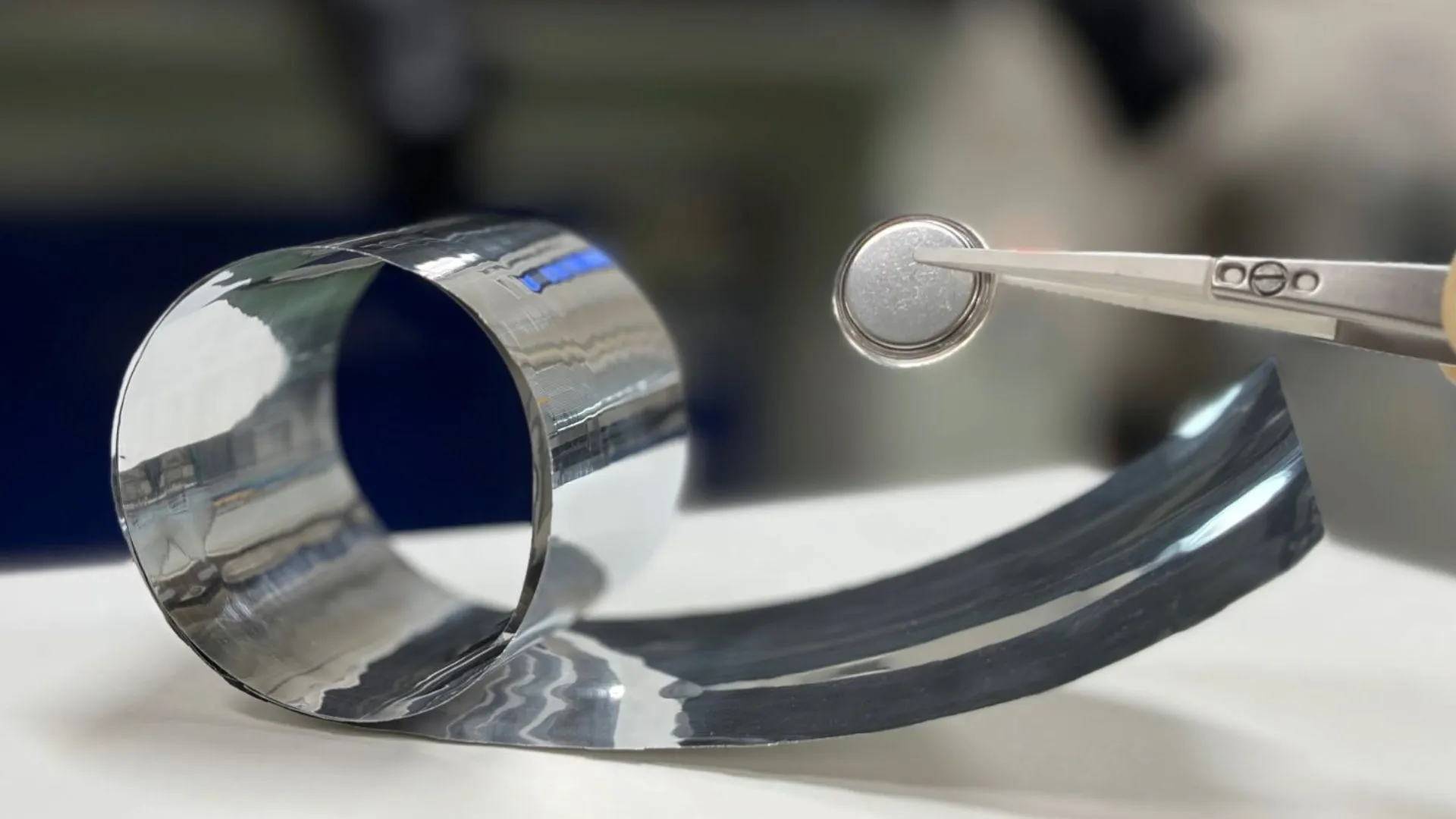
Researchers at Tohoku University and Japanese aluminum manufacturer UACJ Corporation have found a simple way to stop aluminum-foil battery anodes from crumbling during repeated charging cycles.
By dissolving a trace amount of manganese directly into pure aluminum, the team stabilized the metal’s internal structure without sacrificing its high energy-storage capacity, tackling a key bottleneck for cheaper, lighter electric vehicle batteries.
Conventional lithium-ion batteries rely on copper foil coated with active electrode materials, polymer binders, and conductive additives, a multi-step manufacturing process that adds weight, cost, and energy consumption.
Aluminum foil offers an attractive alternative because a single sheet can store lithium ions and conduct electricity, eliminating copper current collectors and slurry-coating steps.
The study addressed a persistent trade-off that has stalled commercial aluminum anodes. While pure aluminum holds large quantities of lithium, repeated charging and discharging cause severe volume shifts.
As lithium ions exit the foil during discharge, a lithium-depleted layer forms at the surface and blocks deeper ions from escaping, forcing microscopic voids and cracks to open throughout the metal while side reactions with the liquid electrolyte build up resistive surface layers.
Previously, engineers tried reinforcing aluminum by alloying it with about 1 atomic percent silicon. However, silicon has a high chemical affinity for lithium, which traps ions deep inside the electrode, prevents full discharge, and reduces usable capacity.
To avoid that penalty, the Tohoku University and UACJ team tested an aluminum alloy containing just one atomic percent of manganese, an element with low chemical affinity for lithium and high solubility in solid aluminum.
Source link





