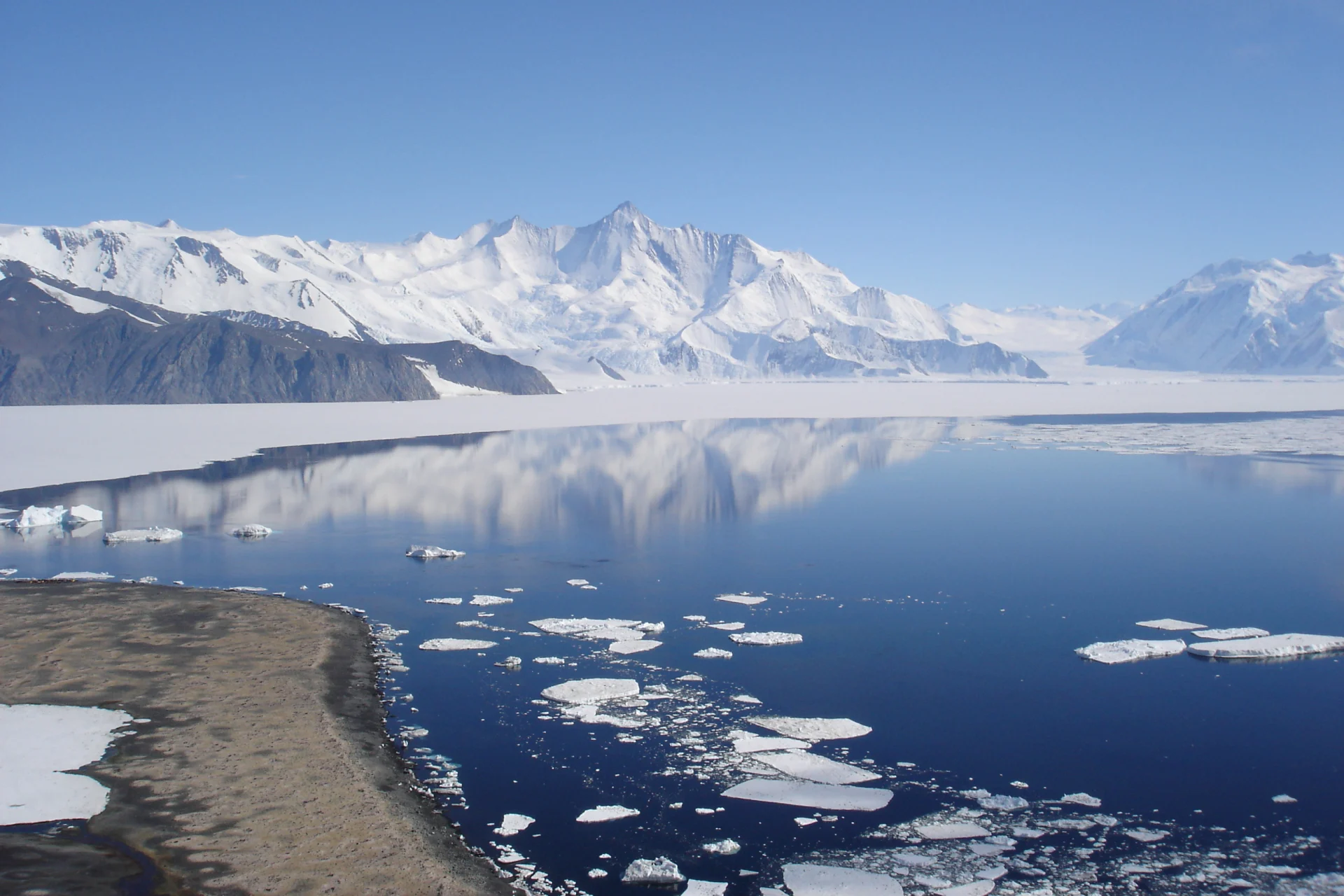
The Cambrian explosion brought exactly that to Earth—an “explosion” of life that kickstarted the evolution of animals as we know them. Scientists have come up with a myriad of theories to explain this phenomenon, such as a recent paper on a literal sh*t-ton of poop. And here’s now another odd idea: gigantic Antarctic mountains that eroded millions of years ago.
To be exact, a new analysis of zircon particles from Antarctica strongly suggests that the barren lands once hosted an enormous mountain range. As these ancient mountains eroded over the years, they would have shed nutrients that fed organisms at the very bottom of the food chain. Their photosynthesis sparked a huge leap in atmospheric oxygen, which was good news for more complex organisms—and the rest is history. Bei Chen and Ian Campbell, both Earth scientists at the Australian National University, published their findings in a recent paper for Earth and Planetary Science Letters.
“If rapid advances in evolution occur in response to favorable environmental change,” they wrote in the paper, “the dramatic evolutionary changes that occurred during the Cambrian should be matched by an environmental change of comparable importance.”
And that dramatic environmental change was the erosion of Antarctica’s lost mountains, the team argued. For the study, the researchers collected 1,712 zircon grains from 12 different locations in Antarctica. Then, they dated the samples using uranium-lead dating, which helps determine the precise crystallization age of zircon. From these measurements, the team picked out four peaks in the distribution for the zircon particles’ age.
Source link