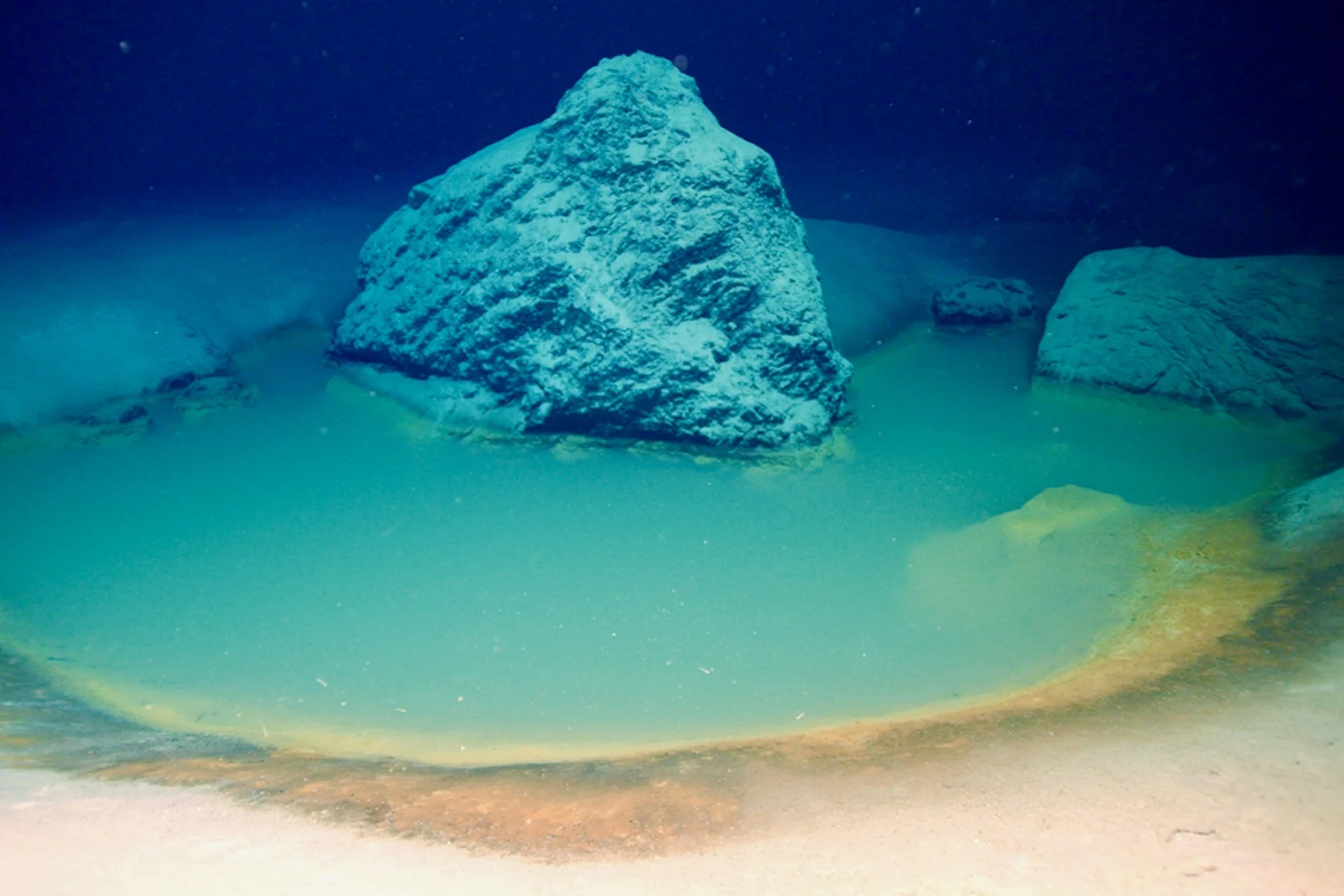
Marine ecologists used to call them “black pools of death.” Only as far back as a decade ago, teal-colored, deep-sea brine pools had been assumed to be oxygen-sapping dead zones, despite the wealth of deeply weird and alien-like “extremophiles” that biologists have found living along their margins.
But something was alive within these phenomenally salty undersea lakes—and now researchers have found evidence of a once-active brine pool whose remains may explain how some of Earth’s earliest primordial life survived in the eons before oxygen gas became abundant. According to their new study, conducted with scientists onboard the research vessel (R/V) OceanXplorer, these even-more-extreme extremophiles managed to make this now “extinct” brine pool in the Red Sea their home between roughly 2,000 and 16,000 years ago.
Species like these, as the team wrote in its study for AGU Advances, may have been “an early mechanism for energy production in Earth’s pre-Great Oxidation Event.” These microbes, in other words, may have set the stage for the colossal flood of oxygen that erupted into Earth’s atmosphere from its oceans between 2.4 and 2.1 billion years ago.
These extremophiles, including novel forms of Myxococcota phylum “slime bacteria” and the no less scummy genus Nitrospira, also appear to oxidize free-floating manganese and iron into minerals, offering “a rare glimpse into how early life on Earth may have functioned” and a valuable clue for locating more extinct brine pools.
Morgan Chakraborty, a PhD candidate in marine geosciences at the University of Miami’s Rosenstiel School of Marine, Atmospheric, and Earth Science, worked with her advisor Professor Sam Purkis, their academic colleagues, and the nonprofit OceanX on the new study.
Source link