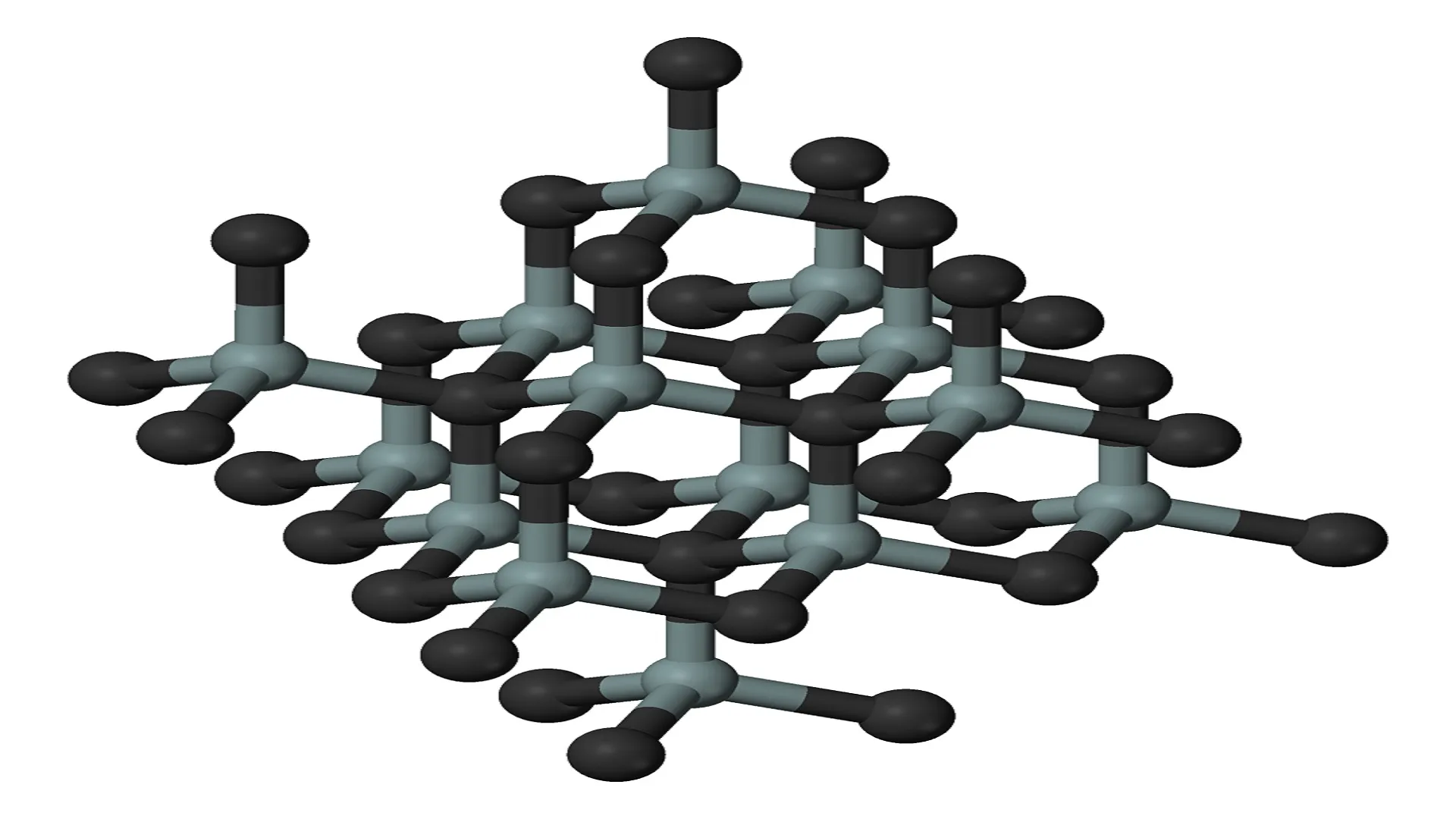
A team of Japanese researchers has obtained Silicon Carbide (SiC) crystals at approximately 1,472 °F, two-fold less than the temperatures at which commercial production begins.
Typically, in an industrial setup, the purest form of SiC is obtained at temperatures reaching 4,500 °F. However, at such high processing temperatures, formation and control of its porous structure at the nanometer scale becomes a challenge.
Scientists at the Institute for Materials Research (IMR) at Tohoku University circumvented the problem.
Using the age-old technique of liquid metal dealloying (LMD) under milder thermal conditions (1,472 °F), they generated SiC nanomaterial crystals with a distinct porous architecture.
In LMD, a solid precursor is dipped into multiple molten metals for selectively remove a specific element.
”LMD is a method that has been previously applied mainly to metals, intermetallic compounds, and semimetals, but our research expands the scope to strongly covalently bonded ceramics,” said Hidemi Kato, professor at the Institute for Materials Research, Tohoku University.
Researchers took molten bismuth and immersed Mn5SiC, a layered solid precursor, into this liquid bath. They discovered that Manganese melted away and got mixed with the molten metal, while the Solid SiC precursor rearranged to form crystalline β-SiC.
The newly formed structure comprises nanoscale plates that were interconnected in the three-dimensional space.
The findings were recently published in Scripta Materialia, showing that first-principles energy calculations confirmed the stability of the framework obtained by this innovative technique.
Scientists proposed that the layered crystal structure of the precursor may have influenced the formation of the nanoplate architecture.
Source link