

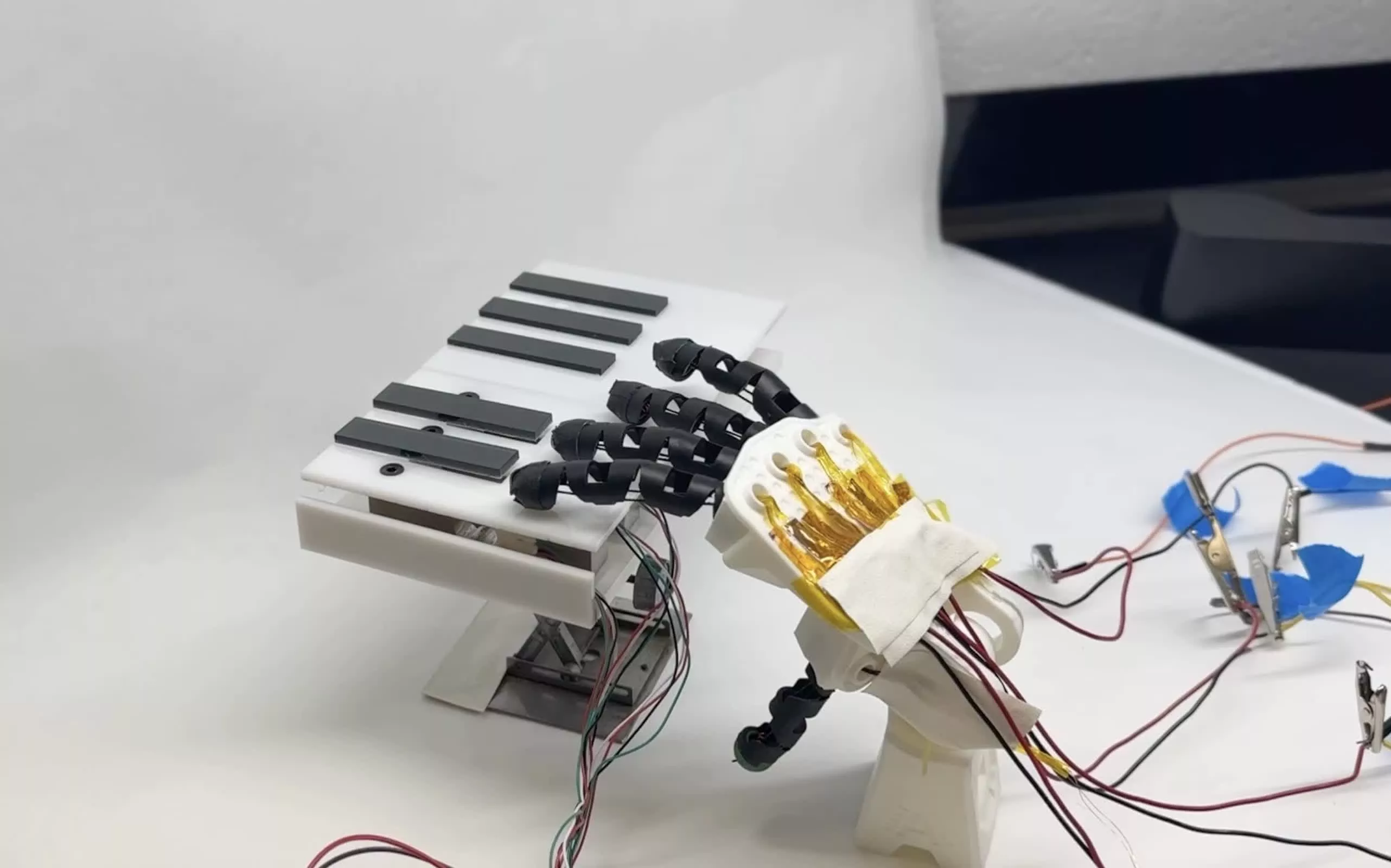
What just happened? Engineers at the University of Pennsylvania have built an artificial muscle fiber that tracks its own temperature and corrects itself, so it can hold a precise position instead of slowly drifting back to its resting shape. The fiber pairs a rubber-like liquid crystal elastomer with graphene and an ultrathin copper coil that works as both a heater and a sensor. In lab tests, the muscles let a robot hand strike piano keys with different amounts of force and let a pair of robotic eyes hold a steady gaze.
The work, published in Advanced Functional Materials, is modeled on the small muscles that move human fingers and eyes. Those muscles make fine, controlled movements, and that kind of control has been hard to get from the hardware inside most robots today.
Large humanoid robots usually run on bulky, rigid motors and mechanical parts. That setup is good enough for walking and lifting, but not for small, careful motions. It's a familiar problem in robotics. Machines that can dance or do acrobatic flips still struggle with jobs people find easy, like folding laundry or keeping their eyes fixed on one spot.
Moving to soft materials brings its own trade-off. "Soft robotic muscles need to be both strong and flexible to mimic human movements, but these properties are rarely found in the same material," said Shu Yang, a University of Pennsylvania engineer and co-author of the study, in a statement.
The team's answer was a composite fiber in which each material has its own job.
Source link





