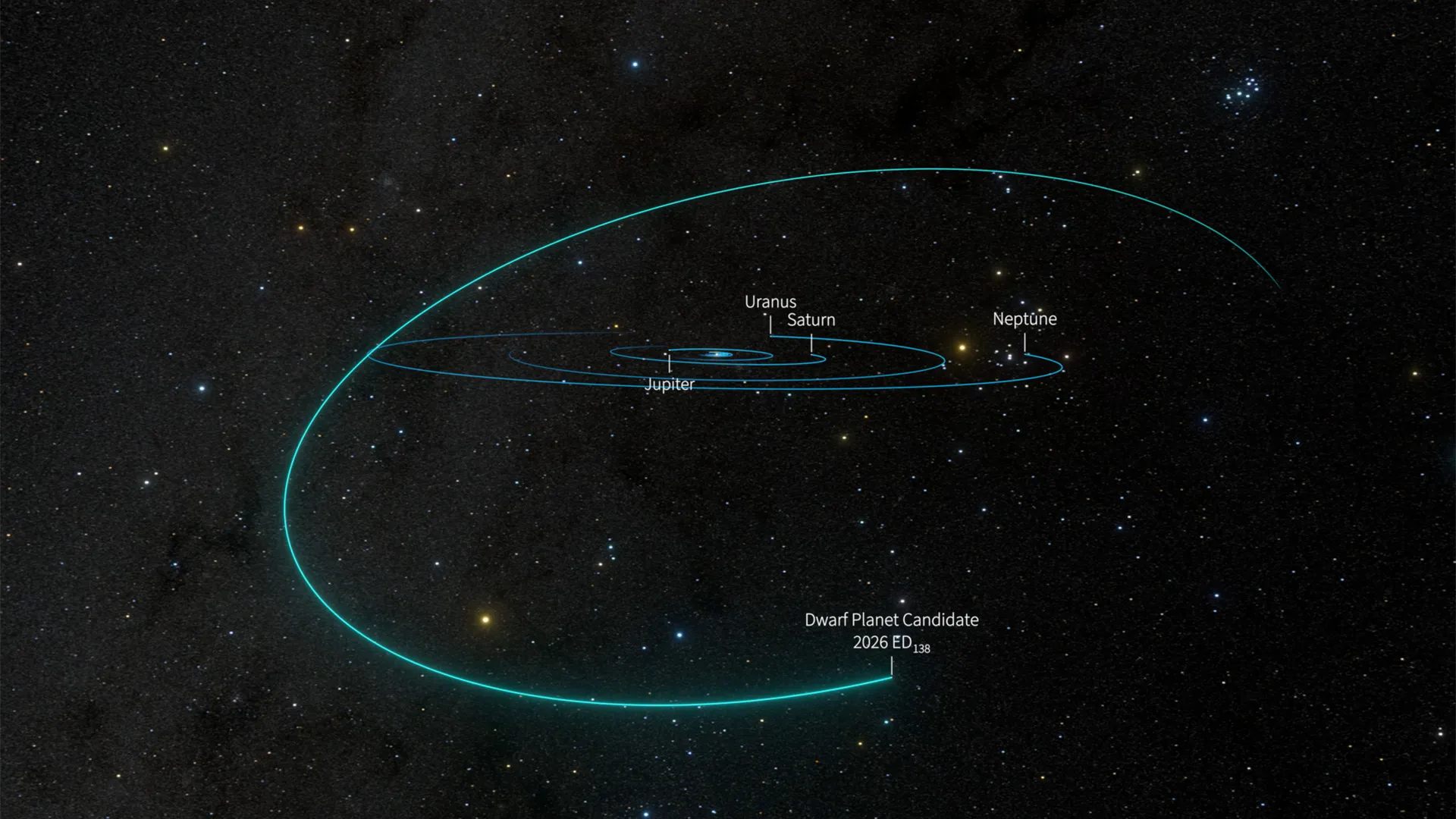
Space is vast, with trillions of objects in it, so it’s not necessarily a surprise when scientists find new objects there, even if it’s sometimes entirely by accident. Some objects are scarcer than others, and dwarf planets in our solar system are among the rarest, with only five recognized examples. A group of researchers from the Vera C. Rubin Observatory may have just found a sixth.
Meet ED138, a dwarf planet candidate. It was found earlier in October when Rubin Operations team member Matthew Holman noted an unusually large object uncovered by a program he’d written with colleague Kevin Napier to scan Rubin Observatory data for moving objects.
“My first reaction was one of excited disbelief,” Holman said in a statement. “Objects like this are very rare, so I immediately started checking whether I or the code had done something wrong.”
Holman ran the search a second time through archived data and found the same object 20 more times dating back to March 2026. He checked even more data from the Dark Energy Camera at the US National Optical-Infrared Astronomy Research Laboratory and the Asteroid Institute’s Asteroid Discovery Analysis and Mapping Precovery service, and found the object in observations going all the way back to 2016.
This presented enough evidence to submit the object to the International Astronomical Union’s Minor Planet Center, which will conduct additional research to determine whether it is, in fact, a dwarf planet.
Researchers at the Rubin Observatory are hopeful, since ED138 seems to have all the properties of a dwarf planet.
Source link