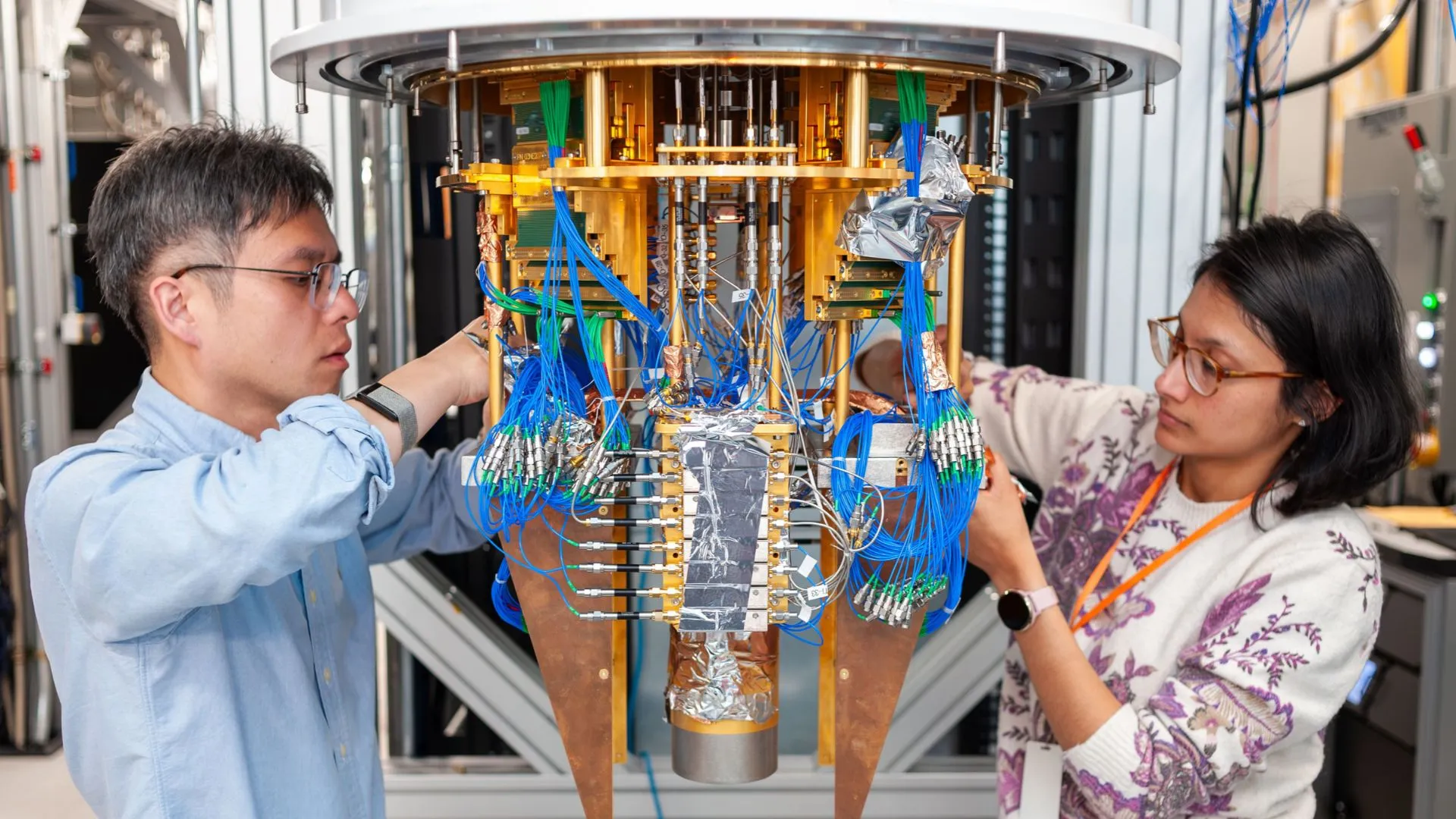
Imagine designing a better battery, discovering a new medicine, or developing a material that can withstand extreme temperatures. Even the world’s most powerful supercomputers can struggle to simulate the behavior of complex molecules and materials accurately. Quantum computers could eventually help with some of these problems, potentially opening doors to discoveries that are difficult or prohibitively expensive today.
But don’t expect a quantum computer to replace your laptop or suddenly solve every problem that conventional computers cannot. Its potential is much more specialized. And while companies are racing to build increasingly powerful machines, the most important applications are still taking shape. So, what could quantum computers actually solve, and how long might we have to wait?
Traditional computers process information using bits, which represent either a 0 or a 1. Quantum computers use quantum bits, or qubits, which can exploit phenomena such as superposition and entanglement to perform certain calculations in fundamentally different ways.
This does not mean they try every possible answer simultaneously. As the US National Institute of Standards and Technology (NIST) explains in its quantum computing guide, extracting useful information from a quantum calculation requires carefully designed algorithms.
Their advantage comes from the ability to manipulate complex quantum states, making certain problems potentially much easier to tackle than with conventional computing.
The catch? Qubits are extremely fragile. Small disturbances can introduce errors, and researchers need increasingly sophisticated error-correction systems before quantum computers can reliably perform lengthy calculations.
One of the most promising applications is quantum chemistry.
Source link