
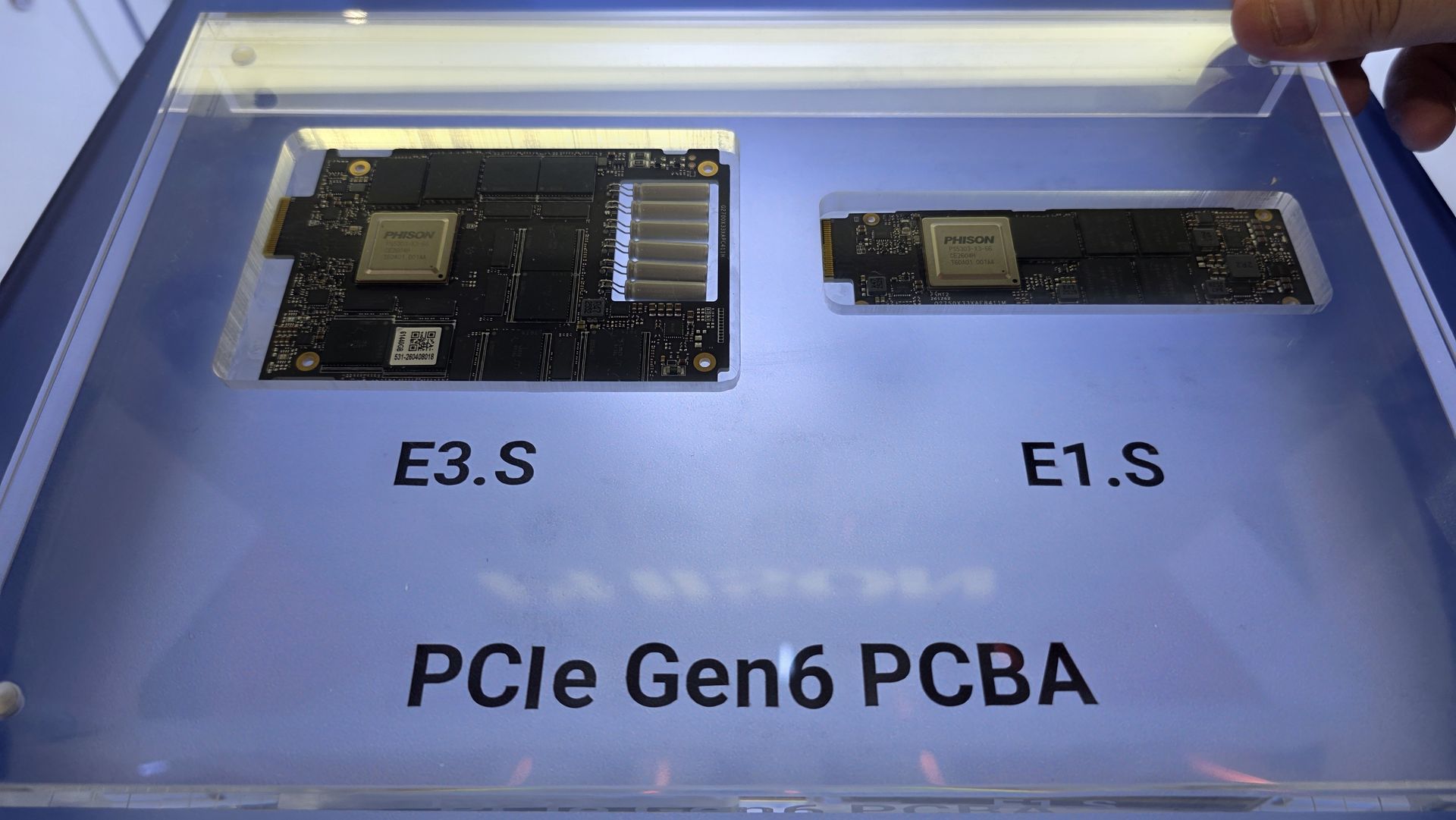
Phison detailed two new enterprise SSD designs at Supercomputer 2026 (SC26) that aim to answer two separate problems: one with a built-in NPU and 64GB of 130 GB/s memory that supports running PyTorch, vLLM, OpenVINO, and llama.cpp directly on the drive, and another that merges fast pSLC cache with large QLC capacity behind just one controller. The company notes that “many of the products and features mentioned are still in development” and will arrive once finalized.
The computational-storage design’s premise is that a server can offload more to the SSD, which runs AI code on the data where it already resides and sends back results, instead of whole datasets. The pSLC-QLC design, meanwhile, puts the cache inside each drive, which may reduce system complexity, as every drive bay contributes usable capacity and none goes to dedicated cache drives.
Phison says that the integrated NPU is expected to deliver “36,800 DMIPS of compute performance,” or Dhrystone Million Instructions Per Second, a typical synthetic benchmark. This is admittedly an old CPU integer benchmark from the 1980s, while NPUs tend to be rated in TOPS, but that figure was not given. For reference, the Topaz NPU add-in card Phison showed at Computex carried eight NPUs rated at up to 40 TOPS each. The DMIPS figure therefore likely refers to, instead, the CPU cores that work alongside it, which we would expect to be based on an Arm Cortex design, adequate for running an SSD of this class but no measure of its AI capability.
Source link





