
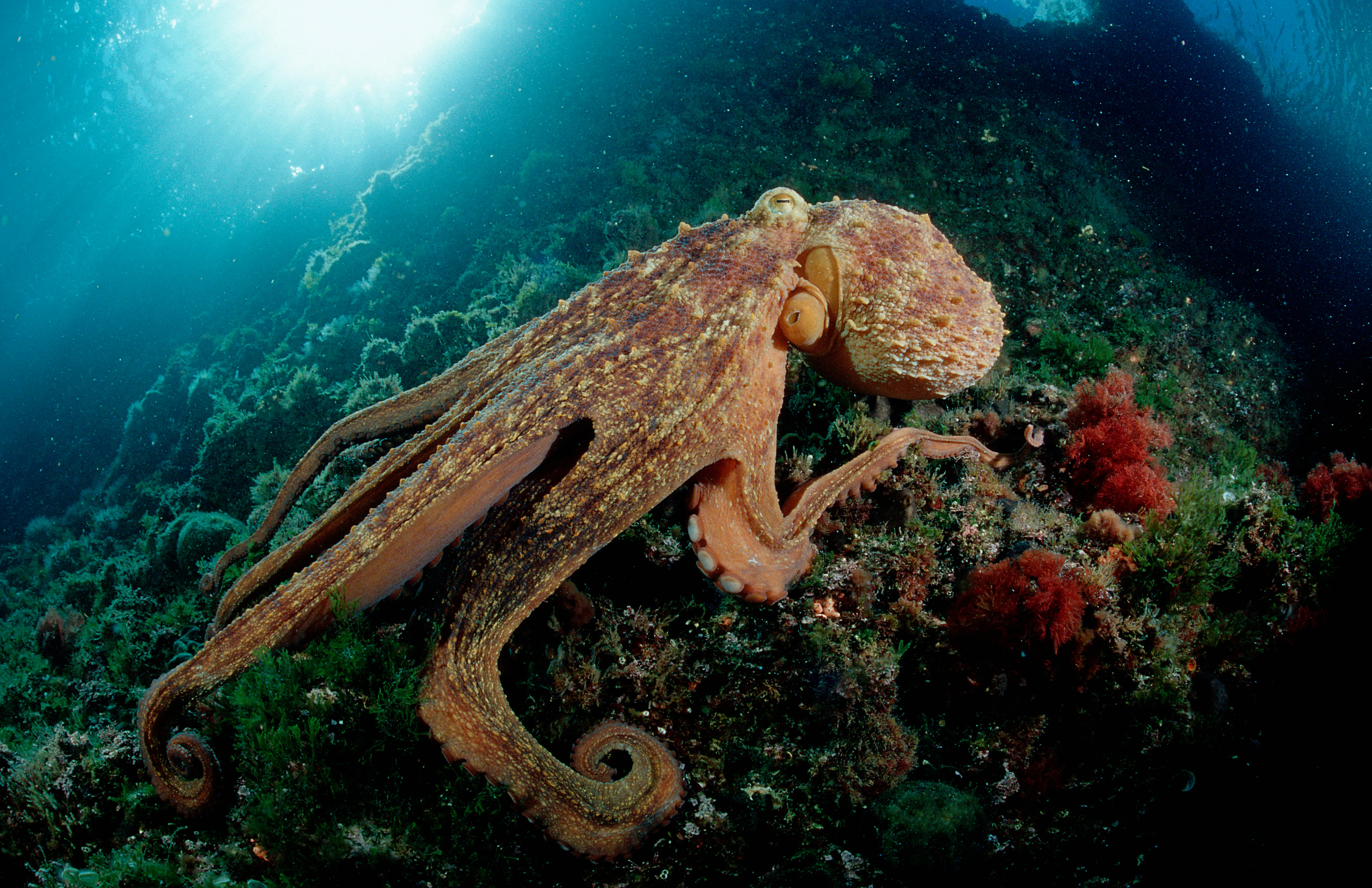
Squeezing your body into the tiniest possible space is no easy task, but it can be very useful, especially if you’re a soft-bodied creature living in the fiercely competitive ocean. Octopuses are the masters of this kind of contortion, being able to squeeze through just about any opening wider than their beaks. Not only is it an impressive feat, but scientists are interested in this ability because it could aid in the design of biologically inspired robots.
In a recent study published in the Journal of Experimental Biology, researchers uncovered the process octopuses go through to squish themselves into small spaces. Before this, “there [was] no information about how octopuses squeeze through an opening far smaller than the body diameter,” Wen-Tzu Hsing, first author of the study, said in a press release.
The research team set up a tank divided by a transparent acrylic panel with a hole in it, allowing the octopus to move through the hole to the other side. They classified the openings as large or small depending on whether the octopuses would have to squish the stiff cartilage structure that protects their central nervous systems, which the researchers could estimate by measuring the distance between their eyes.
What surprised the scientists was the slightly different approaches octopuses used when moving through gaps of different sizes. When the gap was on the larger side, the process involved three distinct steps. First, the creatures would explore the hole with their arms . They’d then usually insert two arms through to the other side before threading their other arms and mantle through the hole.
Source link





