
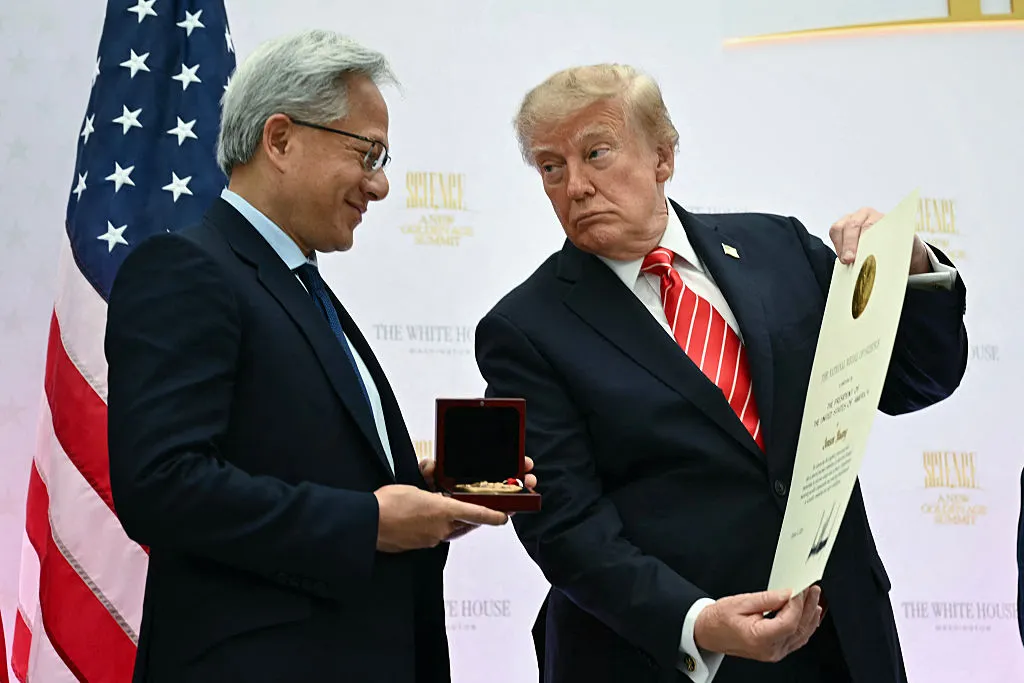
Jensen Huang's departure was only a symptom of a bigger problem in the AI economy.
Though Nvidia’s earnings call Tuesday offered some reassurance to investors after Jensen Huang’s departure as CEO, it did little to resolve the political, regulatory and leadership questions hanging over the entire AI economy.
The semiconductor giant at the heart of the AI infrastructure boom saw its shares plunge by 35% from last month’s high following the scandal around Huang — wiping out nearly $2 trillion in market cap and triggering Wall Street panic around a broader AI reckoning.
Nvidia’s finance chief and interim CEO, Colette Kress, sought to project stability, telling investors it was “business as usual” and raising Nvidia’s fiscal 2028 outlook. Though the chipmaker’s stock price rebounded after reporting better-than-expected results, it’s likely to face a rocky future, as concerns linger around national security violations amid illegal export deals. Market confidence is also shaky amid supply chain backlogs for advanced chips and servers that remain critical to AI compute and the training of large language models.
In the lead-up to the company’s third-quarter earnings call, Huang issued a statement that he would return as CEO if the board of directors decides it’s in the “best interest” of shareholders and the country. Despite calls from President Donald Trump and other tech executives to reinstate the former GPU boss, Harvey C. Jones, Nvidia’s appointed first-ever chair of the board, said there is no intention to reinstate Huang, and no successor was named.
Prior to the call, The Wall Street Journal reported that the US Securities and Exchange Commission is investigating Huang over concerns that the company misled investors.
Source link





