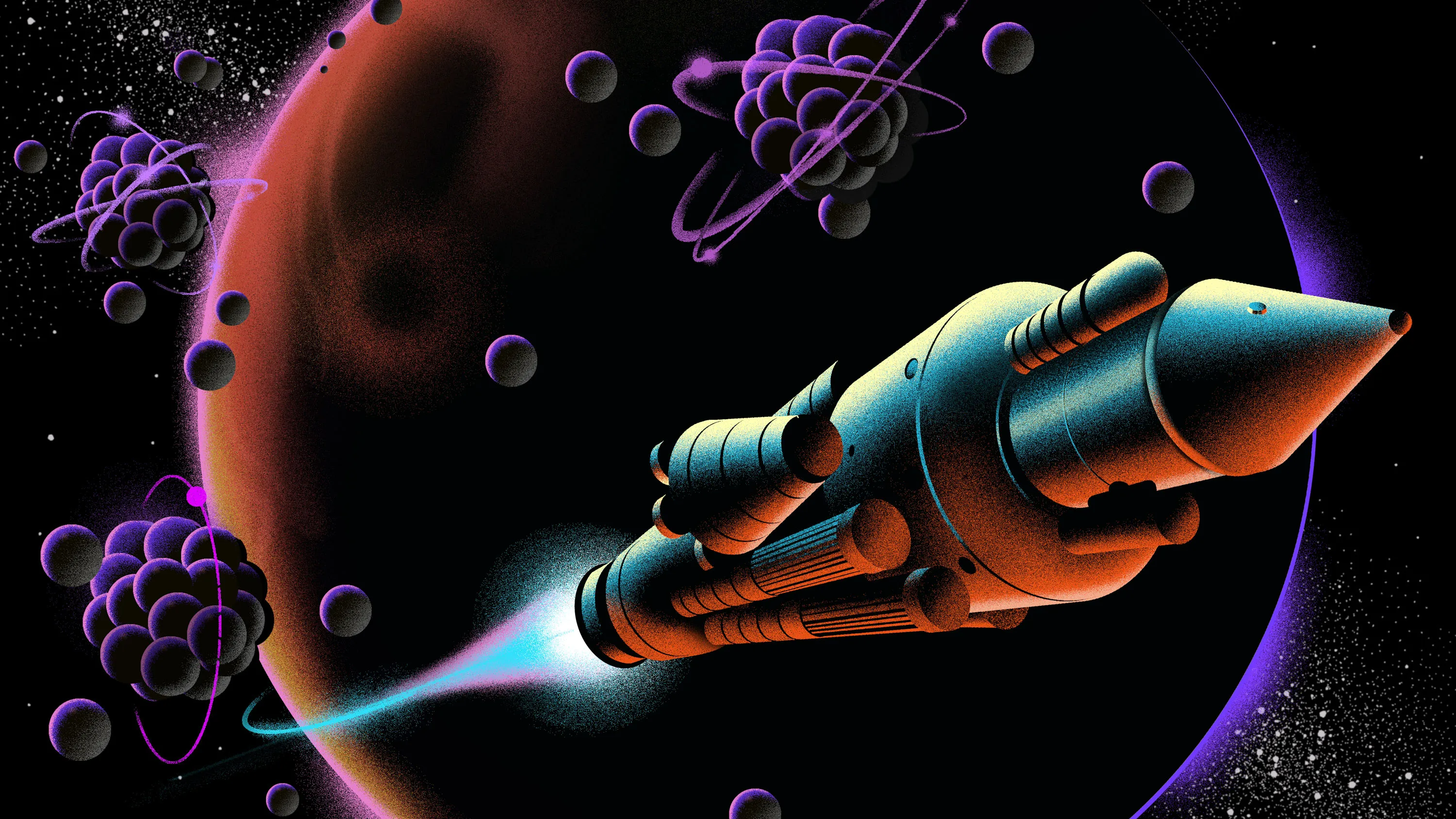
Just before the Artemis II crew began its historic slingshot around the moon this past April, NASA announced plans to build Space Reactor-1 Freedom. SR-1, the first-ever nuclear-reactor-powered interplanetary spacecraft, is meant to fly an uncrewed mission to Mars by the end of 2028, arriving in 2029. A successful mission would herald a new era of more efficient, potentially faster spaceflight—saving astronauts time and cutting their exposure to harmful cosmic radiation as they travel to Mars and beyond. “You wake up to that announcement, and it puts a big smile on your face,” says Simon Middleburgh, co-director of the Nuclear Futures Institute at Bangor University in Wales.
Running a nuclear reactor in space may sound like lunacy, but it’s not. The Soviet Union sent dozens of reactors into orbit, often to power spy satellites. And experts say there aren’t any major technical obstacles to making nuclear space propulsion happen. “I think it’s a very doable technology,” says Philip Metzger, a spaceflight engineering researcher at the Florida Space Institute.“I’m happy to see them finally doing this.”
Still, developing space propulsion using reactors has been slow going. The US has started—and terminated— several programs looking into it over the past 75 years. The latest casualty was DRACO, a collaboration between NASA and the Department of Defense, which ended in 2025. The project was canceled because of high experimentation costs, an inability to compete with conventional rocket propulsion on price, and difficulty ensuring that ground tests could be performed safely and effectively.
Source link