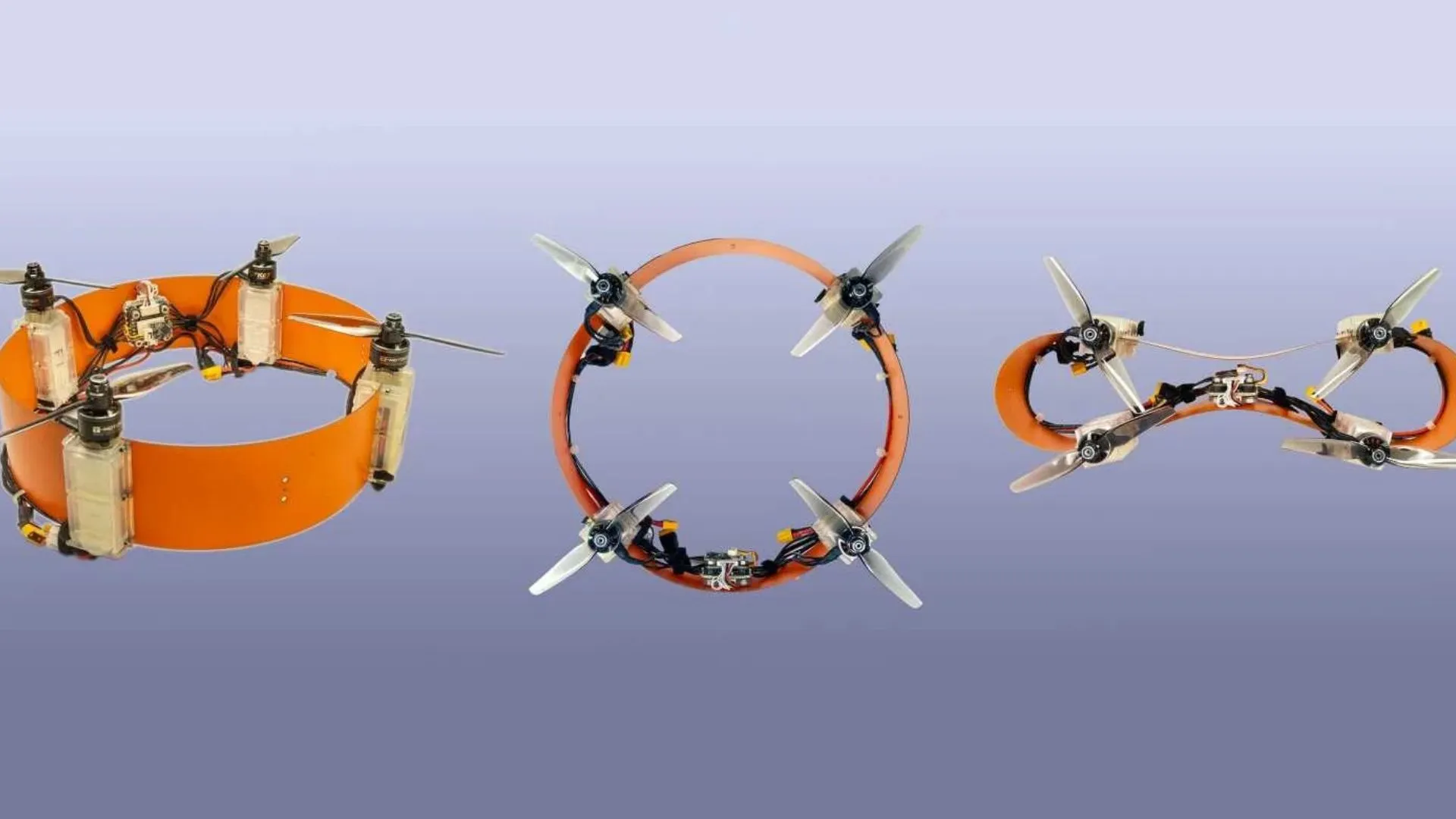
ETH Zurich researchers have developed FlexiQuad, a flexible four-rotor drone designed to withstand collisions while staying airborne.
Unlike conventional drones that rely on rigid frames, the new design uses a deformable structure that absorbs impacts by changing shape.
Despite its flexible body, FlexiQuad can maintain stable flight, reach high speeds, and perform agile maneuvers.
The design could eventually support applications such as infrastructure inspections, rescue operations, and environmental monitoring in confined spaces and challenging environments.
FlexiQuad is a flexible four-rotor drone designed to withstand collisions without losing flight capability. Unlike conventional quadcopters with rigid frames and four arms extending from a central body, the new drone features a deformable, ring-shaped structure that absorbs impact forces.
The design lets FlexiQuad briefly change shape when it strikes an obstacle, reducing the forces on its frame and onboard components. Despite its flexible structure, the drone can fly at speeds up to 49 mph (80 km/h) and achieve acceleration levels comparable to conventional rigid drones.
According to ETH Zurich, the drone’s main innovation lies in how its frame combines flexibility with structural stiffness. Its ring-shaped body has no central fuselage, with the four rotors, batteries, and flight-control module distributed along the frame. This arrangement allows the structure to deform laterally when it encounters an obstacle while remaining stiff in the vertical direction.
The researchers drew inspiration from birds and insects, whose wings can bend in certain directions while remaining relatively rigid in others. With this principle, FlexiQuad absorbs collision energy without compromising the force transmission needed to keep its rotors operating effectively.
Source link