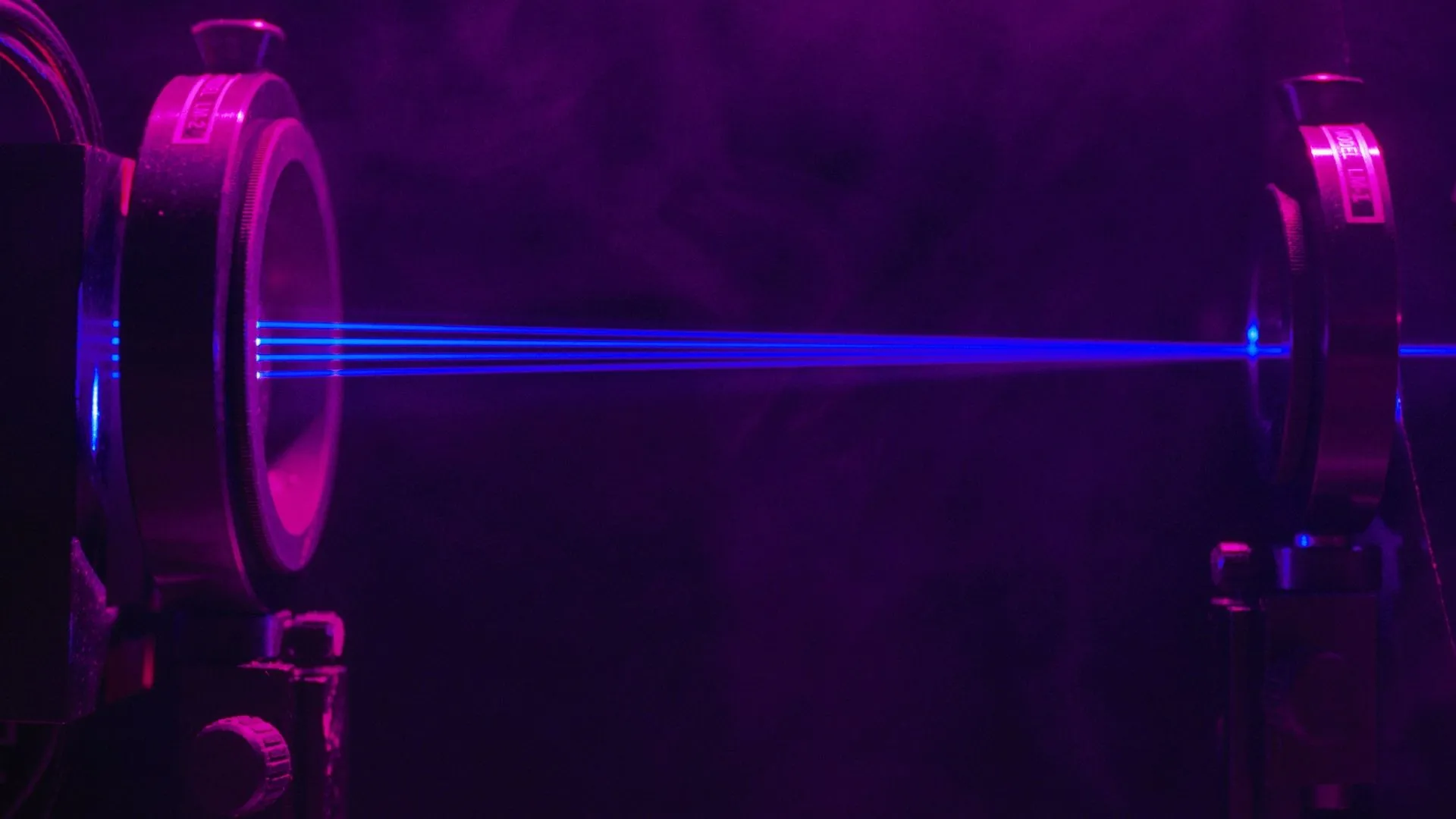
Researchers at Switzerland’s EPFL have shrunk a sophisticated blue laser onto a tiny photonic chip without sacrificing performance. The device keeps its light extremely stable, with frequency variation below 30 kilohertz, while rapidly changing its frequency over 900 megahertz as many as 1 million times per second.
The breakthrough could enable compact underwater communication systems, pollution sensors, and future quantum advancements.
Blue light can travel farther through water and scatters more strongly from tiny airborne particles. These properties offer multiple benefits over infrared light systems, which are used in modern optical communication systems.
However, using blue light for these purposes demands exact control over the laser’s frequency. It must remain stable enough to distinguish weak signals against background noise while also changing rapidly to transmit data or perform sensitive measurements, the researchers noted.
Existing systems capable of this degree of precision commonly rely on bulky optical components, making them difficult to deploy outside laboratories.
Building similar performance onto photonic chips, which guide light through microscopic structures, has proved particularly challenging at blue wavelengths because even tiny manufacturing imperfections can scatter light and degrade performance.
To solve the problem, the EPFL team connected a conventional blue laser to a specially designed photonic chip containing a microscopic ring-shaped resonator. The ring filters the light to a precise frequency and feeds a portion of it back into the laser, helping produce a much steadier beam, the researchers said.
Further, during the experiments, the chip’s light-guiding structure’s thickness was kept at 25 nanometers to cut down optical losses.
Source link