

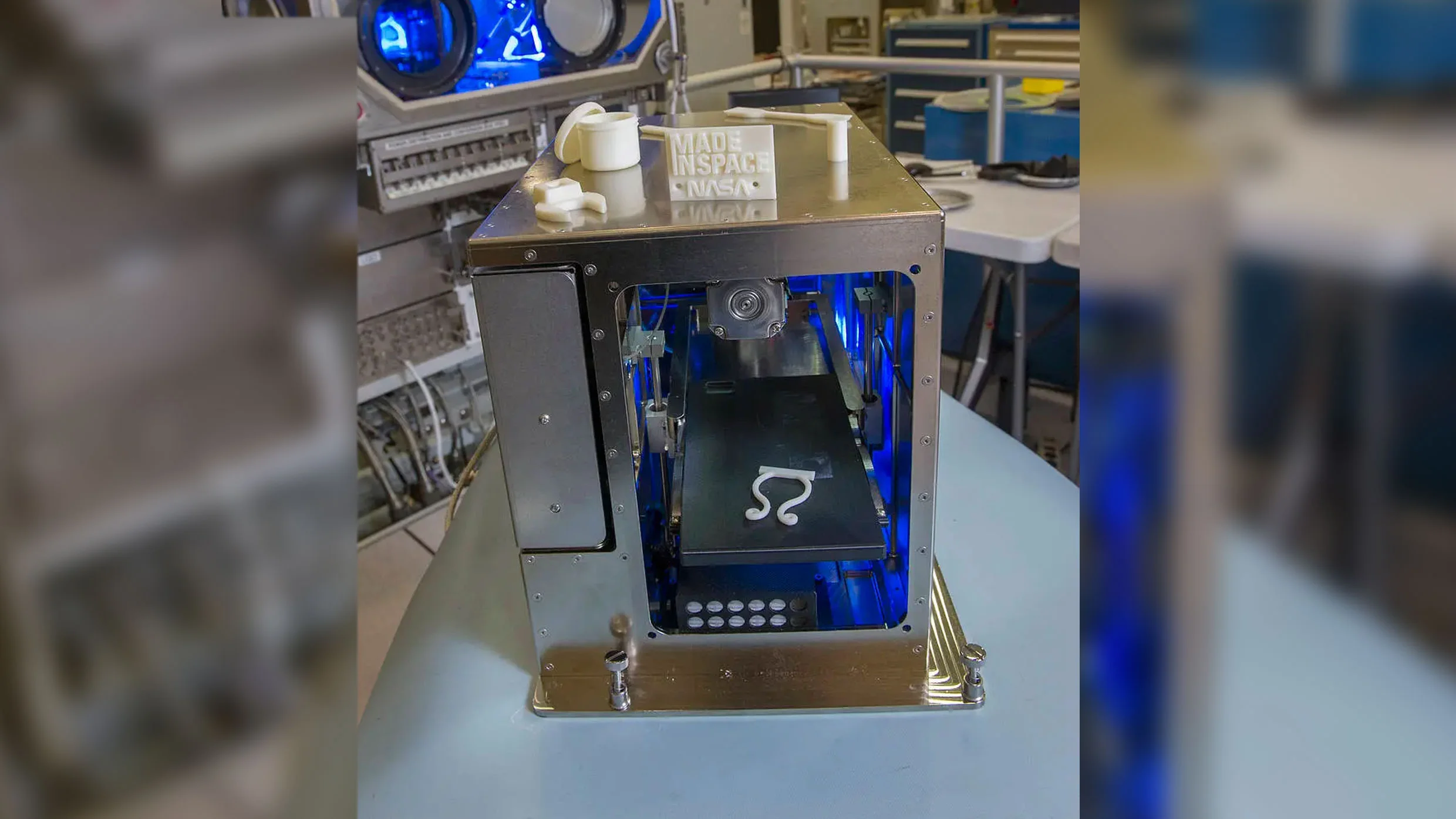
One of the newest items to go on display in the National Air and Space Museum in downtown Washington is also one of its most unassuming: a metal box with a glass door on one side, tucked inside a display case dominated by a humanoid robot with arms extended toward the viewer.
A small white wrench standing next to that box could be even easier to overlook.
But the wrench was made in that box—a 3D printer developed by Made in Space and flown to the International Space Station as the world’s first experiment in 3D printing while in orbit.
“They’re definitely cautious,” Michael Snyder, Made in Space’s former CEO, says of the space agency. On Earth, 3D printers can emit tiny particles that get stuck in people’s lungs; on the ISS, there’s no opening a window to clear the air.
The answer from Made in Space—a space manufacturing startup that was bought in 2020 by the space hardware company Redwire—was to place the printing hardware inside that glass-doored enclosure.
“That kept everything out of their system,” he says, calling the design mindset “NASA-like caution.”
The absence of gravity—technically, “microgravity”—also required modifying standard 3D-printing hardware to yield consistent results; testing was conducted aboard aircraft on parabolic flights to simulate that condition.
“Surface tension dominates in microgravity,” Snyder explains. Engineers had to tweak extruder designs to push out feedstock with enough force and deposit each additional layer consistently.
Made in Space’s engineers then had to optimize the design for easy operation by astronauts juggling dozens of other tasks.
Source link





