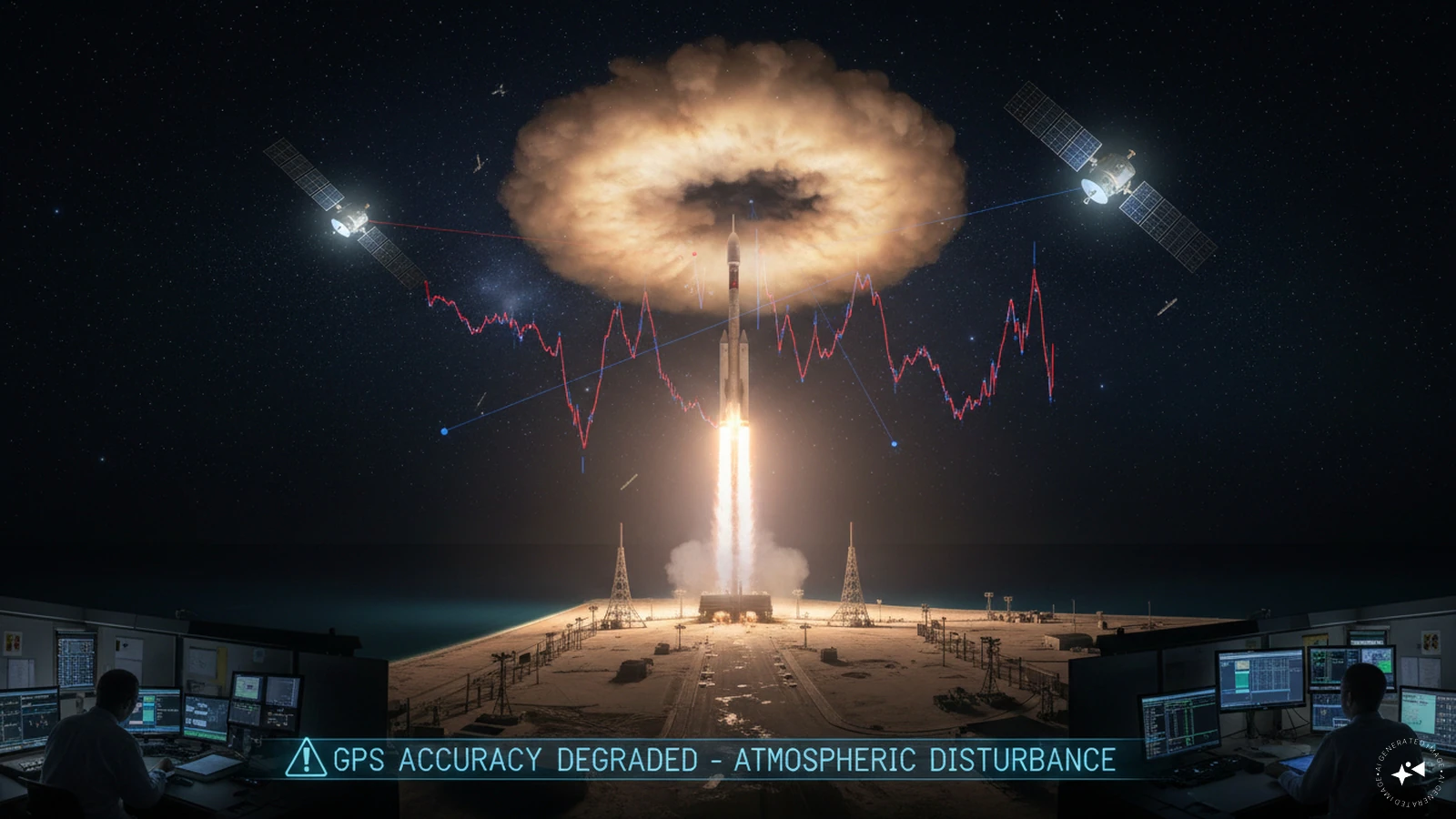
When NASA’s Artemis II mission lifted off on its historic crewed lunar flyby, it did more than break distance records. It also created temporary disturbances stretching 3,100 miles (5,000 kilometres) across Earth's upper atmosphere.
According to a recent study by researchers at Taiwan's National Cheng Kung University, the powerful core-stage ascent and subsequent upper-stage engine burns created intense atmospheric disturbances inside the ionosphere, the electrically charged layer of the upper atmosphere.
The ionosphere begins roughly 50 kilometres above Earth's surface and extends hundreds of kilometres into space. It plays an important role in radio communications and satellite navigation because charged particles in this layer can influence the signals travelling between satellites and receivers on the ground.
Crucially, the study found that these artificial disturbances were significantly more powerful than those recorded following previous heavy-lift rocket launches. Researchers identified three separate disturbances associated with the mission's launch and subsequent engine burns, making it an unusual case of repeated atmospheric disruption over the same geographical region.
The resulting thinning of charged particles altered the time taken for satellite signals to travel through the atmosphere, potentially introducing metre-scale GPS positioning errors across North America.
This happens because GPS receivers calculate their location by measuring how long signals take to travel from orbiting satellites to the ground. Changes in the ionosphere's electron density can alter signal travel times, causing receivers to miscalculate distances and, consequently, their positions.
While consumer mapping apps and turn-by-turn driving directions can accommodate minor positioning fluctuations, high-precision applications such as autonomous vehicle navigation, drone operations and precision surveying could face reliability risks when space weather and rocket-induced disruptions occur together.
Source link