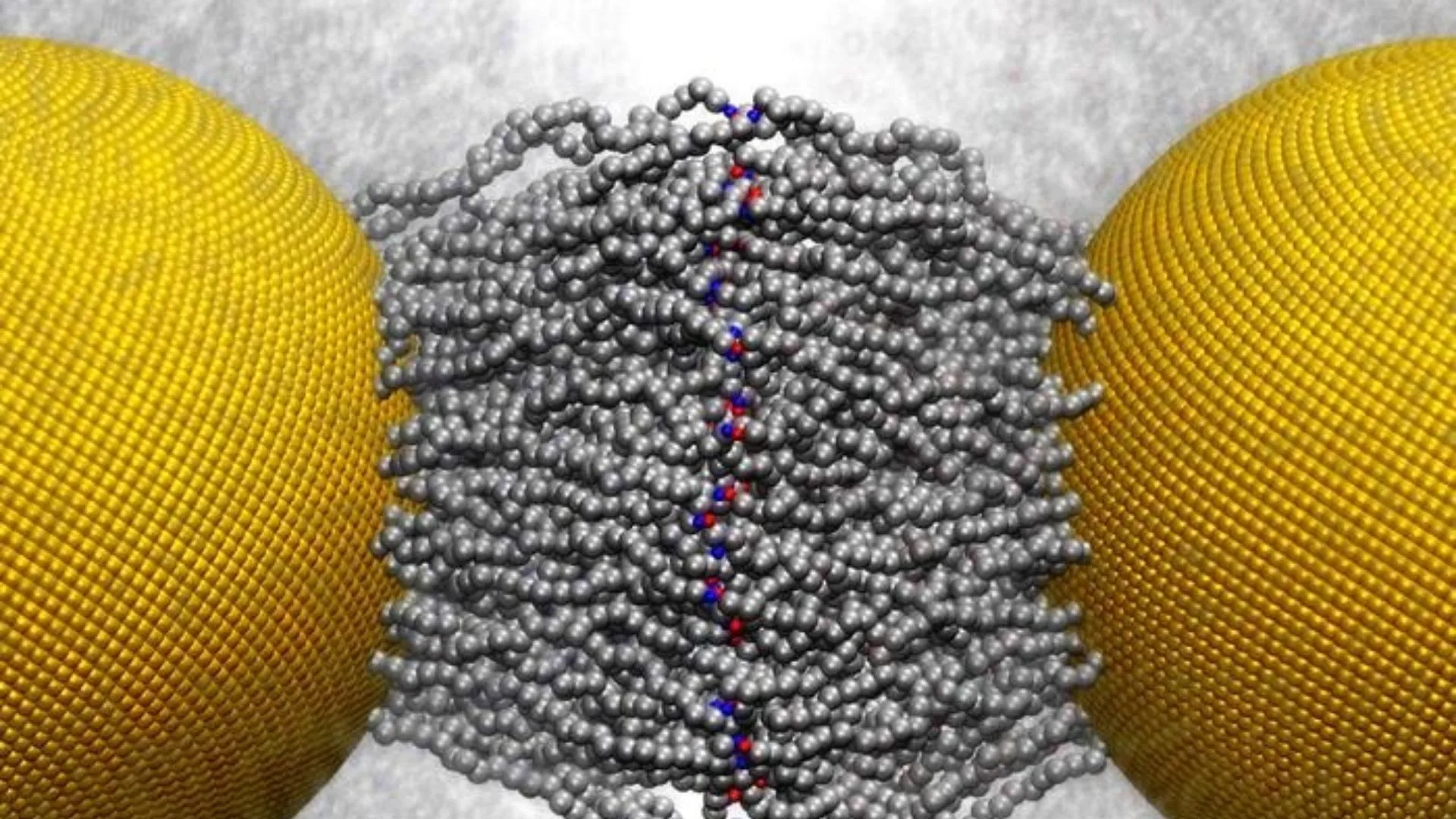
MIT and University of Delaware researchers have disproved a twenty-year rule in nanotechnology by demonstrating that nanoparticle assembly does not require rigid molecular connectors.
Scientists previously believed that flexible connectors caused structures to collapse into disorder. But the team showed that super-flexible, charged polymer connectors let nanoparticles spontaneously reorganize and form customizable, open material structures. This flexible assembly method makes it easier to scale designer materials for applications in medicine, energy, and photonics.
“People are interested in nanoparticle superlattices because of the promise of building designer materials where you have more say in what types of structures they can actually build into,” said Rob Macfarlane, the Richard P. Simmons (1953) Professor in Metallurgy in MIT’s Department of Materials Science and Engineering.
“This is a new approach in nanoparticle assembly that hasn’t been investigated before. It’s exciting to have a new tool that is so counterintuitive. It’s the exact opposite of what the dogma has been for 20 years: that you need to make connector ligands rigid, and any deviation causes assembly to fail. We showed if you just crank it all the way to the opposite extreme, it works just as well,” Macfarlane explained.
Nanoparticles are tiny structures designed down to the billionth of a meter, making them ideal building blocks for modern materials science. The highly customizable shapes enable applications ranging from drug delivery systems to energy storage devices.
However, scaling these tiny components into larger, functional superlattices has been tough. Standard assembly techniques use rigid connector molecules called ligands.
Source link