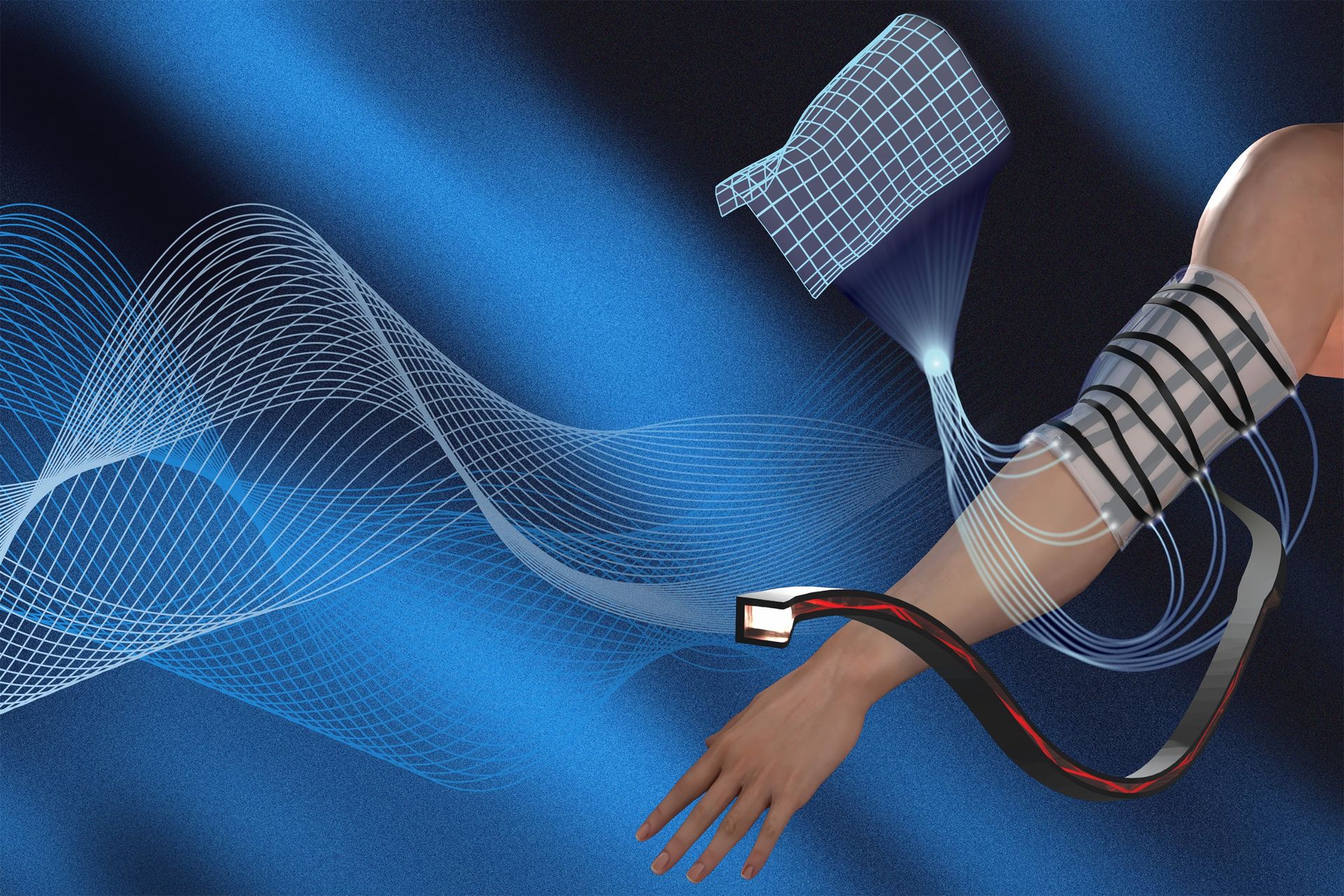
MIT engineers have built a soft, wearable shape-sensing sheet with self-tracking movement that could be useful for controlling games, virtual reality, and physical therapy applications, reports MIT News. The technology, which leverages optical fibers to track the sheet’s own 3D shape, keeps its error below half a centimeter in lab tests. Qifan Yu, an MIT mechanical engineering graduate student on the team, put rigid-sensor designs at around 1 to 2 cm and called the result “at least on par with existing technologies.” The sheet also still works even when damaged, but the fibers remain thicker than ideal for garments.
The news follows a paper, “Toward fully soft and multifunctional shape sensing via optical waveguide arrays,” recently published in Advanced Intelligent Systems. It details that the waveguides respond to bending in both directions, “bi-directional,” with the array laid out to discern shapes. Combined fiber responses mean fewer sensing elements are needed, and that can also improve damage resilience. The fibers respond to pressure, so they can sense external force, such as a press on the forearm in a physical therapy demo.
Normally, a plain fiber, a transparent core inside a light-trapping cladding, will have less light reach the far end when bent; measuring the light output helps measure the bend. MIT’s changes here include using a flexible rubber core instead of glass, with black-dyed cladding. One side is roughened intentionally so that bending the fiber toward that side, or toward the opposite side, causes different amounts of light to be lost.
Source link