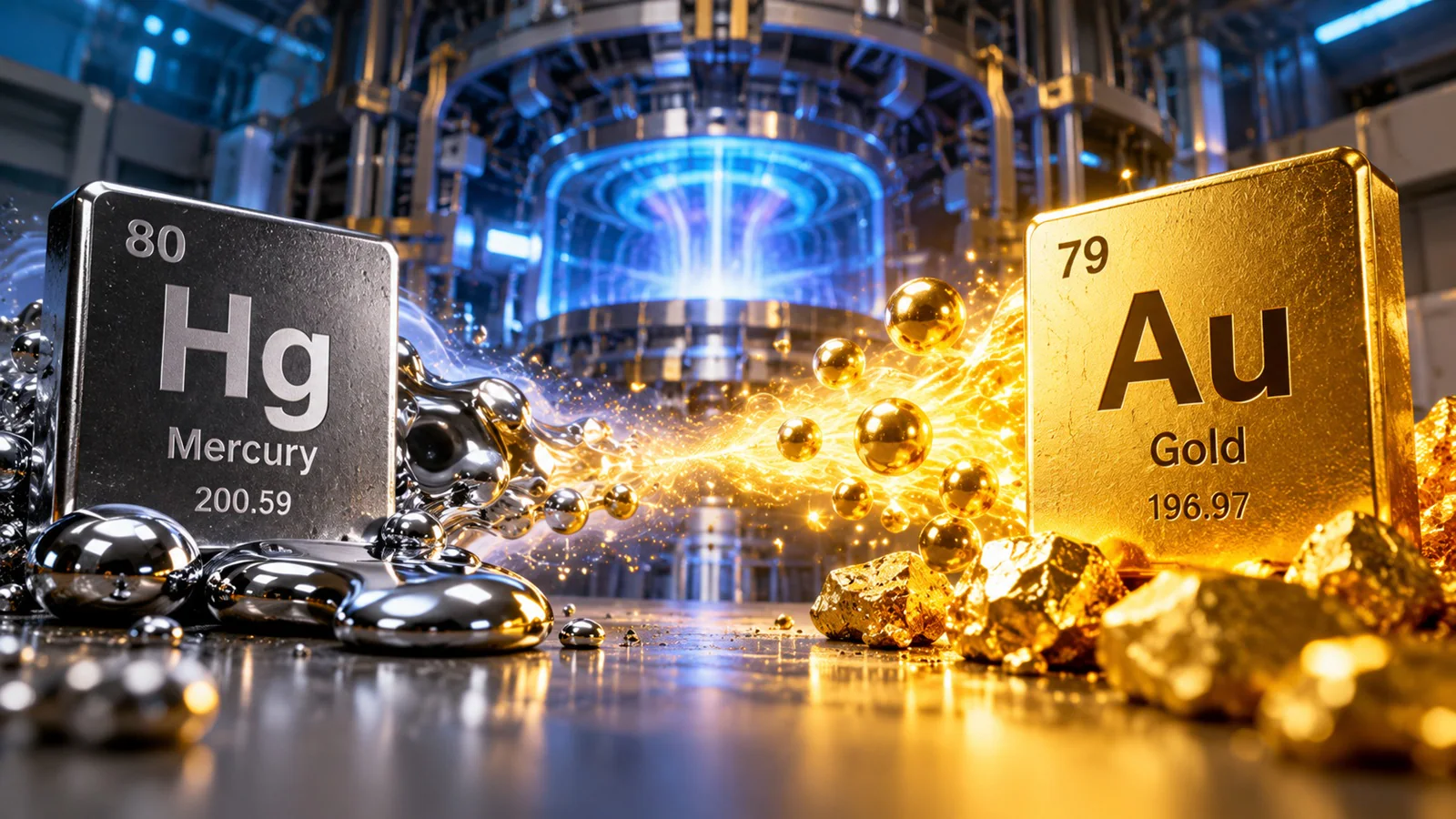
Marathon Fusion, a San Francisco-based fusion start-up, claims it has turned mercury into stable gold using fusion-generated neutrons, at a rate it says is 10 times the record set by CERN in 2025. However, the company has not disclosed how much gold its experiment produced, leaving questions about the scale and commercial potential of the claimed breakthrough.
The announcement has revived a question that has fascinated alchemists for centuries: can scientists manufacture gold and eventually undermine its scarcity?
The underlying nuclear physics makes the process possible. But producing gold in an experiment is different from manufacturing it at a commercially viable scale. Marathon Fusion's latest claim has not been independently verified in the information available, and the company has not demonstrated that its process can produce gold economically.
The company is also pursuing another application for its technology: producing medical isotopes used in cancer diagnosis and treatment.
The process, known as nuclear transmutation, involves changing an atom's nucleus to produce a different element or isotope. Unlike chemical reactions, which rearrange atoms without changing their nuclei, nuclear transmutation changes the composition of the nucleus itself.
Marathon Fusion's proposed method uses high-energy neutrons generated by a deuterium-tritium fusion reaction to transform mercury-198 into mercury-197. The radioactive mercury-197 can then decay through electron capture into gold-197, the stable isotope of gold.
The underlying nuclear physics is established. In May 2025, researchers at CERN's Large Hadron Collider reported producing gold nuclei through collisions involving lead nuclei. CERN's ALICE experiment estimated that approximately 86 billion gold nuclei, equivalent to 29 picograms of gold, were produced across four major experiments during the collider's 2015–2018 run.
Source link