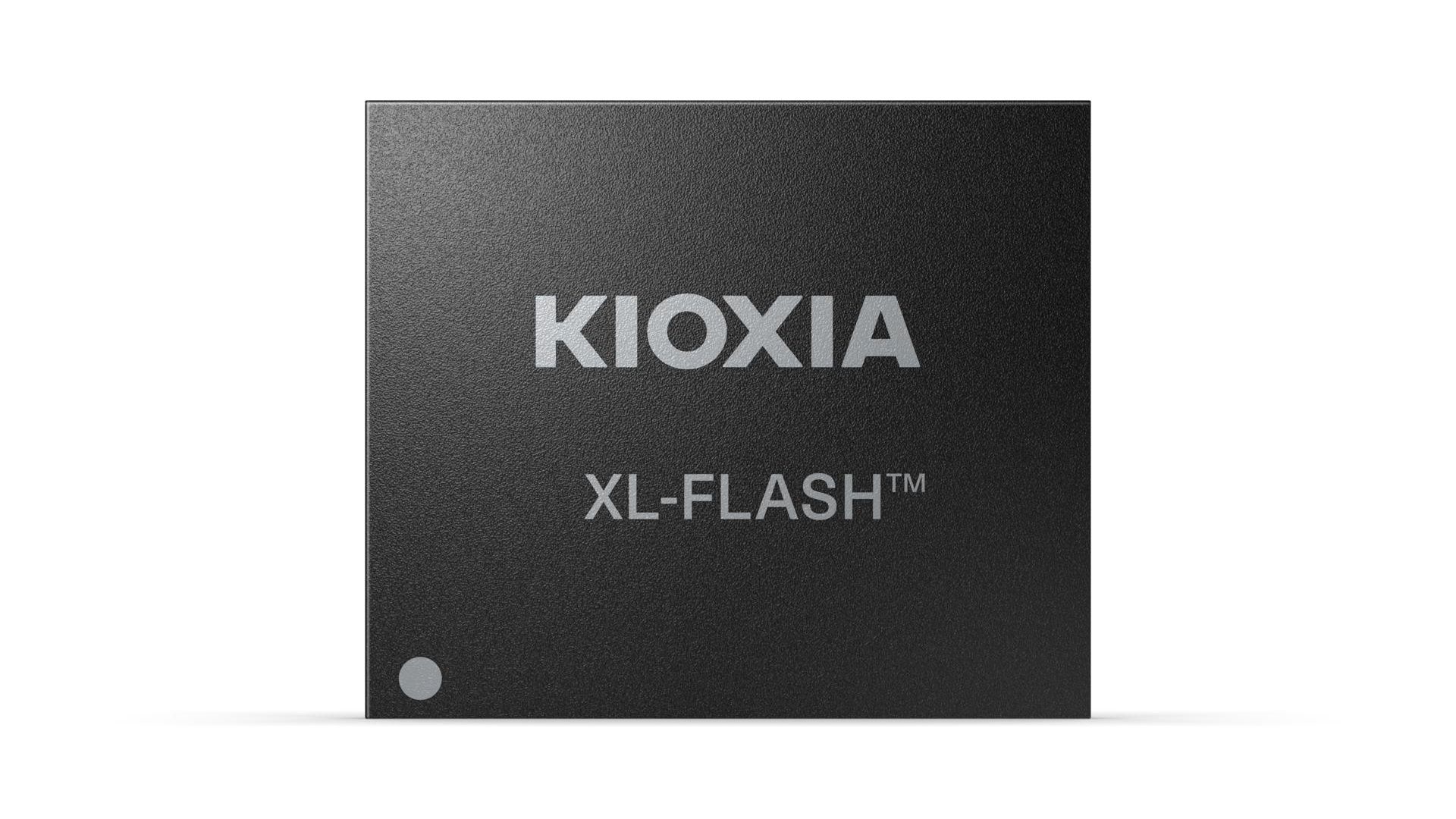
The Kioxia Corporation showcased a prototype of its new XL-Flash Generation 3 technology, next-generation low-latency, high-performance flash memory, at its KIOXIA Forum in Tokyo. The flash, which uses CMOS directly Bonded to Array, or CBA, for better power efficiency and storage density, is about 135% more efficient with 70% higher bit density than Gen 2, and its 3 µs average read latency is less than 10% of that of Kioxia’s standard BiCS8 TLC. Samples are due March 2027, and Kioxia named its GP2 enterprise SSDs, rated for more than 18 million 512-byte random read IOPS, as its first product using it.
The low-latency XL-Flash fills “a new memory tier” to bridge the gap between DRAM and regular flash memory, in a way that can complement or replace some DRAM to help drive down costs, especially in AI servers and data centers. This has some similarities to Optane, which used 3D XPoint instead, as a storage class memory (SCM) option to reach higher IOPS. Intel and Micron’s 3D XPoint stored bits as changes in the cell material’s resistance rather than as trapped charge like NAND, and Intel exited the Optane business in 2022. The XL-Flash NAND is built on BiCS flash technology, but it’s tuned for low read latency and high write endurance.
The first generation was SLC with under-5 µs reads, arriving in 2019. By 2022, Gen 2 added 2-bit MLC as an option for lower bit cost, trading some like-for-like performance for better price-to-density. Gen 3 is reported to use SLC, and its 3 µs average read latency challenges the first gen’s sub-5 µs rating while being more than ten times faster than the 40 µs of standard BiCS8 TLC.
Source link