
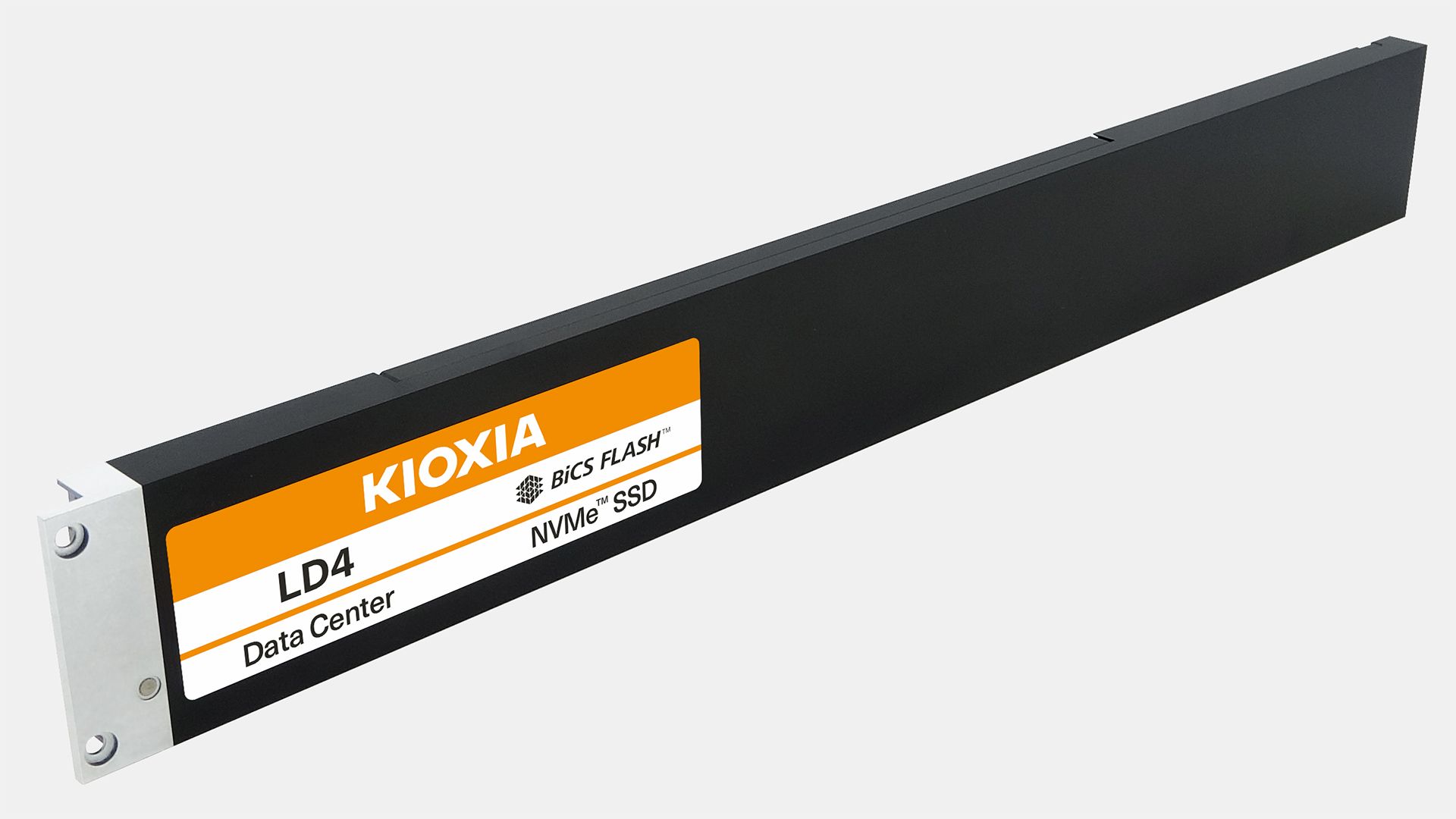
Kioxia introduced its LD4-series solid-state drives (SSDs) in an E1.L form factor with capacities up to 122.88TB designed for high-density storage deployments in hyperscale data centers on Friday. The new drives use proven BiCS8 3D QLC NAND and are aimed at read-intensive workloads like AI data repositories and object storage, according to the manufacturer.
- Leading-edge foundry roadmaps
- Nvidia Enterprise GPU and CPU roadmap
- AMD's Enterprise GPU and CPU roadmap
- Intel's roadmaps examined — 14A, Nova Lake, Diamond Rapids & AI accelerator push
- Co-Packaged Optics (CPO) foundry roadmaps
Kioxia's LD4-series SSDs rely on the company's proprietary platform complying with the NVMe 2.0e specification and featuring a single-port configuration along with select requirements of the Open Compute Project Datacenter NVMe SSD specification 2.6. Although Kioxia lists PCIe 5.0 compliance, the drives operate at PCIe 4.0 x4 speeds of up to 16 GT/s per lane, which provides a theoretical maximum bandwidth of approximately 7.88 GB/s in each direction. While the company currently offers capacities of up to 30.72 TB, it has validated an architecture capable of supporting 122.88 TB drives, though it never revealed when such drives are set to be available, something not surprising in a world where 3D NAND memory is sold in advance.
Interestingly, Kioxia did not disclose any actual performance characteristics of its LD4-series SSDs, including sequential read and write speeds, random read and write IOPS, or latency. The company also did not reveal their endurance ratings in drive writes per day (DWPD) or total bytes written (TBW), nor did it specify their power consumption.
Source link





