

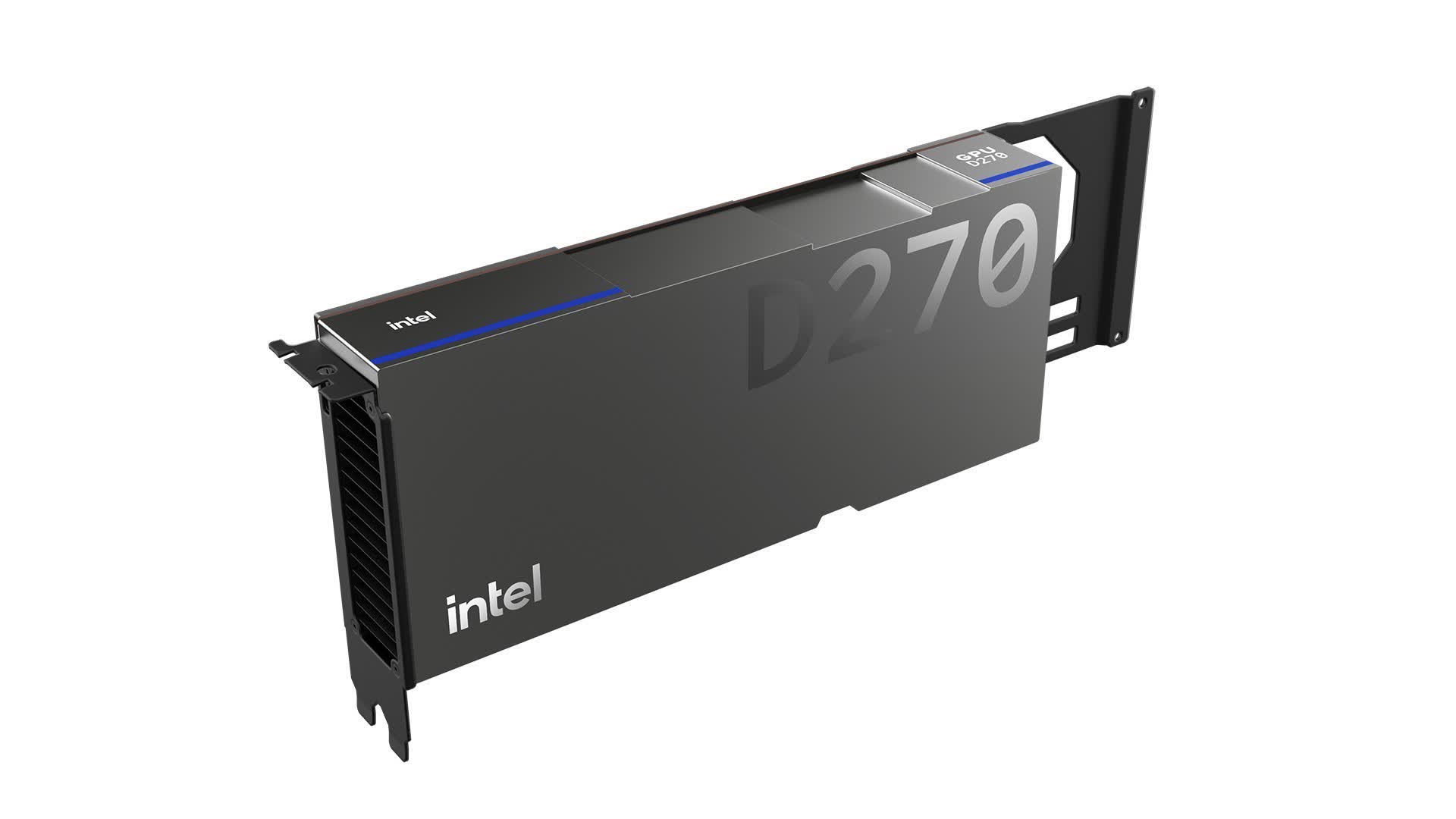
In context: Intel first teased Crescent Island over a year ago as a data center GPU that can't even render graphics. It has none of the 3D or ray-tracing hardware you'd find on a regular graphics card; instead, the chip – now sold as the GPU D270 – spends that space on AI and scientific work. Until this week, though, Intel hadn't really shown how fast it is. That changed at the SC26 supercomputing show in Chicago.
In a post, Intel put the D270 up against Nvidia's RTX Pro 6000 Blackwell Server Edition. Instead of games or AI models, Intel went with something a little more niche. It picked four workloads that banks rely on to put a price on financial contracts.
Across those four, the D270 delivered between 1.92 and 5.9 times the performance of Nvidia's card. Its biggest win showed up in a European Monte Carlo simulation. Intel's card also did all of this at just 350W, compared to the 600W that Nvidia's card is rated for.
All four tests rely on double-precision, or FP64, calculations. Intel's Xe3P architecture handles those calculations at full speed, so the D270 barely slows down when a task needs that extra accuracy. That full-speed FP64 support is where most of the D270's lead over Nvidia's card comes from.
The RTX Pro 6000, on the other hand, uses the same chip as the GeForce RTX 5090. That silicon only handles FP64 at a tiny fraction of its usual speed, so by sticking to FP64-heavy workloads, Intel chose the kind of tests where Nvidia's card was likely to fall behind.
Source link





