
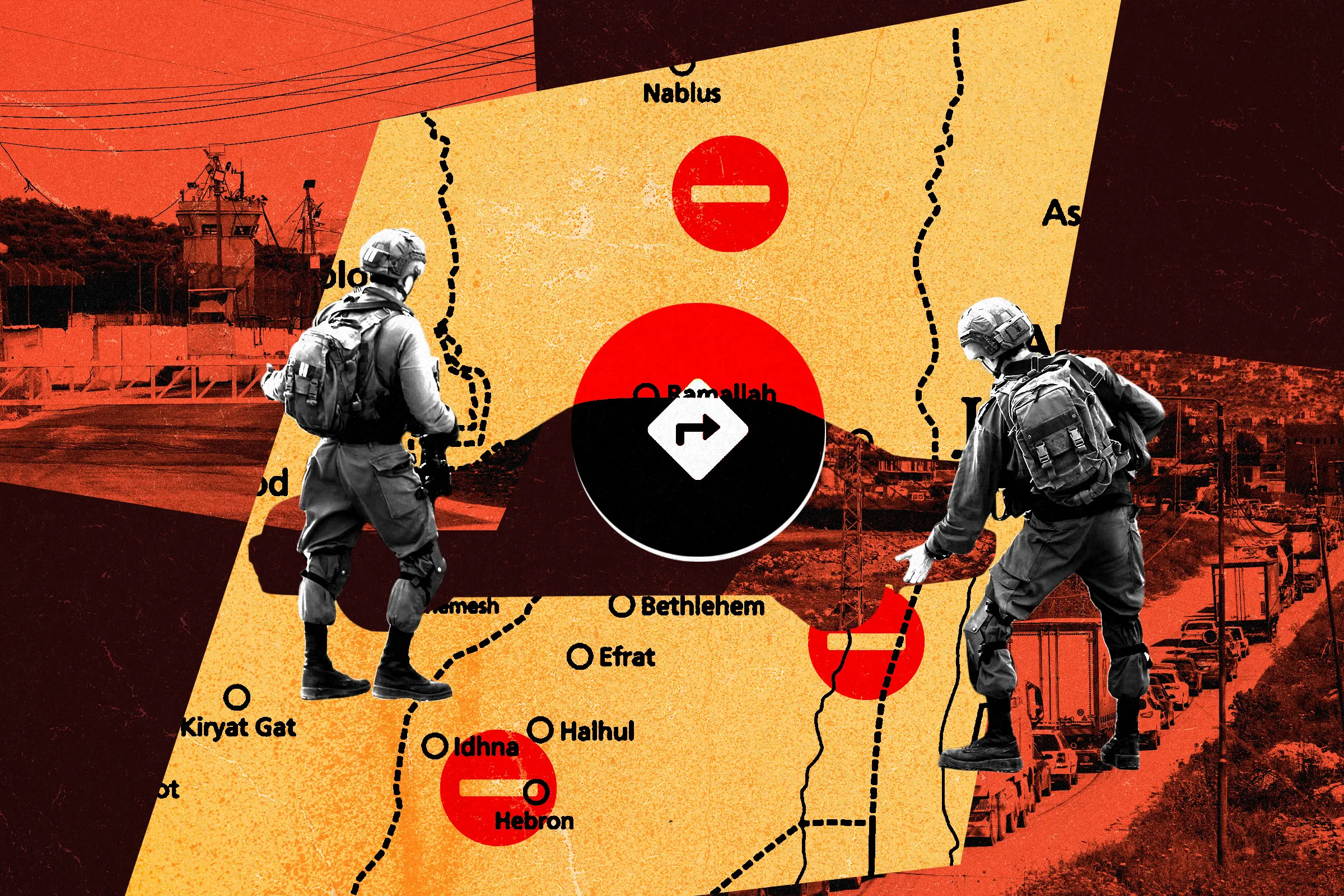
On the road that connects the villages to the north of Ramallah, in the occupied West Bank, there is always a watchtower and a gate, often flanked by Israeli soldiers with machine guns around their necks. None of these things are visible on Google Maps. Where drivers see a checkpoint, a barrier, and soldiers searching cars, the world’s most popular navigation app renders a clear blue line indicating the coast is clear.
This story was produced in partnership with the Palestine Reporting Lab, Arab Reporters for Investigative Journalism (ARIJ), Lighthouse Reports, and Evident.
Routes and maps are not just a matter of journey times or congestion for the nearly 3.5 million Palestinians in the West Bank. Drivers there are forced to navigate a growing and arbitrary system of more than 900 movement obstacles, like checkpoints, which can be policed with lethal force. For Palestinians, these roads can be a matter of life or death. Google Maps could help them make safer choices. It has failed for years to do so.
Google has the ability to alert checkpoints, a feature that it added to Maps in some locations around the world during the Covid crisis. It is aware of the problems experienced by Palestinian drivers in the West Bank. In fact, a former Google product manager spent six years trying to get Maps to serve Palestinians in the same way it serves the rest of the world.
Interviews with more than a dozen former and current Google employees reveal for the first time the inner tensions at the heart of the Google Maps project.
Source link





