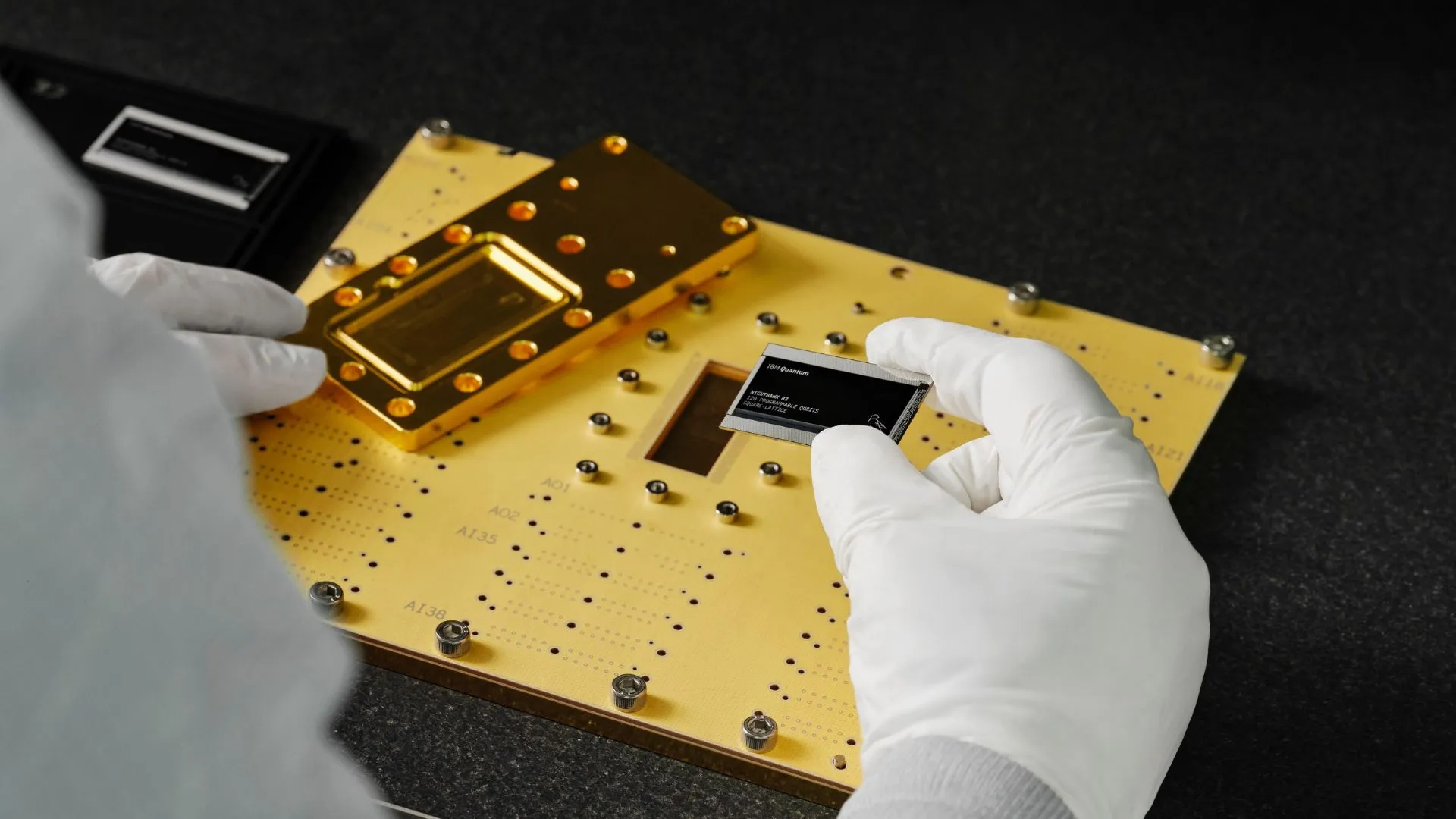
IBM plans to connect two next-generation quantum processors into a single system with 1,040 qubits in 2027. The proposed system will use the company’s upcoming Nighthawk r3 architecture. Each processor will support 520 programmable qubits and execute up to 10,000 quantum operations.
The announcement signals IBM’s push toward larger quantum systems capable of handling increasingly demanding computational workloads. The company also reported substantial performance gains from its existing Nighthawk r2 processor. Industry partners have already executed more than 34 billion circuits on the hardware.
IBM’s current Nighthawk r2 processor has demonstrated significant improvements in quantum execution speed. Introduced in September 2026, the system can deliver up to 100,000 samples per second. It also supports computations involving more than 7,500 quantum operations across 120 qubits.
Quantum applications often require millions or billions of samples to produce useful results. Faster execution allows researchers to complete demanding experiments without spending excessive time running individual circuits.
Partners including German energy company E.ON, Algorithmiq, and Q-CTRL have reported improvements of up to 19 times. E.ON, for instance, achieved a 15-fold speedup in quantum machine learning for electricity grid optimization.
IBM also used Nighthawk r2 to accelerate a magnetic materials simulation conducted with Oak Ridge National Laboratory. The experiment ran 12 times faster than its earlier implementation on IBM’s Heron processor.
An experiment with Algorithmiq delivered another notable result. Nighthawk r2 executed circuits eight times faster than the original Heron-based experiment. The updated computations also presented a greater challenge for classical simulation methods.
Source link