
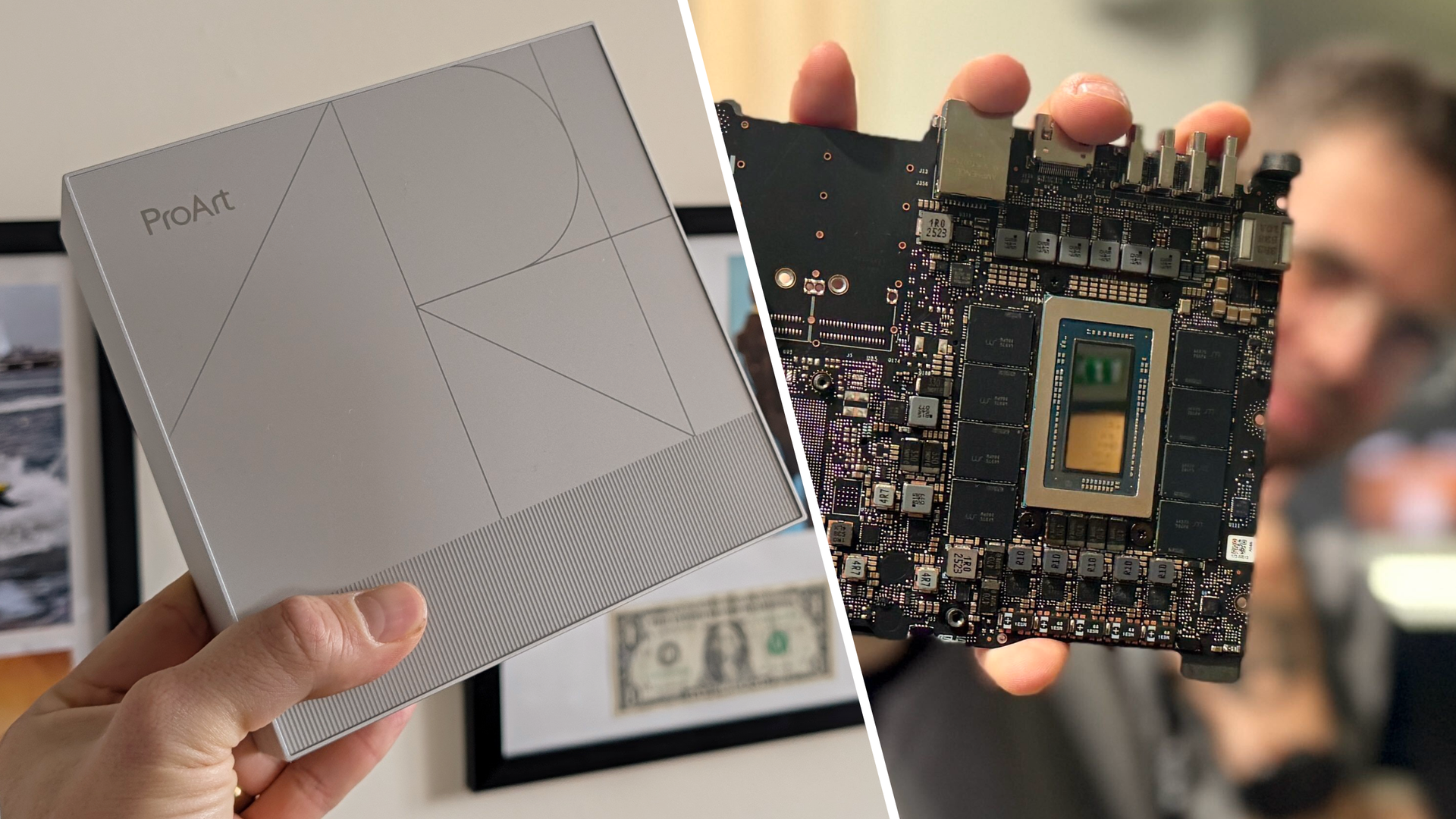
Testing Nvidia’s RTX Spark inside laptops for the past month felt like the birth of a different species of computer. Confined to a portable chassis, that local AI prowess and raw horsepower make good sense to turn it into a real everything machine.
But when you rip that N1X out of a laptop, drop it into a desk-bound mini PC like the Asus ProArt GR1X, and slap a price tag of at least $4,499 on it ($6,999 for the 128GB version I’m testing), the entire narrative changes.
Yes, when tethered to a wall, it is faster than its laptop counterpart. But this chip is no longer fighting the MacBook Pro. It is fighting the desktop market — a more ruthlessly powerful space where (in some ways) Nvidia is fighting with itself.
I currently have two 128GB heavyweights on the test bench. In the green corner is the Asus ProArt GR1X, powered by RTX Spark and 128GB of memory. In the red corner is the Geekom A9 Mega, armed with AMD’s Ryzen AI Max 395 and the exact same 128GB memory pool, but priced $3,000 cheaper.
And remember when I said Nvidia is fighting with itself in the desktop space? Well, to prove that point, I also threw my custom-built RTX 5070 Ti desktop into the ring for good measure (a quick foray on PC Part Picker shows that would be around $4,000 cheaper).
You are buying a 128GB mini PC to act as an always-on, hyper-secure household brain that you don’t pay subscriptions for.
Source link





